Feeds:
Posts
Comments

Posts Tagged ‘manuscripts’

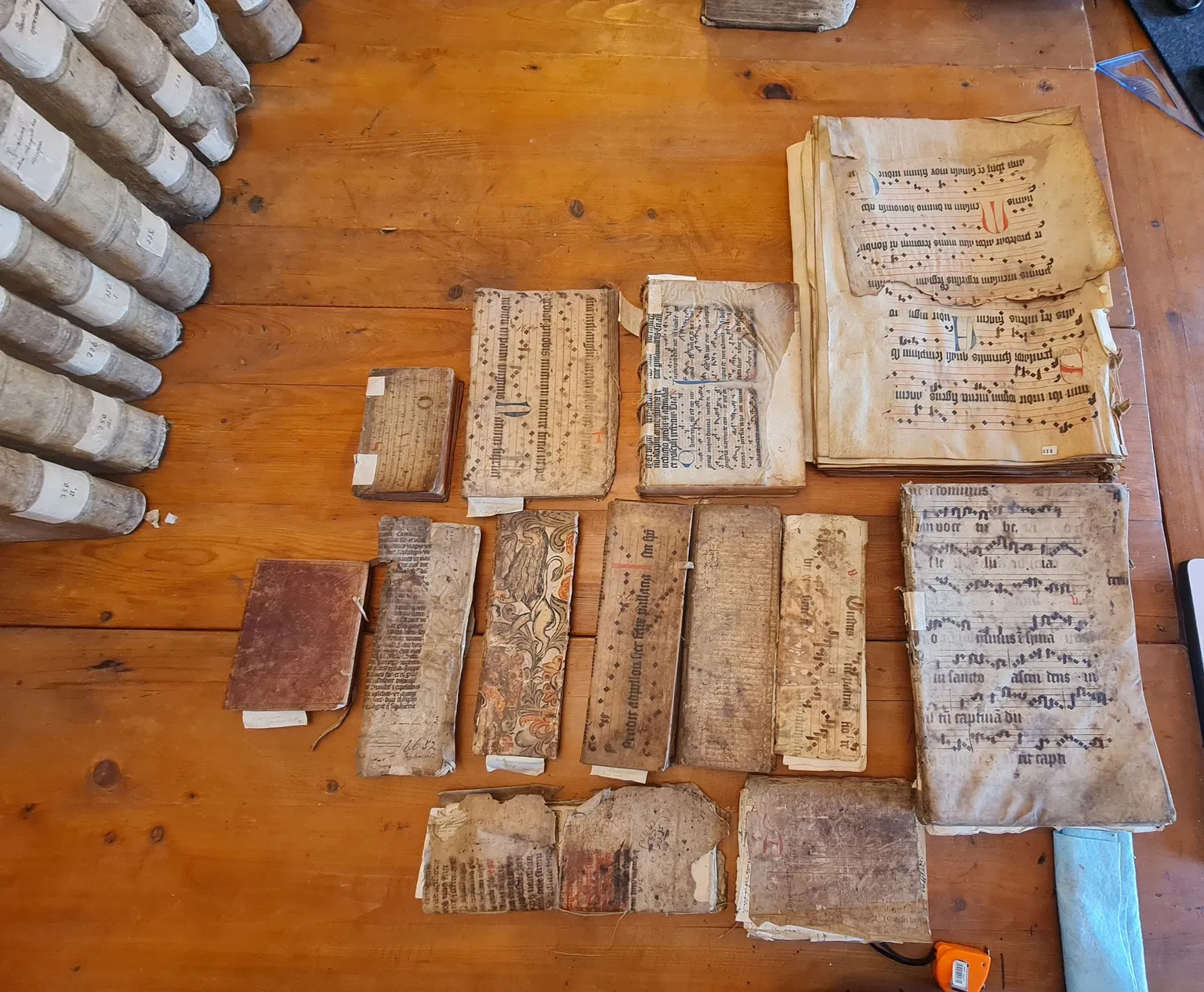
Photo: Adinel C. Dincă / Biblioteca Batthyaneum.
Buried for centuries in a Transylvanian church tower, a forgotten medieval library has come to light, offering a glimpse into the intellectual and cultural life of medieval Romania.

By Jove! How many treasure troves are yet to be discovered on Planet Earth? It makes me want to start a limerick using “Jove,” “trove,” “grove” …

The website Medievalists reports, “Hidden away for centuries in a Transylvanian church tower, a forgotten medieval library has come to light, revealing treasures as old as the 9th century. This extraordinary discovery of manuscripts, books, and documents offers a rare glimpse into the intellectual and cultural life of medieval Romania.

“The discovery was made two years ago in the Church of St. Margaret in Mediaș, a 15th-century Gothic structure built by the Transylvanian Saxons. A team led by Professor Adinel C. Dincă of Babeș-Bolyai University uncovered the collection in the church’s Ropemakers’ Tower, where it had remained hidden for decades, possibly centuries. Biblioteca Batthyaneum, which first announced the find, described it as a scene straight out of an Indiana Jones adventure, complete with a struggle against nesting pigeons to recover the precious volumes. The cache includes:

  • Printed Volumes: Approximately 139 books printed between 1470 and 1600.
  • Manuscript Volumes: Two manuscripts from the early 16th century.
  • Original Documents: Around 60 documents from the 14th to 16th centuries, with a few originals and copies from the 17th century.
  • Administrative Registers: About 10 registers from the 17th–18th centuries, containing fragments of medieval manuscripts. …

“Professor Dincă believes the library was deliberately hidden, possibly during a period of war or religious upheaval. The organization of the books suggests a carefully curated collection rather than a haphazard storage. ‘When I first encountered the books, I immediately noticed the disposition of the volumes according to a certain historical typology: bibles and biblical texts, patristic, theology etc,’ Dincă explained to Medievalists.net. ‘This order doesn’t look like an improvisation. …

“The items found are likely part of a larger collection held by the church. A catalogue from 1864 lists around 7,700 books in the church library, many of which were authored by key Protestant Reformers such as Martin Luther, John Calvin, and Philip Melanchthon. The cache provides researchers with the rare opportunity to match the recovered volumes with the historical records and explore what remains of this once vast repository.

“Among the most intriguing finds are fragments of medieval manuscripts, some dating as far back as the 9th century. These include texts written in Carolingian minuscule, a script commonly associated with the Carolingian Renaissance, as well as liturgical manuscripts from the 14th and 15th centuries. Many of these fragments were found recycled into administrative registers, offering insights into how older texts were reused within the community.

“ ‘One highlight of this historical collection is the large number of original 16th-century bindings, many of them dated,’ Dincă notes. ‘In addition to that, in the series of administrative registers of the parish, there are several fragments of mediaeval manuscripts, among them one copied in Carolingian minuscule, the rest of the “fragments collection” containing the usual liturgical manuscripts from the 14th to 15th century. The closed context of re-use makes it very likely that such recycled pieces of parchment are in fact remnants of a pre-Reformation stock of manuscripts locally used.’

“The discovery has launched a comprehensive research project. … Funded by Germany’s Ministry for Culture and Media, the project focuses on preserving the collection, digitally reconstructing it, and conducting detailed scientific analysis. …

“Researchers are particularly interested in the collection’s role in reflecting the intellectual and cultural life of the Transylvanian Saxons. The books and manuscripts provide unique insights into the circulation of ideas in medieval Europe. …

“Professor Dincă and his team believe the discovery represents more than just a hidden archive — it is a time capsule that offers a rare glimpse into the cultural and religious life of the region during the Middle Ages.”

More at Medievalists, here. No paywall. (Once I started thinking about rhymes for “ove,” I realized once again how weird English is. You can’t use “love” or “shove” with “trove” or “move” either.)
Read Full Post »

brautigan-web-1020x1141

Image: Jennifer Luxton / Seattle Times
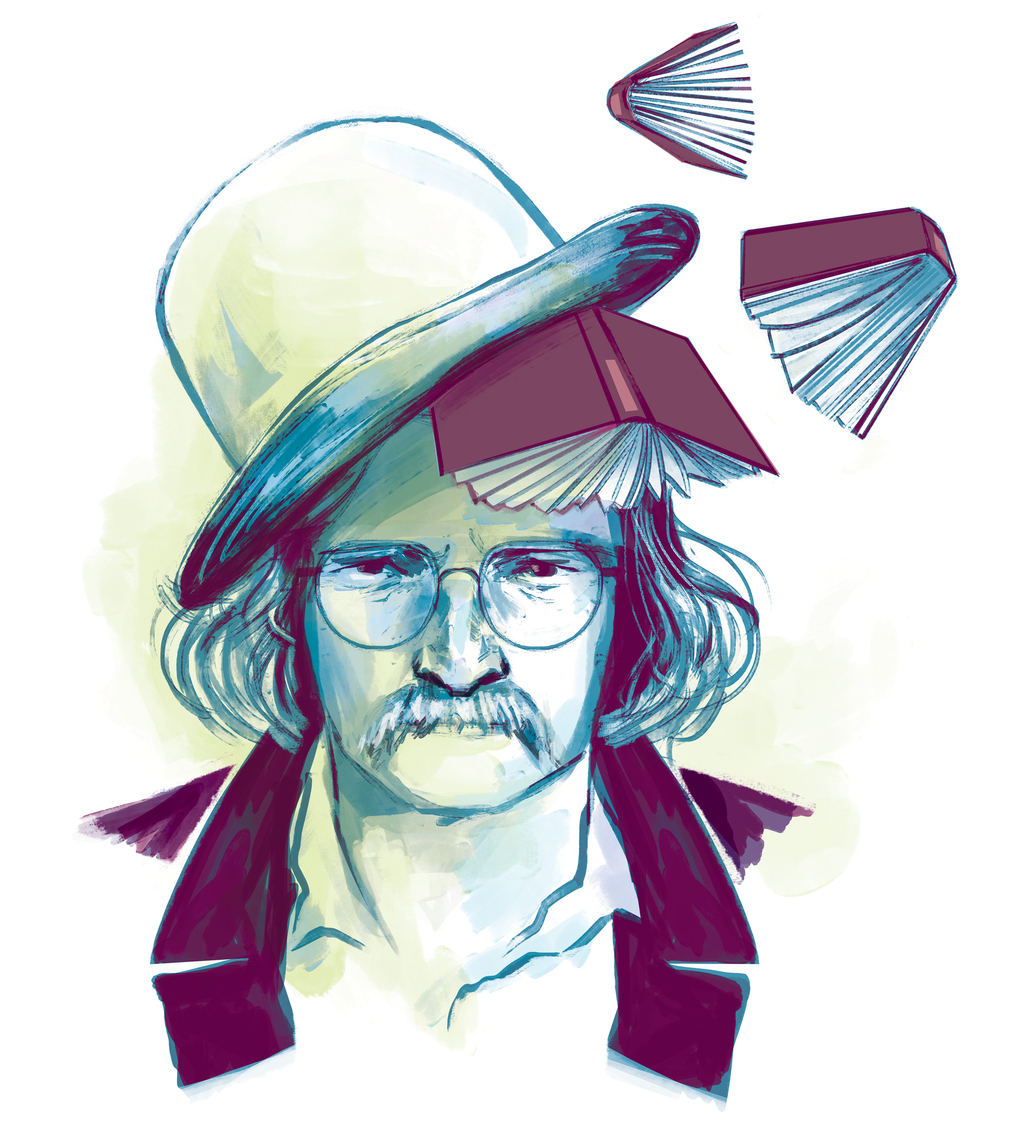
Richard Brautigan, best know for the quirky
Trout Fishing in America, encouraged unpublished writers to express themselves. Now there’s a library in his honor — a library of unpublished manuscripts.

In bookshops, I have often perused books by Richard Brautigan but have always concluded they were too odd for me. After reading about the unusual library the writer inspired, however, I have changed my mind. I’m going to take the plunge.

Megan Burbank writes at the Seattle Times, “It’s easy to trace the lingering influence of Tacoma-born writer Richard Brautigan if you know where to look. Though known for depicting San Francisco’s counterculture of the 1960s and ’70s with surrealistic flair, you’ll find one of his greatest legacies on three bookcases in the basement of Vancouver’s Clark County Historical Museum.

“Known as the Brautigan Library, the collection spans family histories, absurd Brautigan-esque capers, DIY religious tracts and memoirs of ordinary lives. They don’t feel like books at all, really, so much as the complete, unfiltered contents of other people’s minds. And they all have one thing in common: They’re unpublished. …

“When I visited the Brautigan Library in February, I couldn’t stop thinking of a passage from ‘Trout Fishing in America,’ perhaps Brautigan’s best-known work, that compares a bookstore to a graveyard:

‘Thousands of graveyards were parked in rows like cars. Most of the books were out of print, and no one wanted to read them any more and the people who had read the books had died or forgotten about them …’

“The books I encountered, crouched on the floor in that vaguely antiseptic-smelling basement, ran a fierce gamut. … Some stood out for their titles alone. My favorite was Alyce Cornyn-Selby’s ‘Did She Leave Me Any Money? A philosophical comedy about men, money, motivation, winning strategies, architecture, nudism, trucking, corporate assassinations, heart attacks, sexual politics, hometown parades, Spiritual Warriors, and the dredging of Willapa Bay.’ …

“The rows of manuscripts are punctuated with little cardboard printouts of mayonnaise jars, a nod to the collection’s cataloging technique, known as the Mayonnaise system.

“The name is a reference to the last line of ‘Trout Fishing in America.’ (‘Expressing a human need, I always wanted to write a book that ended with the word Mayonnaise.’)

“When Richard Brautigan died in 1984, control of his literary estate fell to his daughter, Ianthe Brautigan Swensen. [She] started getting letters from a man named Todd Lockwood. … His request [to create a library like the one in a Brautigan novel] was the first proposal Brautigan Swensen received that reminded her of the person her father had been.

“ ‘All of the sudden, I was like, “Right, this is the father that I remember,’” ‘ she says. ‘And right after my dad died, I was so — obviously — devastated and I thought in my mind that I’d lost him forever, and I picked up one of his books and there he was.’ …

“In 1990, Lockwood took on [the role of the novel’s librarian, who collected manuscripts.]. His Brautigan Library, based in Burlington, Vermont, operated as a nonprofit. At its peak, he says, it had about 100 volunteer librarians and attracted visitors from out of town.

“But in 1997, it closed due to lack of funding, and the manuscripts were put in storage in Lockwood’s basement.

“This caught the attention of John Barber, a faculty member in the Creative Media and Digital Culture program at Washington State University, Vancouver, who had once studied under Brautigan.

“He found space for the collection at the Clark County Historical Museum, and the library was moved and reopened in 2010. The manuscripts in the library date from the Vermont years: 1990-96. In 2013, it began accepting manuscripts again, but only electronically; there’s not enough space to keep accumulating paper volumes.” More.

What fun! This could be for you!

Read Full Post »

When I got my current job, I went through the human resources “onboarding” with a young man from Mali. Even though he went back to Africa a couple years ago, we keep in touch. Naturally, I was worried when radicals took over Timbuktu, Mali, for a while. Fortunately, Mamoudou wasn’t living in Mali at the time, although he says Guinea is not that much safer.

Because of Mamoudou, I continue to follow the Mali news, and was especially interested in a link at the Arts Journal blog today: “Mali’s Underground Railroad: How Timbuktu’s Ancient Manuscripts Were Smuggled To Safety.”

Writes Sudarsan Raghavan of the Washington Post, “It was 7 o’clock on a hot night in August, and Hassine Traore was nervous. Behind him were 10 donkeys, each strapped with two large rice bags filled with ancient manuscripts. The bags were covered in plastic to shield them from a light rain.”

Radicals had taken over Timbuktu four months earlier and “had demolished the tombs of Sufi saints. They had beaten up women for not covering their faces and flogged men for smoking or drinking. They most certainly would have burned the manuscripts — nearly 300,000 pages on a variety of subjects, including the teachings of Islam, law, medicine, mathematics and astronomy — housed in public and private libraries across the city.”The scholarly documents depicted Islam as a historically moderate and intellectual religion and were considered cultural treasures  …

“A secret operation had been set in motion … It included donkeys, safe houses and smugglers, all deployed to protect the manuscripts by sneaking them out of town.

“This is the story of how nearly all the documents were saved, based on interviews with an unlikely cast of characters who detailed their roles for the first time. They included Traore, a 30-year-old part-time janitor, and his grandfather, a guard. …

“The New York-based Ford Foundation, the German and Dutch governments, and an Islamic center in Dubai provided most of the funds for the operation, which cost about $1 million.

“ ‘We took a big risk to save our heritage,’ said Abdel Kader Haidara, a prominent preservationist who once loaned 16th- and 18th-century manuscripts from his family’s private collection to the Library of Congress. ‘This is not only the city’s heritage, it is the heritage of all humanity.’ ”

There are heroes everywhere, keeping a low profile. And I am also pretty impressed with the funders, springing into action like that.

More here.
Map: National Geographic

Read Full Post »