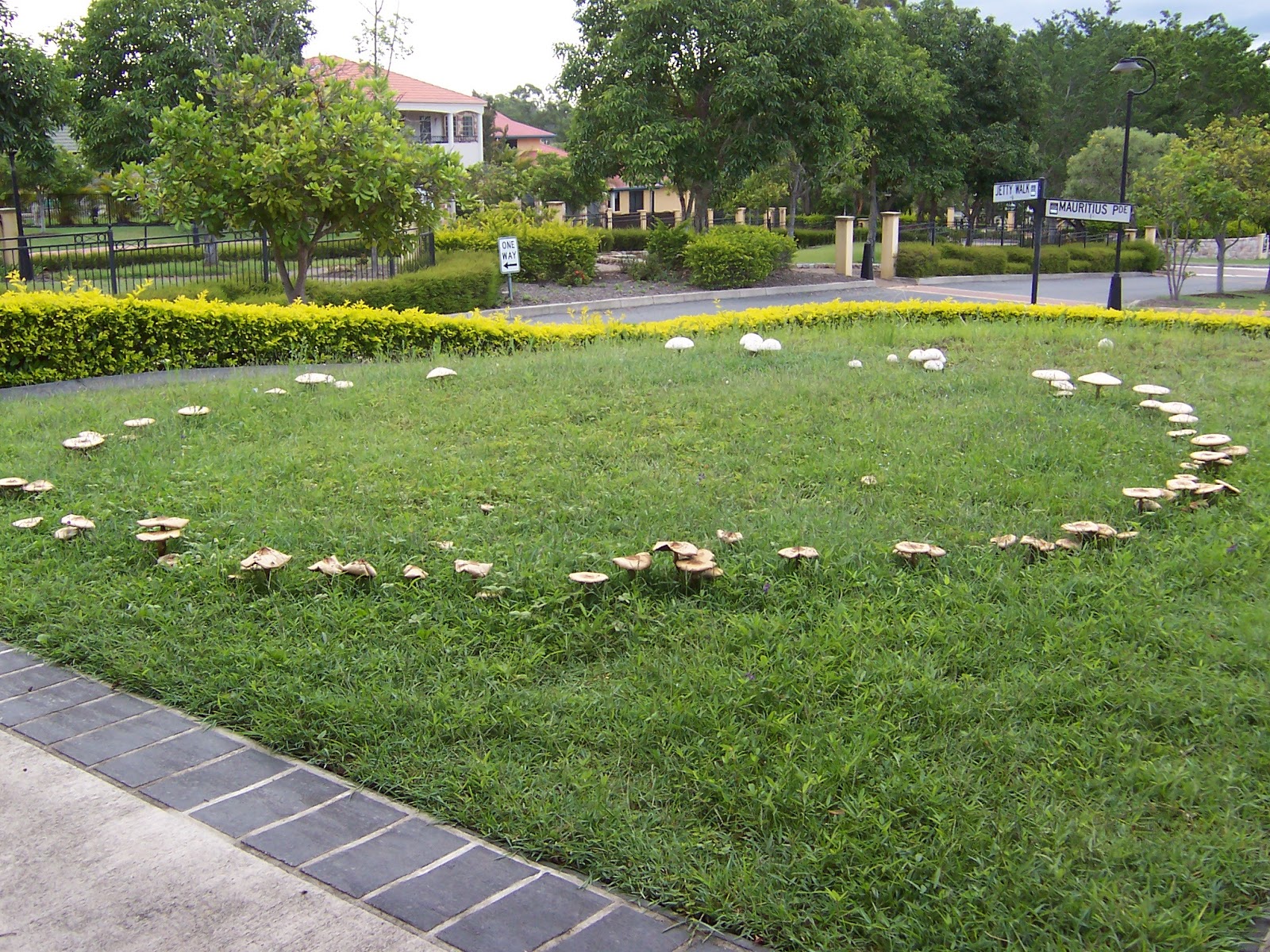
Sometimes called a Fairy Circle, fungi like these tell a story of what is going on underground.
I don’t know as much about about fungi as New Zealand blogger Spores, Moulds, and Fungi — who posts some amazing photos from time to time — but in recent years, I have gotten interested in mushrooms and more.
Part of the reason is that I am noticing that they are beautiful. But also, as Jonathan Moens reports at the Washington Post, a few bags of dirt with the right fungi “could make the planet more resilient to climate change.”
Moens begins his story in Kazakhstan.
“A team of scientists loaded into a gray minivan [earlier] this year and drove for hundreds of miles west through the Kazakh steppe — a vast region marked by endless open plains of grass, abandoned farms and flower-filled meadows.
“It’s a desolate, semiarid landscape, but just a few inches below the ground may lie one of the most diverse fungi ecosystems on Earth.
“Across much of the planet, thin, wildly interconnected filamentous structures — known as ‘mycelium’ — hold the earth together. When these underground fungi come together, they form sophisticated systems known as ‘mycorrhizal networks.’ The Kazakh steppe, which stretches from the north of the Caspian Sea to the Altai Mountains, is one of the largest dry steppes in the world and is predicted to have a wild diversity of mycorrhizal fungi. But as the region becomes increasingly desert-like, many of these fungi may disappear.
” ‘There’s a time limit, 100 percent,’ said Justin Stewart, an evolutionary ecologist who led the mapping expedition. ‘If we collect a sample when it’s already a desert, then we’ve already lost all that diversity.’
“The Kazakhstan mission is part of a worldwide project led by the Society for the Protection of Underground Networks, or SPUN, a scientific research organization dedicated to mapping out underground fungi. The goal is to sample soil in 10,000 biodiversity hot spots across the world to create a global picture of what species of fungi exist and where.
“The team identified these areas using a predictive map based on thousands of observations and environmental data. In it, the Kazakh steppe stood out because of its wide-ranging diversity of ecosystems.
Understanding which mycorrhizal fungi survive in the harsh temperatures there may help scientists determine how these fungal communities might adapt to the climate crisis as droughts, fires and desertification become more prevalent.
“The researchers chose three areas of the steppe, each with a different climate: They began in the southern deserts, then drove out west to an area dominated by vast grasslands, agricultural lands and meadows. They ended north, near the Russian border, where they entered a forest ecosystem.
“At each site they took tens of samples by mapping out a grid with measuring tape, pounding a tube into the ground to extract the soil and storing this soil in a plastic bag for mixing. These samples may help scientists unlock secrets that could one day help ecosystems capture more carbon dioxide and restore soil health — as well as the trees, plants and animal life that rely on it. …
“Mycorrhizal fungi often form mutually beneficial relationships with plants. They trade essential nutrients such as phosphorus and nitrogen in exchange for carbon, and act as an extended root system, allowing plants to access water they can’t reach.
“These networks may also prove to be invaluable for transporting carbon underground, a study published in June found. About 13 gigatons of carbon fixed by vegetation — equivalent to about one-third of all carbon dioxide emissions from fossil fuels in one year — flows through underground fungi, according to an analysis of nearly 200 data sets.
“In the steppe, these plant-fungal benefits may be short-lived, however. While deserts are a natural part of Kazakhstan’s ecosystem, more than half of the country’s vegetation and drylands is at risk of becoming desert as well. The main drivers are large-scale intensive agriculture and increasingly warm and dry temperatures brought by climate change. …
“As the minivan moves northwest toward Kostanay, a city about 100 miles away from Russia’s southern border, the clay-red, barren landscapes give way to endless fields of grass. Herds of horses reared for meat consumption trot along the wide expanse while eagles circle the skies in search of prey.
“For hundreds of years, the steppe was a region of nomadic herders. In the 1950s, under Soviet rule, the government mobilized thousands of young volunteers to produce as much grain as possible in order to alleviate food shortages, an initiative known as the virgin lands campaign.
“The fields were extensively plowed, which degraded the soil, and were later abandoned because they were not productive. ‘It had an impact on vegetation, on steppe species — it’s now very fragmented in the northern part,’ said Alyona Koshkina, a researcher at the Association for the Conservation of Biodiversity of Kazakhstan, a national conservation group.
“The farming damaged the fungi networks, too, by ripping them out of the ground and stripping the soil of nutrients. The researchers hope the samples here give them more information on what kinds of fungi are able to survive in such unfavorable conditions, and compare it to other sites, such as forests and meadows.
“Over the years, the fields have had time to slowly recover, but they face new threats. Since 2021, the Kazakh government has been working on a nine-year project to bolster the livestock sector in the steppe.
“While grazing of the grasslands can help these ecosystems thrive, overgrazing may lead to further desertification, Koshkina said. To restore the steppe would mean winding back the clock to its pre-Soviet era, when the region was largely undisturbed or ‘pristine,’ she said. …
“Conservationists agree that the health of aboveground vegetation is inextricably linked to that of below-ground biodiversity. As such, mycorrhizal fungi may play an important role in shaping the steppe’s future. …
“Studying the steppe’s fungi could help scientists figure out whether they could thrive in other, similar climates. One way to test this would be via inoculation. If, for instance, SPUN’s work revealed that pristine steppes had higher mycorrhizal diversity compared with more degraded land, those same fungi could be transferred elsewhere to test whether they improve soil quality.”
More at the Post, here. A good person to follow at X, formerly known as Twitter, is Sam Knowlton, @samdknowlton, who works with fungi to improve soil health in agriculture.
See also the Guardian, here, where Fiona Harvey has more about mapping the world’s fungi. She quotes Jane Goodall, adviser to the SPUN project: “An understanding of underground fungal networks is essential to our efforts to protect the soil, on which life depends, before it is too late.”

 Suzanne's Mom's Blog