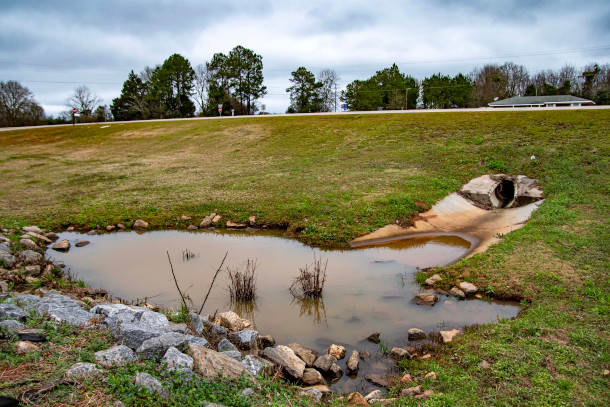
Photo: Lee Hedgepeth, Inside Climate News via Living on Earth.
These highway drainage pipes send water directly toward homes in Shiloh, Alabama — homes that Black landowners have maintained since the Reconstruction era. Other neighborhoods benefit from drainage that runs parallel to roadways.
“Climate injustice” is not a term favored by the billionaire class, but removing out-of-favor words doesn’t make the realities they represent go away. Whether injustices occur on purpose or by accident, they happen. But around the world, ordinary people do what they can to fight back.
Paloma Beltran, associate producer of environmental radio show Living on Earth, has written that recent government decisions “will have a ripple effect across communities that have been pushing back against the impacts of industrial pollution for years. On this week’s show, we spoke with Patrice Simms, the Vice President of Litigation for Healthy Communities at Earthjustice, about the federal government’s role in protecting people from environmental discrimination. … Here’s some of what he said:
“ ‘Really significantly for me, what continues to motivate me is my tremendous respect and appreciation for the people on the front lines of pollution and exposures. I work really closely with communities across the country who are in very real ways, fighting for their lives, fighting for their families, fighting for their well-being, and fighting for their communities. And these aren’t people who are getting paid to do this. These are people who are doing this because they have to. They’re doing this because they’re watching their children get sick. They’re doing this because they’re watching their communities die. And there’s nothing more motivating than understanding and knowing the members of these communities. … It’s an honor and a privilege to get to work with them and beside them and for them, and that keeps me going every day.’
“So it feels like an opportune time to highlight a few environmental justice leaders who have shared their stories with us:
- “Sharon Lavigne is a former school teacher who has become a fierce environmental defender out of love for her community. She’s from Cancer Alley, an eighty-five-mile stretch of the Mississippi River, from Baton Rouge to New Orleans. Slave plantations once lined this part of the river, and many descendants of former slaves still reside in that area. In the 1960s, petrochemical plants began flooding the area, in part due to the river allowing trade, transportation and the disposal of waste in an unseen and cheap way. Most of these plants are in close proximity to predominantly Black communities, exposing them to toxic emissions. According to a 2023 study published in Environmental Challenges, toxic emissions in Louisiana are 7 to 21 times higher in communities of color compared to white communities, and chemical manufacturing is the largest contributor to this disparity. Sharon Lavigne … co-founded Rise St. James, a faith-based grassroots organization fighting against the proliferation of chemical industries in St. James Parish, Louisiana. In 2021, Sharon won the prestigious Goldman Environmental Prize for her activism. For more, take a listen to our conversation. ….
- “Nalleli Cobo grew up within 30 feet of an oil well — one of more than 5,000 oil and gas wells across Los Angeles, California, 700 of which are currently active. Like much of her community, Nalleli suffered from chronic headaches, nosebleeds, stomach pain, and asthma, and at the age of 19, she was diagnosed with cancer. Following treatment, Nalleli is now cancer free, but unable to have children. In March 2020, she joined a coalition of environmental justice organizations and successfully sued the city of Los Angeles for environmental racism and violation of CEQA, which is the California Environmental Quality Act. AllenCo Energy was forced to close down its well located near Nalleli’s home. … Tune into my interview with her here.
- “Andrea Viduarre is another environmental justice advocate who organized her community and convinced the California Air Resources Board to adopt transportation regulations that limit trucking and rail emissions. (However, the state withdrew these rules [after the 2024 presidential election.] Southern California’s Inland Empire serves as a the hub for logistical infrastructure and is home to a predominantly Latino population. A staggering 40% of all US goods move through the area, a lot of which is transported through diesel trucks which emit toxic pollutants linked to cancer, asthma and premature death. Andrea Viduarre’s work has made huge strides in getting pollution out of her community. … You can learn more about in our discussion here.
- “Robert Bullard is known to many as the father of environmental justice. He ran the first study on eco racism in 1979, and found that toxic facilities in Texas were disproportionately located in Black communities. His research was used in the Bean v. Southwestern Waste Management Corporation lawsuit, the first case to use civil rights law to challenge environmental racism. He’s the founding director of the Bullard Center for Environmental and Climate Justice, as well as Distinguished Professor of Urban Planning and Environmental Policy at Texas Southern University. He’s been advocating on behalf of the predominantly Black community of Shiloh, Alabama, whose homes have been repeatedly flooded since a nearby highway was widened in 2018. Dr. Bullard joined us back in 2024 to talk about this case.”
It has always lifted my spirits to see everyday people doing what they can where they are. Public radio’s environmental show Living on Earth will lift your spirits.
PS. Join me on Mastodon? @DudeShoes.

 Suzanne's Mom's Blog