Photo: Teagan Glenane/The Guardian.
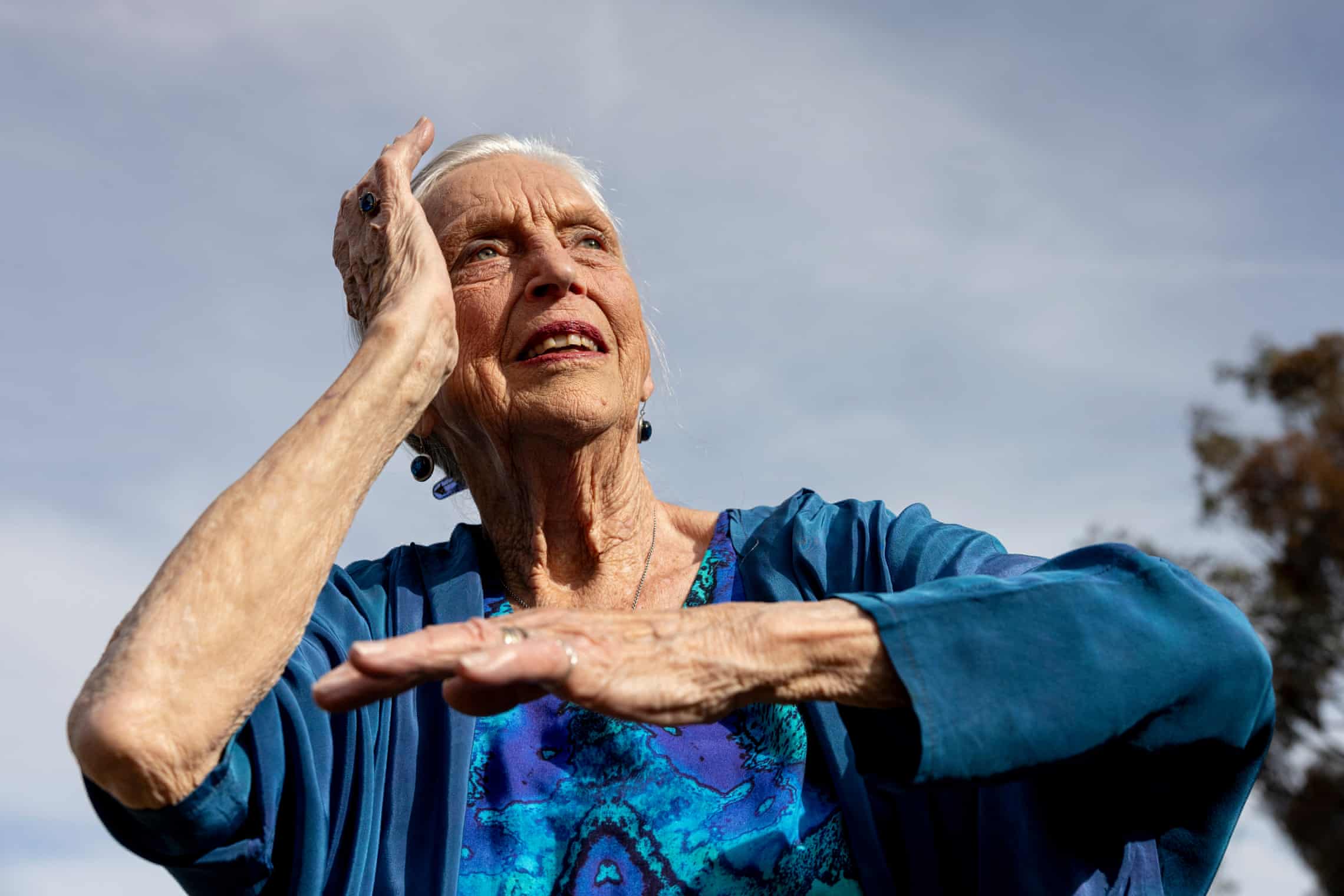
Australian choreographer Elizabeth Cameron Dalman at her property in Bungendore, just outside Canberra. “I’d always been inspired by nature, which I imagined as I was performing.”
As an older citizen who thinks backing up in a parking lot is living life on the edge, I can never resist a story about elderly people who ignore aging.
Steve Dow at the Guardian wrote recently about a dancer in Australia.
“At 91, Elizabeth Cameron Dalman dances in nature at her bushland retreat outside Canberra, Mirramu Creative Arts Centre, surrounded by writers, singers and visual artists. … ‘So many people bring up this age thing,’ she says, ‘and my reply is that in dance we are ageless.’
“A contemporary dance pioneer in Australia, Dalman has just seen the final performance of one of her ‘great inspirations’ and occasional collaborators, dancer Eileen Kramer, in a filmed component of the dance work ‘Afterworld,’ part of Sydney festival. Kramer died in November at 110. ‘I’m going to live to that age,’ Dalman chuckles.
“In Adelaide in 1965, Dalman co-created Australian Dance Theatre, running the company for a decade, confounding the era’s prejudice against modern dance and women artistic directors. …
“She [likes to] talk about what feeds longevity, pointing to medical research showing the health and mobility benefits of dancing for Alzheimer’s and Parkinson’s patients. ‘It’s not just pure exercise, you are adding creative activity,’ she says. ‘You’re engaging the left and right side of the brain.’ …
“Dalman has been consulting with ADT’s current artistic director, Daniel Riley, on the company’s 60th anniversary production ‘A Quiet Language.’ … The show, created by Riley, is billed as an examination of legacy, ‘transmuting the rebellious energy of the company’s early days into an electric new era.’
“Over the past decade, Dalman herself has graced international stages, notably touring for four years as part of the Irish choreographer Michael Keegan-Dolan’s critically acclaimed ‘Swan Lake/Loch na hEala,’ which transposed the classical ballet to the Irish midlands. When Keegan-Dolan posted an international callout for a woman aged 60 with long white hair to play the story’s cranky, arthritic matriarch, Dalman – 82 at the time – emailed saying she had the requisite long white hair. …
“Dalman has always been determined to dance. … She enrolled in dance class at three, learning both classical ballet and modern. Later, she began an arts degree at the University of Adelaide. …
“In 1957, aged 23, Dalman paid her way to London with the hope of launching a dance career. There, she saw a life-changing performance by the Mexican choreographer José Limón. ‘He touched my soul. I thought, “Oh wow, that’s how I want to dance,” ‘ she recalls. In 1960-61 she studied at the Folkwang school in Essen, Germany, where her classmates included Pina Bausch: ‘She was amazing, a technical whiz.’
“In Germany, Dalman met the Colombian American choreographer Eleo Pomare, who rose to prominence in the civil rights era. She created works with Pomare’s company from 1961 to 1963, living in Amsterdam with him and four other dancers. Pomare later remarked that Dalman danced ‘as if she swallows the heat and you feel that the heat is burning from the inside out.’ …
“Dalman returned to Australia in late 1963, and performed in the artist Stan Ostoja-Kotkowski’s experimental theatre show ‘Sound and Image’ at the 1964 Adelaide festival. It inspired her to open a dance school, and in 1965 she took her students on a regional tour, alongside dancers from Royal Ballet alumnus Leslie White’s Adelaide academy.
“Buoyed up by the tour’s success, Dalman and White set up Australian Dance Theatre, but the going was financially tough, and White left in 1967. Dalman put Australian Dance Theatre forward to perform in the 1968 Adelaide festival, but when it turned down her request for financial support she instead bought some half-price cruise ship tickets and took the troupe on its first international tour, sailing to the Netherlands, Switzerland and Italy.
“Back home, Dalman faced discrimination because of her gender: ‘I felt the battle, I had to keep proving myself. Even once we got a little bit of funding later, in 1973, and I’d been running the company since 1965, never in the red, this board member, a man, said, “Oh we have to do something about the finances, they haven’t been run correctly.” Then he took us into the red the next year.’
“Dalman remained artistic director until 1975. Then, having split with her husband, she and [their son] Andreas moved to Ventimiglia, a seaside town in northern Italy. … She founded a dance school and a youth dance theatre there in 1976, and it became ‘a place of healing.’
“In 1986, on a visit home to Australia, Dalman met another mature artist, who became an inspiration: the Japanese butoh dancer Kazuo Ohno, then almost 80. … A decade later, Dalman and Andreas visited Ohno – who was still dancing, and preparing to tour the US – at his Yokohama home. ‘He said, “Oh Elizabeth, it’s so good to talk to a senior, mature artist.” ‘ Dalman, then 60, had been contemplating ending her career. ‘When I met him, I realized I had to keep going.’
“In 1989, Dalman bought a 40-hectare property at Bungendore, near Weereewa/Lake George, outside Canberra. The bush reminded her of Italy, dancing among the olive groves or by the river. She established Mirramu Creative Arts Centre there the same year, followed by Mirramu Dance Company in 2002. …
“ ‘It was hard leaving Adelaide because that was my home, but the pull of this place, the land and the lake, is very powerful.’ “
More at the Guardian, here.

 Suzanne's Mom's Blog