Photo: Mariam Ehab.
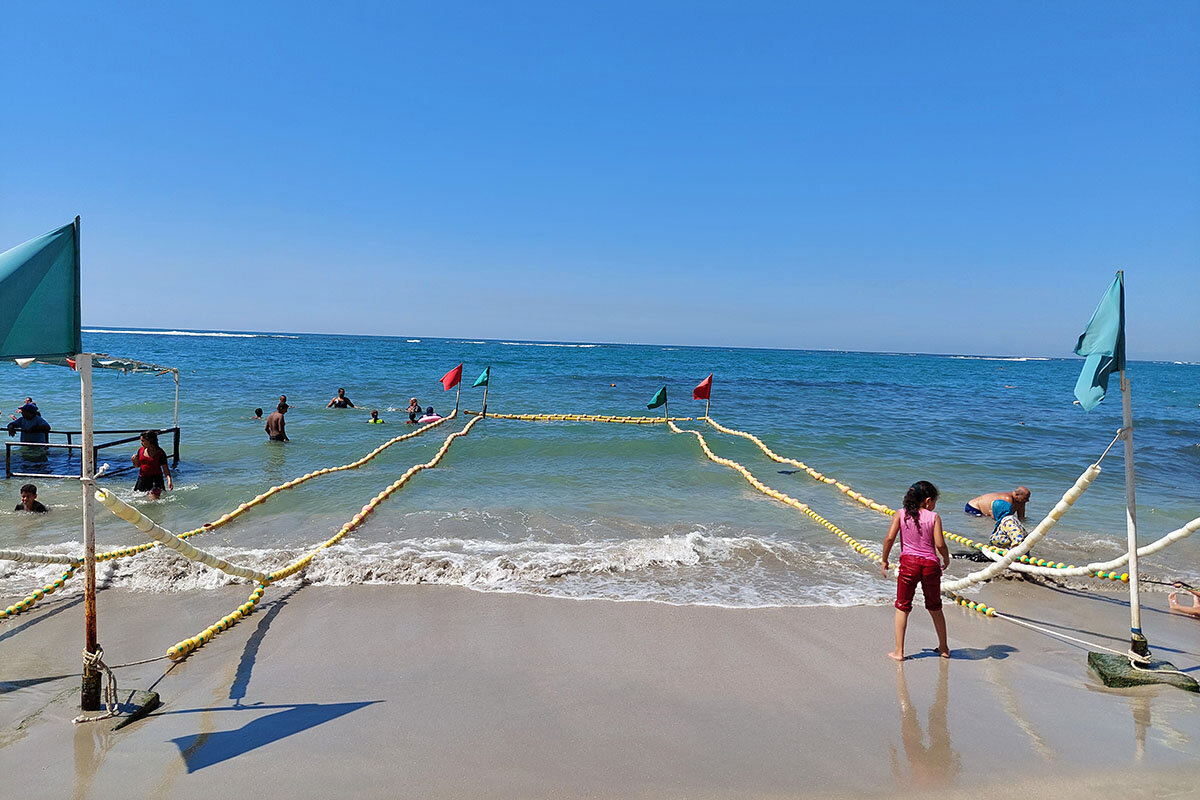
View of Mandara Beach in Alexandria, Egypt, where floating ropes help the visually impaired enter and exit the Mediterranean Sea, Aug. 23, 2022.
You may have noticed that I love stories about Sweden and Egypt. That’s because two of my grandchildren are half Swedish and two are half Egyptian. How lucky is that!?
Today’s story comes from Alexandria in Egypt. Miriam Ehab covered it for the Christian Science Monitor.
“In a sunny spot along the bustling shores of Alexandria, Egypt’s second-largest city, a group of beachgoers splash and frolic in the sea. But this is no ordinary beach.
“Holding onto floating barriers and ropes, safe in the knowledge that attentive lifeguards are nearby, almost everyone here is blind or visually impaired. Mandara Beach is the first of its kind in the Arab world’s most populous country, specially fitted so it’s accessible to swimmers with physical disabilities. For many, it’s more than just a day of fun and relaxation – it’s a rare window of empowerment.
“Inaugurated in 2021 for people using wheelchairs, Mandara underwent another renovation last year. When the revamped beach opened again in June, at the height of Egypt’s summer season, thousands of citizens with visual impairments could also safely swim in the calm cerulean Mediterranean waters. …
“ ‘This is the first time I’ve been to the sea,’ Sarah, one beachgoer, says with a beaming smile. ‘I was very happy and did not feel afraid at all when I was swimming.’ …
“Some 12 million Egyptians live with a disability, roughly 3.5 million of whom face visual challenges. In 2018, President Abdel Fattah al-Sisi declared the ‘year of persons with disabilities.’ … Parliament responded with a slew of laws, including the provision of state-subsidized health care to people with disabilities.
“Other benefits included tax exemptions on the purchase of cars, educational and medical materials, and imported assistive devices. Legal fees, whether for plaintiff or defendant, also were lifted for people with disabilities. And in 2021, Parliament approved tougher penalties for the bullying of people with disabilities.
“ ‘The laws from 2018 are excellent,’ says Hassan Abdel Qader, head of Alexandria’s Blind Association. ‘But the problem is in their implementation.’
“The fact is, say campaigners, that many public spaces and means of transport still lack accessibility, assistive technologies are hard to come by, services for people with disabilities are patchy, and discrimination is not uncommon. Still, change is coming, slowly.
“Some months ago, Jihad Mohammed Naguib, an employee at the Department of Tourism and Resorts in Alexandria, was inspired by something she heard from the governor of Alexandria, Maj. Gen. Mohamed el-Sherif. He noted that there were never any blind people on the beaches, which are the pride of the coastal city. …
“ ‘The idea of allocating a part of the beach for the visually impaired … was put forward after we inaugurated the free Mandara Beach for people with motor disabilities and the success that it met,’ Major General Sherif says in an interview. And so, with funding from the Rotary Club of Alexandria Pharos, the work began.
“Floating ropes with plastic balls were installed on a flat portion of the beach, so that swimmers with visual impairments could enter and leave the water holding these ropes. People in wheelchairs could use a modified ramp, the end of which was fitted with a metal box submerged in the water, ensuring their safety while in the sea. Lifeguards and a first-aid unit were also available – which isn’t always the case on Egypt’s public beaches.
“Those directly affected – and most likely to benefit – were consulted from the beginning. ‘We proposed some things that they have already implemented, and others that they promised would be implemented in the future,’ Mr. Qader says.
“Those suggestions included a whistle for children who feel endangered, and a rope that extends from the entrance of the beach to the water, so that even if a visually impaired person visits on their own they can reach the sea without assistance. …
“The beach is the latest in a recent string of hard-won successes for Egypt’s visually impaired people. The Egyptian Blind Sports Federation already runs several sports teams, including soccer, weightlifting, judo, and showdown – a type of air hockey for blind people.
“But gaps remain. ‘Most services, and recreational and sports activities for the visually impaired, are concentrated in the Egyptian capital, Cairo, while other Egyptian cities have little capabilities,’ says Moamen Mostafa, the former head of public relations for the Blind Association of Egypt. …
“That makes Mandara Beach all the more poignant for a group who have difficulty accessing recreational and sports activities. For 52-year-old Mohamed Attia and his 40-year-old wife, Sahar, both wheelchair users, this was the first time they could enjoy the beach together.
“ ‘I am happy to go into the sea for the first time in my life, after I could only watch it from afar,’ says Ms. Attia.
“The couple were delighted to find a group of people who helped them move their wheelchairs into the water. …
“Mr. Attia says … ‘Those who had this idea have a compassionate heart. We really wish this project to continue and spread on all the beaches of Egypt,’ he adds.
“That wish may come true. Buoyed by the success and widespread acceptance of Mandara Beach, Major General Sherif says there are plans to open a similar facility in Alexandria’s Anfushi Beach. From there, he hopes, the idea will spread through the country.”
More at the Monitor, here.

 Suzanne's Mom's Blog