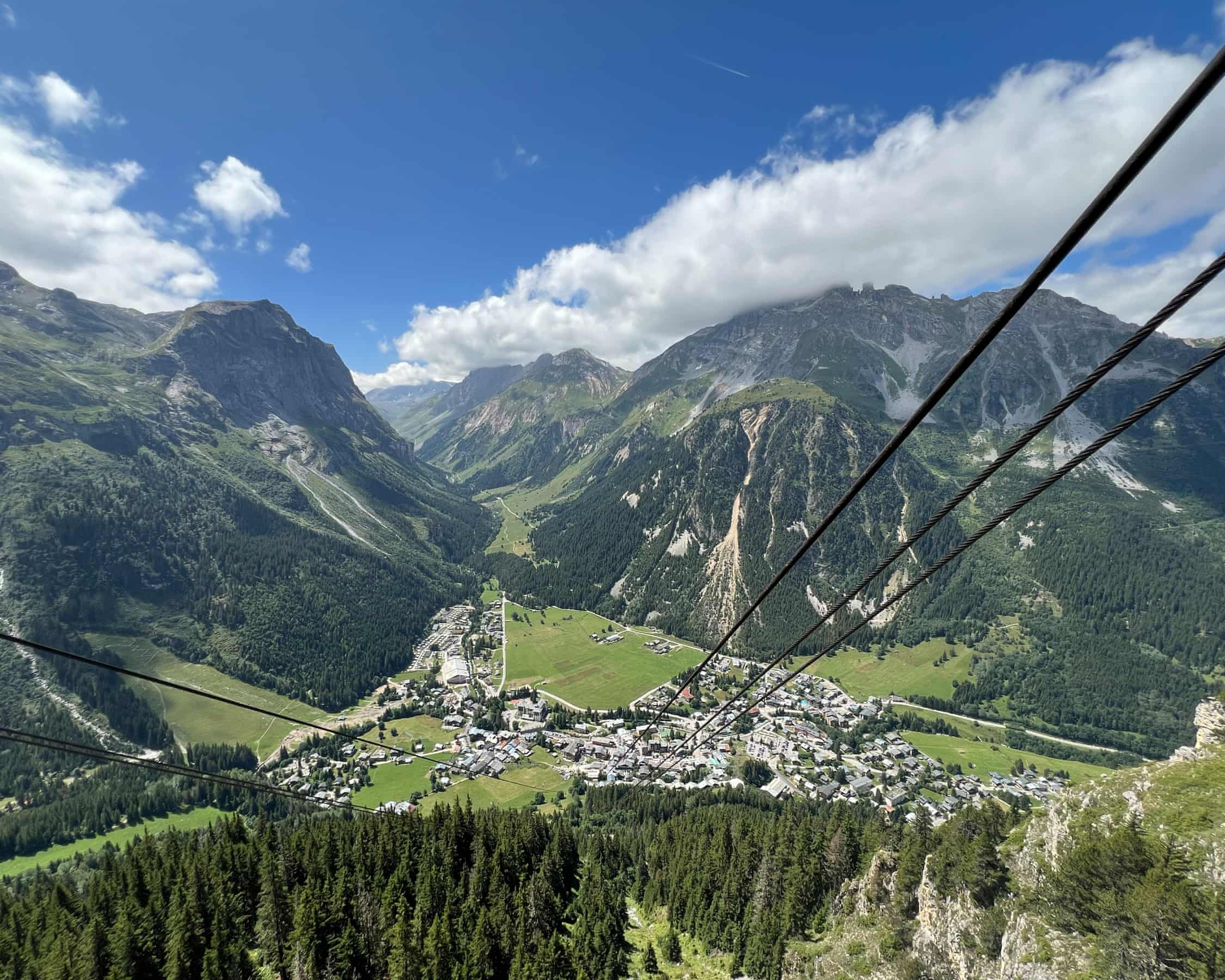
Photo: Kim Willsher/The Guardian.
Pralognan-la-Vanoise in the French Alps is in danger from global warming. An engineering operation to prevent catastrophic flooding will cost about €400,000 ($465,000).
As discouraging as it is to read another story about global warming, one has to feel a little hopeful that human ingenuity keeps tackling its effects.
Kim Willsher reports at the Guardian about how engineering is fighting back in France. I leave it to you to decide whether putting humans first or the glacier first would be best.
“The villagers of Pralognan-la-Vanoise in the French Alps know well the perils posed by the mountains that encircle them. Avalanches, rockfalls, mudslides, sudden crevices and torrents of water are within the living memory of most villagers, and every day the climate emergency throws up new dangers.
“Less than a year ago, an enormous lake formed by a melting glacier was discovered high above Pralognan that experts feared could inundate the village with more than 60,000 cubic metres [15,850,000+ gallons] of icy water. …
“As used to natural hazards as local people are high up in the Alps, they are not, however, an idle threat. The Swiss village of Blatten was wiped out by a rock and ice avalanche in May and last year a mountain lake swollen by heavy rainfall caused torrential flooding in La Bérarde in the Isère, forcing inhabitants to flee the hamlet. They have not returned.
“Today, an engineering operation is under way to prevent such a catastrophic scenario in Pralognan. Three workers have been helicoptered to the Grand Marchet glacier at an altitude of 2,900 metres [1.8 miles] to gouge a [narrow] ‘overflow channel’ in the ice. …
“ ‘The aim is to help the water find its way down the mountain gradually and avoid a rapid emptying of the lake,’ said David Binet, the director of the mountain land restoration service (RTM) for the northern Alps, part of the national forestry commission tasked with identifying and preventing natural hazards.
“ ‘What causes the problems and damage with torrents in the mountains is not the water but the stones, gravel, sand and even large rocks it brings down with it.’
“The glacier blocks the lake from spilling down the mountain but it is shrinking at a rate of 2 to 3 metres [6.6 to 9.8 feet] a year. There is also the risk that that the warmer waters of the lake could form a channel gush from underneath.
“Binet said his agency was examining 300 of the estimated 600 lakes in the Alps and Pyrenees one by one for such hazards. The Pralognan operation will cost about €400,000 [$465,000)]. …
“The idea of taking mechanical shovels to glaciers already shrinking at an alarming rate was deemed the least environmentally damaging option. Olivier Gagliardini, a glacier expert at Grenoble University, described it as ‘unfortunate, but necessary.’
“Martine Blanc, the mayor of Pralognan, said … ‘We asked ourselves could it wait but on the principle that prevention is better than cure we decided to go ahead,’ she said. ‘We decided to anticipate events rather than suffer them. Nature is nature and there’s no such thing as zero risk.’ …
“Local shopkeepers say the number of tourists and hikers this summer is down, possibly because the campsite is closed, but Silvere Bonnet, the director of the tourist office, said he had had very few calls from potential visitors concerned about the lake. …
“On a sunny day, the giant rock faces etched with shimmering cascades that rise almost vertically have a benevolent beauty. An hour later in a rapid change of atmosphere, the peaks are cloaked in dark clouds and loom intimidatingly.
“ ‘They can appear rather menacing at first to visitors because they are so sheer,’ [Bernard Vion, a 66-year-old Alpine guide who has watched the expanse of water grow and the mountain change over his lifetime] said. The 66-year-old knows these mountains ‘like his pocket,’ as the French say. He made his first high-altitude climb aged eight with his father, also a guide. Both his grandfathers were Alpinists.
“Vion first spotted what he describes as ‘a puddle’ of water on the Grand Marchet glacier in 2019. Every year since he has watched it grow; it now measures almost 2.5 acres. …
“ ‘We are on the frontline of climate change here. We know it is happening,’ he said.
“Blanc agreed. … ‘People here are used to natural hazards. We’re used to avalanches, falling rocks, torrential floods and mudslides because we’ve seen them and lived with them since we were young. Local people understand there are things we can control and then those we cannot.’ ”
More at the Guardian, here.

 Suzanne's Mom's Blog