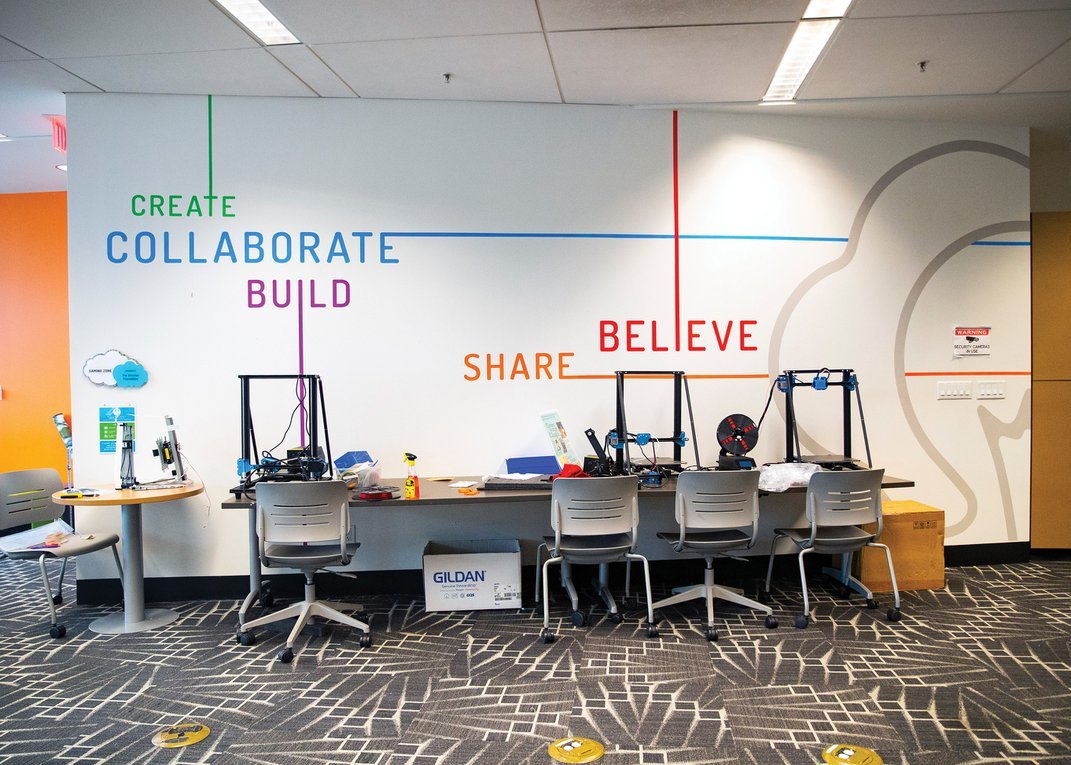
At the Memphis, Tenn., library, Cloud901’s maker space is equipped with such high-tech tools as laser cutters and 3-D printers. The workshop is open to all ages, not just teens.
Today’s story is about an astonishingly innovative library in Memphis, Tennessee. It makes me ashamed to recall that my younger tradition-bound self thought libraries should never spend money on anything but books! Who knew the extended role libraries were going to play in people’s lives — from providing shelter during Ferguson, Missouri, protests to launching kids on undreamed-of careers. My own local library was recently renovated, and I wouldn’t give up a single 3-D machine.
Richard Grant writes at the Smithsonian magazine, “The Benjamin L. Hooks Central Library, a building of pale concrete and greenish glass, rises four stories in midtown Memphis. Walking through its automatic doors on a weekday afternoon, I hear unexpected sounds, muffled but unmistakable, almost shocking in a library context: the deep, quaking bass beats of Memphis hip-hop, plus a faint whine of power tools cutting through metal. …
“Here at the Central branch in Memphis, ukulele flash mobs materialize and seniors dance the fox trot in upstairs rooms. The library hosts U.S. naturalization ceremonies, job fairs, financial literacy seminars, jazz concerts, cooking classes, film screenings and many other events — more than 7,000 at last count. You can check out books and movies, to be sure, but also sewing machines, bicycle repair kits and laptop computers. And late fees? A thing of the past.
“The hip-hop beats and power tool noise are coming from an 8,300-square-foot teenage learning facility called Cloud901 (the numerals are the Memphis area code). Two stories high, it contains a state-of-the-art recording studio staffed by a professional audio engineer, a robotics lab that fields a highly competitive team in regional and national championships, and a video lab where local teens have made award-winning films. Cloud901 also features a fully equipped maker space (a kind of DIY technology innovation workshop), a performance stage, a hang-out area and an art studio. …
“Many cities have slashed their library budgets and closed branches. Memphis, Tennessee, one of the poorest cities in the nation, chose instead to invest, recently opening three new branches, for a total of 18, and increasing the library budget from $15 million in 2007 to almost $23 million today. Attendance at library programs has quadrupled in the last six years. In 2019, before the pandemic, more than 7,000 people attended the annual Bookstock festival, a celebration of literacy and education.
Memphis Public Libraries (MPL) is the only public library system in the country with its own television and radio station, and its branches receive more than two million visits a year.
“ ‘How did this happen?’ I asked Mayor Jim Strickland, who is serving his second term in office. He was sitting in his seventh-floor office with a view of downtown and the Mississippi River. ‘I’m a strong believer in libraries as a force for good,’ he said. ‘But none of this would have happened without our library director Keenon McCloy. She is amazing. We’ve got library people coming from all over the country to see what she’s done here.’
“McCloy is high-energy, fit from running, always busy, sometimes frenetic. Though passionate about public libraries, she has no training in the highly specialized field of librarianship, not even an undergrad degree in library science, and this provoked dismay and even uproar when she took over the Memphis system in January 2008.
“ ‘I was the director of public services and neighborhoods for the city, and the mayor — it was Mayor Herenton at the time — appointed me without doing a search for other candidates,’ McCloy says over a salad lunch near her office in the Central branch. ‘It caused quite a stir in Libraryland.’ …
“McCloy’s first big task was to reorganize the funding and administration of the library system. Then she went looking for advice. She talked with directors from other states and visited acclaimed public libraries. ‘I wanted to meet the rock stars of Libraryland with the most progressive ideas,’ McCloy says. ‘And they all wanted to help me and share what they’d learned, because that’s how library people are. No one is proprietary and we’re not competitive with each other. We’re all about the greater good.’
“In Chicago, she toured the Harold Washington Library Center, where a 5,500-square-foot facility called YOUmedia opened in 2009. It was the first dedicated teen learning center in an American library, and it had a maker space and an in-house production studio to record teenage musicians. ‘That’s where I got the idea for Cloud901,’ says McCloy. ‘People kept saying the biggest problem at the Central library was all the teens hanging around, and I thought, well, they’re in our library, let’s find a way to redirect their energy.’
“The next step was to meet with the Memphis Library Foundation, a volunteer fundraising organization with connections in the business community and social elite. ‘I asked them if they would support a teen center at the Central branch,’ says McCloy. ‘Well, not immediately, but then they started raising money, and we decided to double the expense and really go for it.’
“Instead of a basic recording studio, McCloy and her team wanted a professional-quality studio. The legendary Memphis music producer Lawrence ‘Boo’ Mitchell, co-owner of Royal Studios and a longtime supporter of the libraries, agreed to design it. For the maker space, they hired a native Memphian who had been overseeing such facilities in the Bay Area. He stocked the workshop with 3-D printers and other equipment, and brought in FedEx, a Memphis-based corporation, as a supporter. It was the same approach with the video and robotics labs: hire experts, buy the best equipment, recruit sponsors. Cloud901 opened in 2015, at a cost of $2.175 million. …
“When [when Janay Kelley, now 18] first arrived at the video lab, an instructor there, Amanda Willoughby, taught her how to use the equipment — cameras, lights, editing software. …
“The first film that Kelley made here was titled The Death of Hip-Hop. She lit and filmed herself. … ‘I was going to upload it onto YouTube, but Amanda insisted on entering it into the Indie Memphis Youth Film Fest.’ “
Read the rest of the story at the Smithsonian, here. It’s free. It’s a long article with fascinating testimonials. Pretty sure Laurie Graves will want to read the whole thing!


 Suzanne's Mom's Blog