Feeds:
Posts
Comments

Posts Tagged ‘mexican’

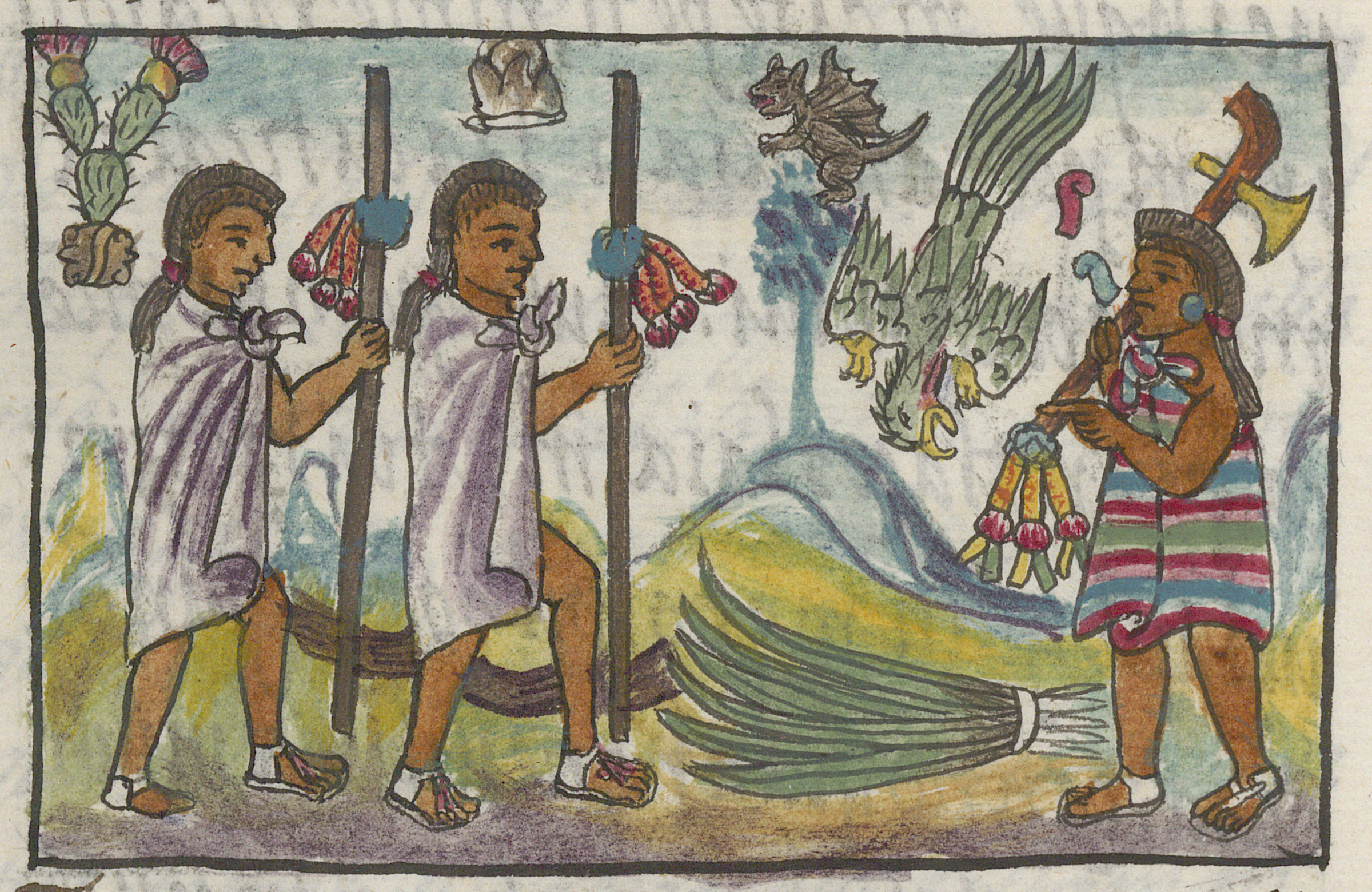
Photo: Biblioteca Medicea Laurenziana, Florence, and MiBACT.
Disguised Mexica merchants in Tzinacantlan acquiring quetzal feathers.

Thanks to work by the Getty Research Institute and indigenous partners to post an ancient codex online, some mysteries about Aztec hstory are available for all of us to plumb.

Maya Pontone opines at Hyperallergic that “the 16th-century ‘Florentine Codex offers a Mexican Indigenous perspective that is often missing from historical accounts of the period.” So how did this knowledge end up in Italy?

“After centuries of remaining largely inaccessible to the public,” she writes, “a rare manuscript featuring 2,500 pages of detailed illustrations and text documenting the history and culture of 16th-century Mexico is now available online. The Digital Florentine Codex, a seven-year project by Los Angeles’s Getty Research Institute, features new transcriptions and translations, updated summaries, searchable texts and images, and more.

“Modeled after medieval European encyclopedias, the Florentine Codex is a three-volume, 12-book collection written in Spanish and Nahuatl documenting the daily life and customs of the Mexica (Aztec) people, as well as other information including astronomy, flora, and fauna, during the time of Spanish conquest. It was originally created by Bernardino de Sahagún, a Spanish Franciscan friar who began logging information about the Indigenous communities in central Mexico with whom he worked closely.

“Although Sahagún is frequently credited as the primary author, the 12-book manuscript was created with the help of numerous elders, grammarians, artists, and scribes from the Nahua community. As a result, the codex maintains an important Indigenous perspective that is often missing from other historical accounts of the time.

“In 1577, the codex was sent to Spain, where it then somehow traveled to Italy to fall under the ownership of Cardinal Ferdinando I de’ Medici, who brought the work to Florence. The codex was stored away in one of the Medici family libraries and remained forgotten for several centuries. In 2012, a scanned edition of the work was made digitally available through the World Digital Library, and in 2015, it was incorporated into UNESCO’s Memory of the World Register.

“But, as the Digital Florentine Codex’s project manager Alicia Maria Houtrouw told Hyperallergic, the manuscript still remained largely out of reach for the public.

“ ‘Access to codex was partial in that published transcriptions and translations tackle either the Spanish or the Nahuatl column of text or just a selection of the codex,’ Houtrouw said, adding that reading these reproductions often required knowledge of both early and modern Spanish and Nahuatl. Many published versions also didn’t include the manuscript’s crucial illustrations, or if they did, excluded context.

“ ‘The Nahuatl and Spanish texts provide two complementary, though distinct, narratives, and the images go beyond the alphabetic texts, providing unspoken details and communicating yet another layer of knowledge,’ Kim Richter, senior research specialist and the principal lead of the Florentine Codex Initiative, told Hyperallergic.

“Now the public can access the entirety of the codex through an online portal released by the Getty Research Institute last [October], and learn a wide span of subjects including the origin of ancient Aztec deities, theology and philosophy, cooking, and gardening. In Book 11, Sahagún documents the plague of smallpox, writing of the ‘infinite number of people’ who succumbed to the illness.

“The final book in the codex documents the Spanish invasion of Mexico, including the Massacre in the Great Temple of Tenochtitlan that occurred on May 22, 1520, under Spanish conquistador Pedro de Alvarado. …

“The digital codex was created with the help of native Nahuatl speakers out of the Instituto de Docencia e Investigación Etnológica de Zacatecas (IDIEZ), who translated thousands of sections of the codex and wrote the summary of the Spanish conquest of Mexico.

As a result, the Digital Florentine Codex now makes available a historical narrative about Indigenous resistance and heroism in the face of Spanish colonizers that has largely been absent from many educational curricula. …

“ ‘Indigenous people in Mexico, as in the US, face discrimination — so to have access to such important historical sources restores a sense of pride and also supports language revitalization — the primary mission of IDIEZ,’ Richter said.”

See the wonderful pictures at Hyperallergic, here. No paywall.
Read Full Post »

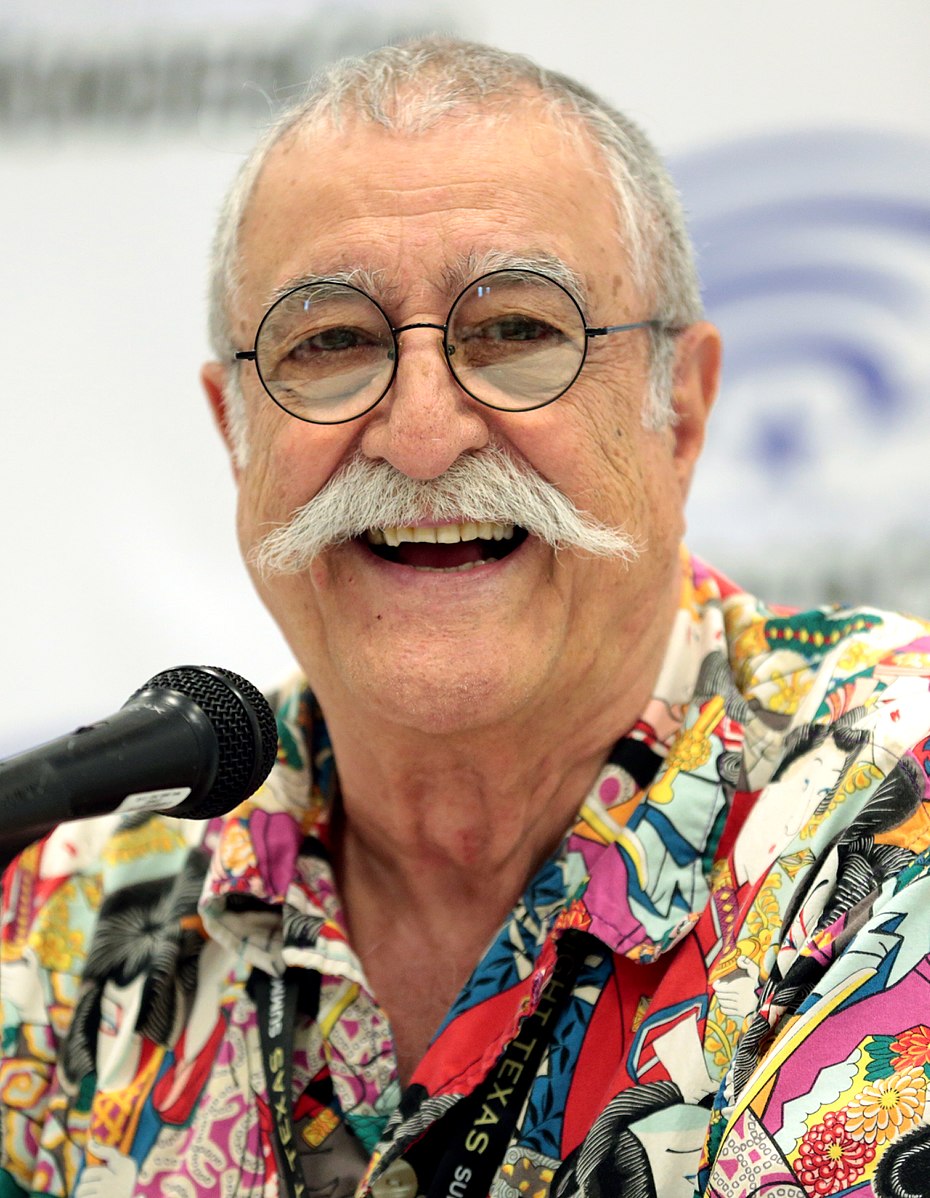
Photo: Gage Skidmore.
Cartoonist Sergio Aragonés speaking at the 2017 WonderCon in Anaheim, California.

I always feel admiration for people who love their work so much that they keep doing it well into their advanced years.

In today’s post, Michael Cavna of the Washington Post writes about the staying power of Mad Magazine’s oldest active artist.

“Sergio Aragonés had long read Mad magazine back in Mexico by the time he first landed in New York, toting fresh artwork and hope. He stepped through the humor outlet’s front doors 60 years ago, expecting to find the place as wild in spirit as the publication’s satirically hip pages. This was, after all, the home of the staff’s self-anointed ‘Usual Gang of Idiots.’

“Instead, the recent college student was introduced to a relatively staid Madison Avenue office. Where was the whimsy? The Mad-cap frivolity? This was no clubhouse of high jinks.

“ ‘I thought it was going to be a lot of jokes on the walls,’ Aragonés says by Zoom from his home in Ojai, Calif., where he celebrated his 85th birthday last month. After he was hired that day he walked in to sell his work, he suggested to publisher William Gaines, ‘Why don’t we paint one of the doors to make it look like an elevator, putting fake numbers at the top?’ and befuddling visitors attempting to exit. Or perhaps better yet: ‘Why don’t we put a bomb in the roof with the sound effect “tick-tock-tick-tock”?’

“ ‘Bill looked at me like: “Sergio, this is an office of working people.” He wanted the office to be very functional.’

“What cartoonists cannot create in life, however, they are armed to imagine on the canvas. So for a new comic, Aragonés has drawn busy Mad office workers momentarily donning character masks … to entertain kid visitors taking phone photos.

“That strip is among a selection that Aragonés contributed to a special edition of Mad [that] marks the magazine’s 70th anniversary. Although the outlet has predominantly reprinted past material since it ceased regular publication in 2019, most of this special edition will be original content, including a Johnny Sampson back-page ‘fold-in,’ a film parody of Robert Pattinson as ‘The Batman,’ and a mini-essay by fanJordan Peele, whose film Nope features a fictional Mad cover.

“The special edition also spotlights Aragonés’s status as the oldest artist currently drawing for Mad. … He says he has been blessed with six fruitful decades at the iconic magazine, which reached millions of monthly readers at its 1970s peak and influenced writers at such shows as The Daily Show and The Simpsons, as well as Judd Apatow and ‘Weird Al’ Yankovic.

“Aragonés’s high standard for consistent creativity is legendary. For decades, he only missed contributing to a single issue, and that was because the mail from Europe was slow in the 1960s. The cartoonist, who also produces the fantasy comic book series ‘Groo the Wanderer,’ attributes his mental fertility to mixing things up creatively, from narrative stories to the wordless art for the Mad margins, his signature domain. ‘The variety of my field,’ he says with gusto, ‘allows me to never get tired of it.’ …

“ ‘I suspect if Sergio were to go and donate blood, ink would come out of him,’ says John Ficarra, former Mad editor in chief. ‘He is incapable of not drawing.’

“Aragonés acknowledges that he does not suffer writer’s block because cartooning is second nature: ‘Drawing has become like walking.’ …

“Aragonés was born in the Spanish province of Castellón, in Sant Mateu, but within six months, his mother fled the Spanish Civil War — Sergio in tow — while his father fought for the Republic. The family reunited a few years later, but by 1942 they were World War II refugees in Nazi-occupied France. They headed to the North American nation that would take them in: ‘I have a debt with Mexico I will never be able to repay.’ …

“In high school, Aragonés drew his own cartoons (a creative ‘form of escape,’ he says), which a classmate submitted to a humor periodical unbeknown to him. They were purchased and published, sparking his self-belief. …

“ ‘The humor that I do wasn’t popular in the United States because American humor is always based on words, the British inheritance of the punchline,’ he says. Pantomime humor lacked such respect in the States. …

Mad editors, though, valued Aragonés’s work immediately. They bought his cartoons featuring astronauts and asked for a piece on motorcycle cops. …

“ ‘When Mad accepted me, that was a change of life, a change of mind, a change of everything. Somebody liked what I did.’ ”

More at the Post, here.

Read Full Post »

My husband’s latest alumni bulletin had a lot of great articles. One was about a new effort to save endangered languages, starting with Zapotec, an indigenous Mexican language.

If you go to this website and click the buttons, you can see and hear the effort that has gone into recording the ways that Zapotec words are pronounced. It’s the “Tlacolula Valley Zapotec online talking dictionary.”

The initiative has received support from the National Geographic and the Living Tongues Institute for Endangered Languages.

Photo: AxisOfLogic.com

Read Full Post »

I liked this multicultural story by Fernanda Santos in the NY Times. It demonstrates that people from different cultures can adapt to one another’s foods and customs very nicely in the U.S. melting pot.

It is all happening at the Ranch Market in Phoenix.

“Tortillas are a Mexican staple of transnational appeal here, bridging divisions carved by Arizona’s tough stance on immigration and reaching far beyond Latin American borders.

“The factory, at the Ranch Market store on North 16th Street, employs a pair of Iraqi refugees to whom flour tortillas have become a replacement for the flat bread known as khubz. There are also Cubans, Salvadorans, Guatemalans and, of course, Mexicans manning the machines like the rounder, which turns the masa into balls that are then pressed and cooked in 500-degree ovens at a rate of eight dozen disks a minute.

“Refugees from Somalia buy Ranch Market tortillas as a substitute for a pancake-like bread called canjeelo. Koreans have taken to using them to wrap pieces of spicy barbecued pork, like a taco. Foodies like them because they are the closest thing to an authentic tortilla that they can find at a supermarket here.”

Read more here.

Photograph: Joshua Lott for The New York Times
The Ranch Market on North 16th Street in Phoenix churns out eight dozen tortillas a minute, cooked in 500-degree ovens.

Read Full Post »