Feeds:
Posts
Comments

Posts Tagged ‘minerals’

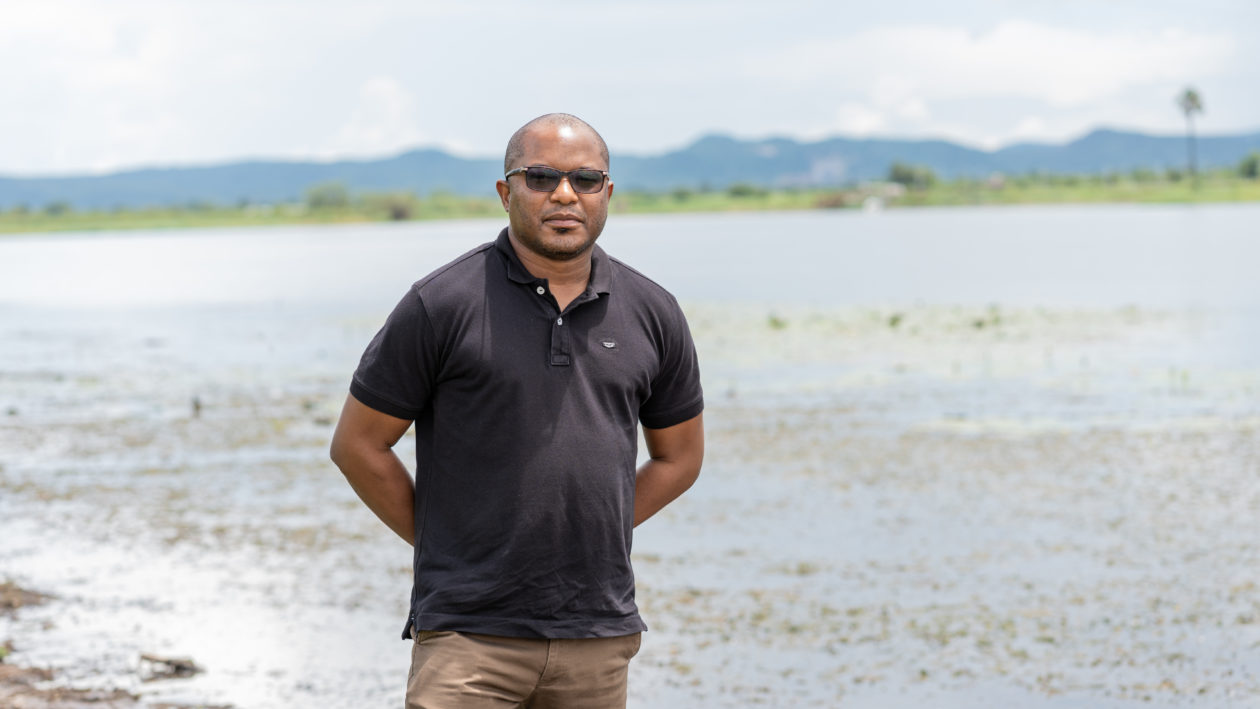
Photo: Goldman Environmental Prize.
Chilekwa Mumba took on a UK mining giant that was polluting Zambia — and won.

Today’s story shows how one person can make a difference, even when the goal is considered impossible. It’s also a cautionary tale, because you can win the battle and not the war. The irony is that powerful entities can excuse polluting a region in order to meet “green economy” needs.

Jocelyn C. Zuckerman reported at Yale Environment 360, “The southern African nation of Zambia is home to a wealth of minerals — in particular, lots of the copper and cobalt that the world will require to power a green economy. Among its largest operations is the Konkola Copper Mines (KCM), located in the country’s Copperbelt Province.

“In 2004, U.K.-based Vedanta Resources acquired the controlling stake in KCM, whose operations span 11 square miles along the Kafue River. Soon after, residents noticed that the Kafue was emitting foul odors. Fish began dying. Crops began to wither.

Livestock fell ill. And villagers came down with mysterious headaches, nose bleeds, rashes, and burns.

“Chilekwa Mumba, who had grown up in the region but since moved to the Zambian capital, Lusaka, learned of the problem and vowed to do something about it. In an interview with Yale Environment 360, he talks about how he spent the next several years facilitating meetings between the communities and British lawyers, gathering water samples, and convincing former mine workers to provide evidence for a lawsuit that made its way through the British court system. Finally, in 2019, its Supreme Court found that KCM’s parent company could be held accountable in the U.K. for environmental damage from the mine’s operations.

“Not only had Mumba, 38, who was awarded a Goldman Environmental Prize [in April], helped win significant financial compensation for the 2,000 villagers involved, but his case set a legal precedent that British companies can be held accountable for the environmental fallout of their operations overseas. …

Yale Environment 360: KCM was already a presence when you were growing up in the town of Chingola. … You did your primary schooling in Chingola, so you got a good education in part thanks to the mine, which funded the schools? …

Mumba: They had excellent schools. We moved to Lusaka when I was 15, but I still went to school under the mine system. I went to a boarding school that was supported by the mines, including KCM.

e360: In 2004, Vedanta Resources, which is headquartered in the U.K., acquired a controlling stake in KCM. What happened after that?

Mumba: When they took over, there was too much collusion with government. They were not being held to account on many different issues. Based on what I was reading in the media, I started talking to residents in Chingola. We’ve got family and friends there, and my parents still maintain a home there. I used to go back occasionally, but it became almost a permanent home when I started to find out about the reports [of pollution]. I began realizing that what I’d been hearing was correct. And I started to do my own investigation. …

“I went to the same spot I used to go to as a child to fish. … There were basically no fish, and the smell of chemicals was quite evident. The soil makeup was different from what I remembered when I was young.

e360: Did you confront the company? …

Mumba: I had a couple of meetings with a local lawyer representing the villagers, and he was telling me that nothing would happen, that I shouldn’t waste my time. But he did give me quite a bit of information, and I put it in my file.

e360: You wrote letters to something like 100 law firms?

Mumba: A combination of law firms and environmental NGOs, all over the world. I was just randomly sending them out from my Yahoo address. I got a lot of automatic replies. And then there was an automatic reply from [British law firm] Leigh Day, followed up with an actual email from a person, Katie Gonzalez. I can never forget that name. I happened to find it in my email and was surprised. They told me they would be there in two weeks.

e360: How did the community respond to this British lawyer coming in? Did they trust him?

Mumba: Not immediately. But the way he is — Oliver Holland, I have to absolutely mention him — he was a white guy in a remote village, but he has this aura about him where he is very friendly, so they warmed up to him.

e360: What sort of evidence did you bring to court?

Mumba: We gathered water samples and soil samples and found that copper, iron, cobalt, and dissolved sulfates were present far beyond legal limits. We also took in — though we did not put that to the court — blood tests for various clients, to test for the presence of heavy metals. We already had overwhelming evidence from the water and the soil.

e360: Did you have help from anybody inside the company?

Mumba: A former mine manager, who knew the whole process and how there was gross negligence on the part of pollution control, gave us a lot of documents. He, of course, did not want to be named, so we videoed his testimony using certain means where his identity could be withheld. …

“Because of my connection to the case, I would get random calls and they would say, ‘Can we meet you? We want to help you. But protect our identity.’ So I would meet as many as possible. I would talk to everyone. It was part of the investigation, to get all that evidence together. …

“At the time, funnily enough, I was working for a local law firm, as a business development consultant. But I abandoned that work and decided to do this. I honestly didn’t even think that I was doing an investigation per se. It all came together when I was just simply inquiring into all these issues. …

e360: We know that copper and cobalt will be critical to the new green economy. Lots of people, including in the United States, want Zambia’s minerals. How does that help or hinder your position?

Mumba: I see it as a very dangerous position, especially the thirst for cobalt. I feel like the communities around the mines have never gotten a fair share of the deal. America says the end game of mining is they want clean energy. Cobalt is one of the components for that. So right now we need to be more watchful about how these mining operations are taking place and what benefit goes to the community.”

More at Yale Environment 360, here. No firewall.

Read Full Post »

Today I’m putting the idea of mining on Mars out there not because it’s imminent but because I’d appreciate hearing folks’ views on that sort of thing. I know we use rare minerals such as those on Mars for all our electronics, but on Earth the mining leads to exploitation and pollution in places like Africa and Afghanistan.

Here’s what Kenneth Chang at the New York Times has to say about the potential of Mars and how certain microbes could perform a cleaner kind of mining.

“Microbes may be the friends of future colonists living off the land on the moon, Mars or elsewhere in the solar system and aiming to establish self-sufficient homes.

“Space colonists, like people on Earth, will need what are known as rare earth elements, which are critical to modern technologies. These 17 elements, with daunting names like yttrium, lanthanum, neodymium and gadolinium, are sparsely distributed in the Earth’s crust. Without the rare earths, we wouldn’t have certain lasers, metallic alloys and powerful magnets that are used in cellphones and electric cars.

“But mining them on Earth today is an arduous process. It requires crushing tons of ore and then extracting smidgens of these metals using chemicals that leave behind rivers of toxic waste water.

“Experiments conducted aboard the International Space Station show that a potentially cleaner, more efficient method could work on other worlds: let bacteria do the messy work of separating rare earth elements from rock. …

“On Earth, such biomining techniques are already used to produce 10 to 20 percent of the world’s copper and also at some gold mines; scientists have identified microbes that help leach rare earth elements out of rocks.

“[Charles S. Cockell, a professor of astrobiology at the University of Edinburgh,] and his colleagues wanted to know whether these microbes would still live and function as effectively on Mars, where the pull of gravity on the surface is just 38 percent of Earth’s, or even when there is no gravity at all. So they sent some of them to the International Space Station last year.

“The results, published [Nov. 10] in the journal Nature Communications, show that at least one of those bacteria, a species named Sphingomonas desiccabilis, is unfazed by differing forces of gravity. …

“At the space station, Luca Parmitano, a European Space Agency astronaut, placed some of [Bacteria and basalt samples] in a centrifuge spun at speeds to simulate Mars or Earth gravity. …

“For two of the three types of bacteria, the results were disappointing. But S. desiccabilis increased the amount of rare earth elements extracted from the basalt by roughly a factor of two, even in the zero-gravity environment. … The results were even somewhat better for the lower Mars gravity. …

“ ‘Certainly this isn’t a demonstration of commercial biomining. … [But] I think eventually, you could scale this up to do it on Mars,’ Dr. Cockell said.” More here.

I wonder — by the time countries are capable of doing mining on Mars, will we even be using those minerals?

Photo: ESA & MPS for OSIRIS Team
Planet Mars, the “red planet.”

Read Full Post »

Erik says he cannot see the appeal of peanut butter. Kids in Sweden never had peanut butter and jelly sandwiches growing up, he says.

I, however, was raised on peanut butter, taking sandwiches in my school lunch that ran the gamut from peanut butter and jelly to peanut butter and whatever was in the house — cucumber, coconut, banana, celery, green pepper, mayonnaise.

Peanut butter is high in protein and recommended in pregnancy, which is why Suzanne got back into it when she was expecting.

Today, as Tracy Boyer writes at the Pulitzer Center for Crisis Reporting, nonprofits are adding extra nutrients to peanut butter and getting the inexpensive protein-rich food into the tummies of undernourished children in poor countries.

“Deep in the mountains of southwestern Honduras, Maria Digna Ramos Mendoza spoon-feeds Plumpy’Doz, a peanut-based supplement, to her infant daughter.

“Four other hungry children watch while either sitting on the dirt floor of their one-room hut or swinging from a hammock. Chickens, dogs and rats roam around the cluttered room, scavenging for their next meal.

“Mendoza is part of a research study being conducted by professors and students at [the University of North Carolina], part of the University’s larger focus on international health. Researchers aim to improve the growth and development of young infants in rural Honduras.

“The Mathile Institute for the Advancement of Human Nutrition, a philanthropic organization founded by former Iams CEO and board chairman Clayton L. Mathile, funds the year-long project [2009].

“The study is also in conjunction with the U.S. nonprofit organization Shoulder to Shoulder, an organization founded and directed by UNC School of Medicine faculty member Dr. Jeffrey Heck. …

UNC alumna Yanire Estrada [was recruited] “to lead a team of 11 local and U.S. health promoters to provide educational sessions for the mothers and assess each infant’s health on a monthly basis.

“Estrada’s team evaluates nearly 300 infants from 18 villages in both a control and intervention group. Heck insisted that both groups receive some beneficial subsidy for participating in the study, so every mother obtains food vouchers in addition to the educational sessions. …

“The intervention group receives Plumpy’Doz, a fortified lipid-based peanut butter spread, packed with essential nutrients including zinc, iron and vitamin A. The supplement is given to the infants three times a day in addition to their normal diet. …

UNC public health professor Margaret Bentley “noticed the easy access to cheap, packaged snacks and soft drinks that exists in North Carolina also exists in Santa Lucia. Both are troubling, as Honduran mothers feed this junk food to their infants, causing chronic diarrhea and sickness.

“ ‘I don’t think about working overseas as working over there (with) no connection to North Carolina,’ Bentley said. ‘Any problem that we have in North Carolina has a mirror image in another place.’ …

“Back in the mud hut, Mendoza stares lovingly as her infant begins eating Plumpy’Doz straight from the jar. Just six months ago, her daughter’s fragility deeply concerned her, but now she prides herself as she watches the color return to her child’s face.

“ ‘People stop me to ask what I am feeding my child because she is beginning to look so pretty,’ Mendoza said. ‘She is developing extremely well now.’ ”

More.

Photograph: Pulitzer Center

Read Full Post »