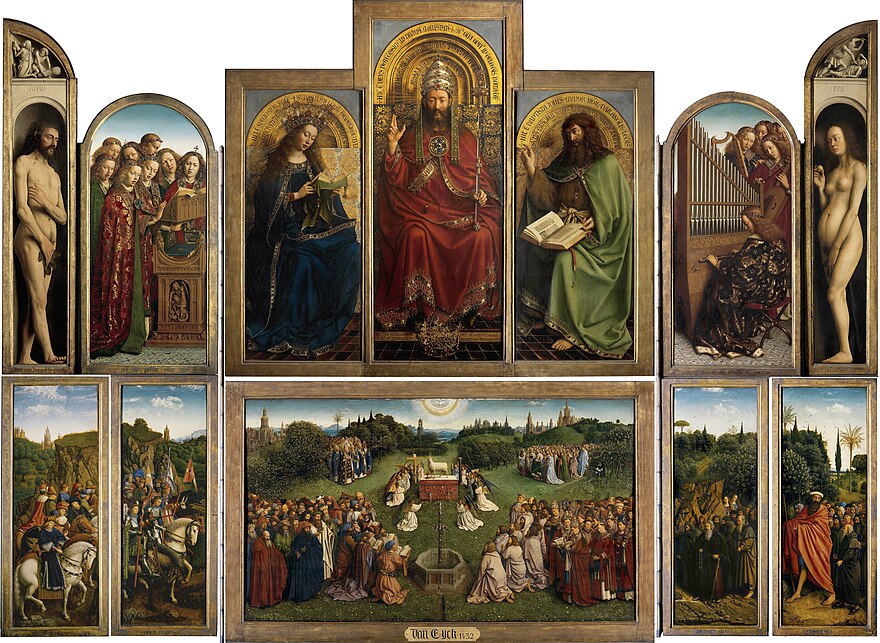
Art: Hubert and Jan van Eyck.
Ghent Altarpiece (completed 1432).
In New England, when we hear about an art thief’s confession, it makes our heart beat a little faster. That’s because we are hoping so much that the Isabella Stewart Gardner Museum heist (see where I wrote about it, here) will be solved in our lifetimes.
Today’s story, however, is about a much older art theft, equally puzzling.
Noah Charney reports at the Guardian, “Just about everything bad that could happen to a painting has happened to Hubert and Jan van Eyck’s Adoration of the Mystic Lamb (also known as the Ghent Altarpiece). It’s almost been destroyed in a fire, was nearly burned by rioting Calvinists, it’s been forged, pillaged, dismembered, censored, stolen by Napoleon, hunted in the first world war, sold by a renegade cleric, then stolen repeatedly during the second world war, before being rescued by The Monuments Men, miners and a team of commando double-agents. …
“In 1934, one of its 12 panels was stolen in a heist that has never been solved, though the case is still open and new leads are followed all the time.
“On 11 April of that year, Ghent police commissioner Antoine Luysterborghs pushed through a crowd at the St Bavo Cathedral that had gathered to gawk at something that was no longer there. One of the panels, depicting The Just (or Righteous) Judges, was gone. …
“The theft was followed quickly by a ransom demand for one million Belgian francs. As a show of good faith, the ransomer returned one of the panel’s two parts (a grisaille painting of St John the Baptist). But police remained baffled.
“Then a stockbroker called Arsène Goedertier had a heart attack at a Catholic political rally. He summoned his lawyer, Georges de Vos, to his deathbed. Just before he died, De Vos claimed, Goedertier whispered: ‘I alone know where the Mystic Lamb is. The information is in the drawer on the right of my writing table, in an envelope marked “mutualité.” ‘
“The lawyer followed the instructions and found carbon copies of the ransom notes, plus a final, unsent note with a tantalizing clue about the stolen panel’s whereabouts: ‘[it] rests in a place where neither I, nor anybody else, can take it away without arousing the attention of the public.’
“But if Goedertier did steal the panel, why? The church has been defensive, and there is an air of cover-up – as well as evidence that other members of the bishopric were involved. One theory goes that a group of church members, Goedertier among them, were involved in a failed investment scheme that lost church money. Rather than admit their failure, they stole the panel and ransomed it to cover the losses. But Goedertier was wealthy and devout; it seems odd he would resort to extorting his beloved diocese. …
“De Vos failed to alert police about Goedertier’s confession for a month. Eventually, after many false leads, police concluded Goedertier had been the thief. The case went cold. …
“The greatest strides in solving the crime have not been made by an active officer, though. Karel Mortier was chief of the Ghent police from 1974 to 1991, and fascinated with the Just Judges theft. It was a huge unsolved mystery, not just for Ghent, for Flanders, for Belgium, but for the art world. Mortier has dedicated his quiet hours to the hobby that drives him to this day: the hunt for the lost panel.
“Now in his 80s, he has done more than anyone to shed light on the case. He was the first to note that Goedertier had an eye problem that meant he could barely see in the dark, much less rob a cathedral at night. He turned up information that Goedertier already had more than the million francs demanded in the ransom in his bank account. What, then, was the motivation for stealing the panel?
“Mortier also suggested Goedertier could not have acted alone: the panel was taken from the altarpiece’s framework, which was so high off the ground that it needed a ladder, and at least two people, to remove it. Surely, Mortier concluded, one of the four church custodians was involved, if only to provide the ladder.
“Mortier’s investigation met many obstacles. The church granted him access to 600 pages of archives relating to the painting – but not the period between 1934-1945. It seemed there was either a conspiracy to hide the truth, or that those involved in the investigation, the police in particular, were wildly inept.”
More at the Guardian, here. No firewall.


 Suzanne's Mom's Blog
