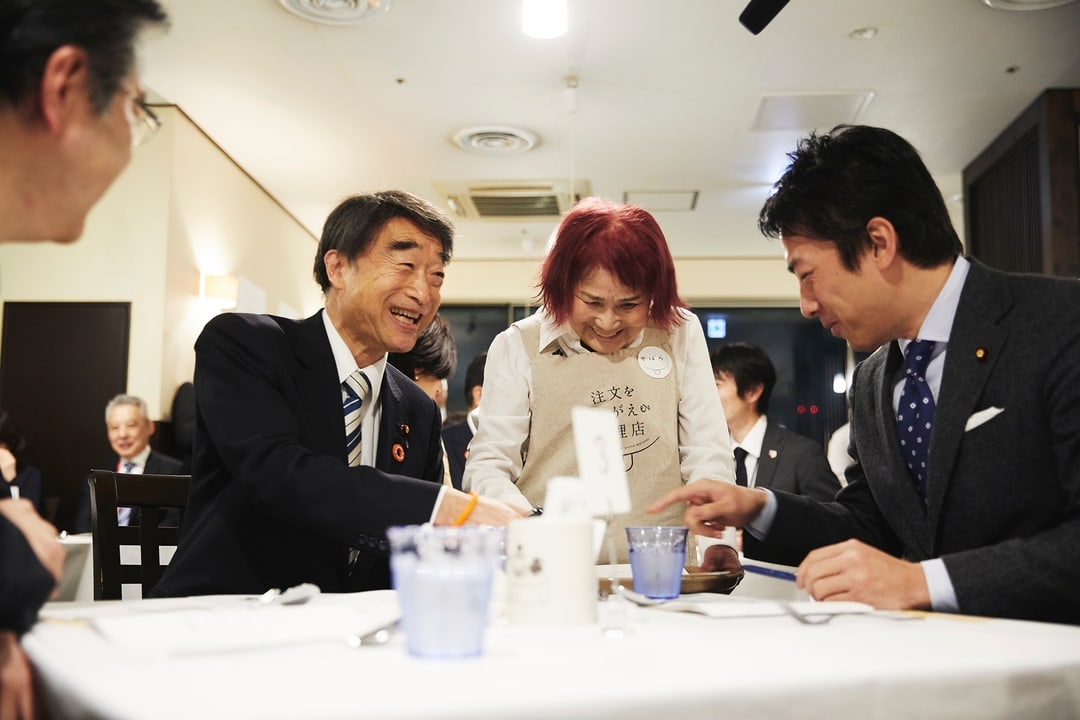
Photo: Restaurant of Mistaken Orders.
Our friend Toshi was lucky to have Yuriko to take care of his aging mother in their home. That was always the custom for daughters-in-law.
Nowadays, Japan has a greater percentage of people over 65 and not enough caregivers. So the Japanese are getting creative. Monthly “dementia cafes,” where elderly people can enjoy working, are a drop in the bucket. But charming.
Michelle Ye Hee Lee and Julia Mio Inuma report at the Washington Post, “The 85-year-old server was eager to kick off his shift, welcoming customers into the restaurant with a hearty greeting: ‘Irasshaimase!’or ‘Welcome!’ But when it came time to take their orders, things got a little complicated.
“He walked up to a table but forgot his clipboard of order forms. He gingerly delivered a piece of cake to the wrong table. One customer waited 16 minutes for a cup of water after being seated.
“But no one complained or made a fuss about it. Each time, patrons embraced his mix-ups and chuckled along with him. That’s the way it goes at the Orange Day Sengawa, also known as the Cafe of Mistaken Orders.
“This 12-seat cafe in Sengawa, a suburb in western Tokyo, hires elderly people with dementia to work as servers once a month. A former owner of the cafe has a parent with dementia, and the new owner agreed to let them rent out the space each month as a dementia cafe. The organizers now work with the local government to get connected to dementia patients in the area. …
“ ‘It’s so much fun here. I feel like I’m getting younger just being here,’ said Toshio Morita, the server, who began showing symptoms of dementia two years ago.
“A condition of unending indignities and financial burdens, dementia is a global phenomenon that every society is confronting. But in Japan, the world’s oldest society, dementia is a pressing national health challenge.
About 30 percent of the Japanese population of about 125.7 million is over 65. More than 6 million Japanese people are estimated to have dementia, and the number is expected to grow as high as 7.3 million — or 1 in 5 people over the age of 65 — by 2025, according to the Health Ministry.
“Japan’s chronic lack of caregivers and the soaring costs of elderly care mean it needs to find creative ways to empower these dementia patients so that they can be mentally and physically active for as long as possible, rather than isolated at home or at a hospital.
“Dementia cafes [were] introduced in Japan in 2017 through pop-up events, but more permanent efforts are now cropping up throughout the country.
“In June, Japan passed legislation to enact a slew of new programs and services to help those with dementia, which Prime Minister Fumio Kishida has identified as an urgent national project. …
“Kazuhiko, a 65-year-old diagnosed with dementia five years ago, has been working at the cafe every month. … At one point, Kazuhiko was heading to a table with an order but became distracted when the construction crew outside made a loud noise. He proceeded to leave the cafe and move toward the sound, and the staff rushed to bring him back in. …
“Kazuhiko rarely talks or shows emotion anymore. He usually doesn’t make eye contact with customers until he sees them multiple times. But that day, he showed a smile.
“The smile was directed at Tomomi Arikawa, 48, and her 16-year-old daughter, Sayaka, who visited around noon for a piece of chiffon cake and a citrus jelly dessert. … Kazuhiko brought them their orders. Sayaka thanked him and smiled, and he smiled back. ‘It felt really special,’ she said. …
“Since April, the Cafe of Mistaken Orders has opened once a month around lunchtime. One dementia patient works as a server per hour, wearing an apron that is bright orange, the color associated with dementia care. There is a chair set aside for them near the kitchen so they can rest in between orders.
“Younger volunteers help the elderly servers as they mark customers’ orders on the order forms, which are simple and color-coded.
“Table numbers were difficult for the elderly to remember, so the staff switched them out for a centerpiece with a single flower, a different color for each table.
“The cafe’s administrators wanted to help the community see that dementia patients can prolong their active years, with a little bit of understanding and patience from those who interact with them. …
“ ‘I hope that our initiative will give people with dementia something to look forward to,’ said Yui Iwata, who helps run the cafe. ‘If people get a deeper understanding, it would become easier for people with dementia to go out, as well.’ ”
More at the Post, here. Or just check out the restaurant’s site, here.

 Suzanne's Mom's Blog