Feeds:
Posts
Comments

Posts Tagged ‘mitigation’

Photo: Inside Climate News.
Children play with a water fountain at a park in flood-prone Hoboken, New Jersey. The playground doubles as storage for stormwater runoff.

Yay for humans who come up with ingenious ways to mitigate the effects of climate change! Here’a a clever idea from Hoboken, New Jersey.

Victoria St Martin reports at Inside Climate News (via the Guardian), “For a city that is almost small enough to fit inside Manhattan’s Central Park just a few miles away, a lot of history has played out within the narrow borders of Hoboken, New Jersey.

“It was the site of the first organized baseball game in 1846, home of one of the US’s first breweries in the 17th century and the place where Oreo cookies were first sold in 1912. And, as any Hobokenite will tell you, the Mile Square City, as it is called, is also known for something else.

“ ‘Everything floods up here,’ Maren Schmitt, 38, said with a nervous chuckle on a Tuesday afternoon as she watched her two boys climb at a city playground.

“Nearly four-fifths of the land area in Hoboken – which sits on the western banks of the Hudson River – rests on a flood plain. And its intense susceptibility to flooding has probably never been more apparent than it was during Hurricane Sandy in 2012, when 500m gallons of storm surge flooded the city.

“But now … Hoboken officials have put in place a series of measures designed to mitigate the destructive effects of storms that are driven by climate change, including one innovation that the city hopes may become known as another Hoboken first.

“Located at the corner of 12th and Madison streets, one of Hoboken’s newest playgrounds, known as ResilienCity Park, [is] doubling as a storage area for roughly 2m gallons of stormwater runoff. …

“The park, which sits on five acres barely a mile and a half from the Lincoln Tunnel into Manhattan, features swing sets, slides, a basketball court and an athletic field – and, underneath it all, a below-ground tank capable of holding hundreds of thousands of gallons of stormwater that city officials say would have otherwise spilled on to the streets or streamed into the basements of Hoboken homes and businesses.

“Building climate-resilient – or climate-smart – playgrounds is part of a growing movement among municipalities and environmental advocacy groups in the US. … The Trust for Public Land, a nonprofit conservation group, estimates it has helped fund the construction of more than 300 such play spaces in communities around the country, including Philadelphia, New York and Los Angeles. …

“Some spaces, like those in Hoboken, utilize an underground tank, porous artificial turf and scuppers or openings on a basketball court to store excess stormwater. Others increase resilience with newly planted trees that can absorb carbon dioxide and airborne pollutants; once they mature, those trees also provide shade cover that can reduce the heat island effect of urban areas, a problem intensified by the traditional black asphalt playgrounds commonplace generations ago. …

“ ‘Every geography is going to have slightly different stressors,’ [Daniella Hirschfeld, an assistant professor at Utah State University who studies environmental planning] said. ‘Hoboken is a place that used to be an island. And the amount of water that it needs to store is very different than where I am here in Utah. But ultimately, you know, places can perform both as a safe haven for stormwater and, hypothetically, can even be a safe haven for fire, which is another threat that we’re facing.’

“Caleb Stratton, Hoboken’s chief resilience officer, recalls how city officials asked him to lead the rebuilding and recovery efforts after Hurricane Sandy. The park, one of four planned resiliency sites in the city, was primarily paid for with infrastructure replacement grants, including roughly $10m from the Federal Emergency Management Agency. Stratton said a key element of the park’s design was its multipronged approach to flood mitigation.

“ ‘It’s a park, stormwater pumping station, the whole thing,’ Stratton said during an interview at the park while a cluster of summer campers squealed on a playset nearby. ‘This is all the strategies mixed up into one.’ …

“In addition to the underground stormwater detention tank, which holds 1m gallons of water, Stratton said above-ground infrastructure including rain gardens could hold a million more. An above-ground pump can also send water back into the Hudson.

“ ‘What we’re doing is creating places for the water to go so that we can manage it and keep it off the streets, keep it out of people’s buildings, and get prepared for the uncertain future, which we’re kind of experiencing in real time.’ …

” ‘They need more like this, for sure, so the kids can get outside,’ said Tyrik Davis, 26, a resident of nearby Fairview, New Jersey, who was visiting the park with his children, Naylani, six, and Tyrik Jr, three. ‘Especially this generation. There’s no more kids at the parks. They’re all inside with their phones.’ ”

More at the Guardian, here. No paywall.
Read Full Post »

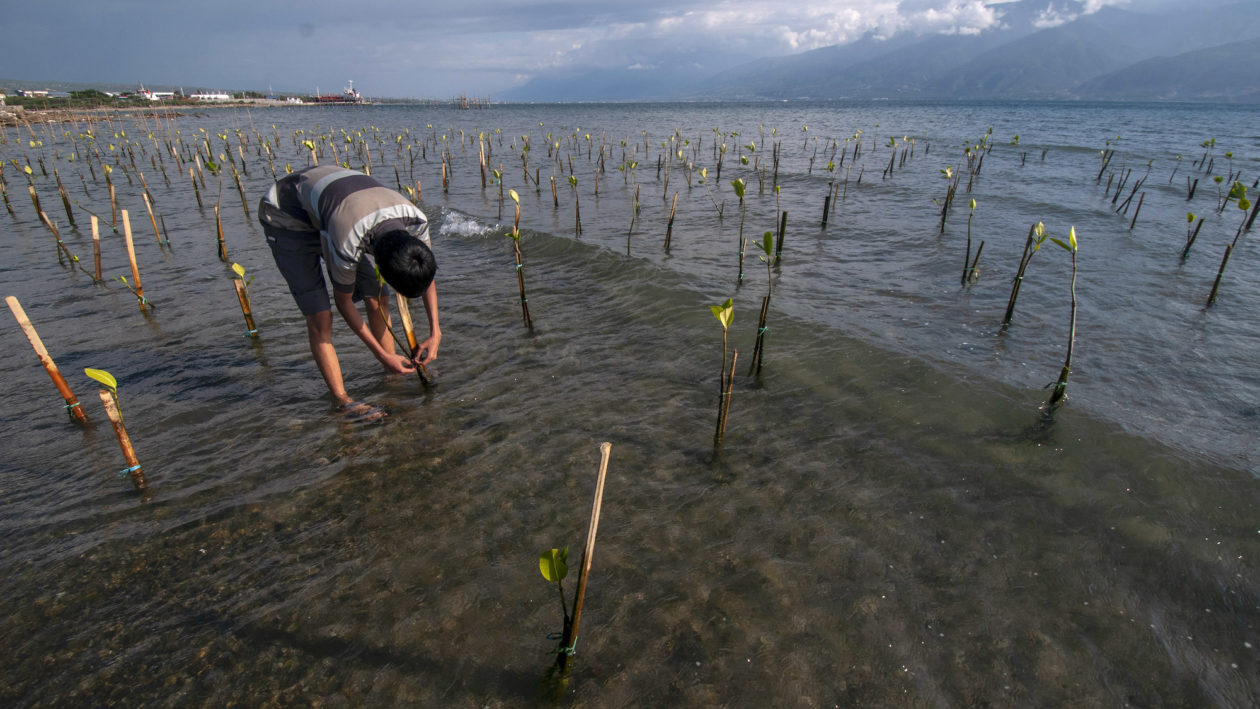
Photo: Basri Marzuki/Nurphoto via Getty Images.
A volunteer ties a newly-grown mangrove to a stake on Teluk Palu Beach, Indonesia. A science writer asks, Is international funding shortchanging nature-based climate solutions like this?

Here’s something to think about. As we try to remedy damage to the environment, are we overlooking the power of small steps that add up and instead favoring big-deal engineering approaches?

Fred Pearce at YaleEnvironment360 suggests we are indeed. “On the low-lying northern shore of the Indonesian island of Java,” he writes, “the sea has invaded a kilometer inland in places in recent years, engulfing whole communities and vast expanses of rice paddy. But villagers are fighting back against further advances by erecting brushwood barriers in the mud to help the natural regeneration of mangroves.

“This innovative nature-based response to rising sea levels and worsening storms, sponsored by the Indonesian government and the Dutch-based environmental group Wetlands International, could be scaled up across Asia. Within a decade it could be helping at least 10 million people in similar situations to protect and restore their denuded coastlines — all at a fraction of the cost of sea walls, says Jane Madgwick, CEO of Wetlands International.

“But it can do that only if local projects are developed and the financing secured. And so far, she says, progress has been slow. …

“There are a ‘growing number of analyses and reviews of the effectiveness of habitats as natural defenses,’ writes Siddharth Narayan, now of East Carolina University. Hundreds of local projects to restore ecosystems on coastlines and mountains, in river valleys, forests, and grassy plains, have proved their worth in using restored nature to boost the resilience of millions of people to the ravages of onrushing climate change. Most are cheaper and more effective than any engineering alternatives, with more spinoff benefits for ecosystems and fewer downsides.

But the political will and funding that could turn pilot projects for nature-based climate adaptation into policy norms benefitting hundreds of millions more people are still largely absent.

“Most nature-climate activities ‘are currently not funded,’ says Ebony Holland, climate researcher at the London-based International Institute for Environment and Development. …

“Nature-based climate adaptation remains the poor relation of climate finance. First, that’s because private investors, philanthropists, aid agencies, and development banks are usually happier to pay for climate ‘mitigation’ projects that curb emissions of planet-warming gases than for helping communities adapt to climate change. Overall, adaptation of all kinds has so far attracted less than a quarter, and by some measures only 5 percent, of international climate funding, according to Barbara Buchner of the Climate Policy Initiative, a San Francisco-based think tank.

“And second because policymakers and funders still mostly prefer engineering solutions. Holland found that less than 10 percent of funding for climate adaptation in the least-developed nations — which are usually the most vulnerable — went into projects that harnessed nature. The remaining 90 percent ‘poured concrete.’ …

“Overall, the UN Environment Programme and the Global Commission on Adaptation, an international body set up by the Dutch government, both estimate that about 1 percent of total climate finance has so far gone toward such nature-based adaptation projects.

“Governments in Glasgow promised to close the funding gap between adaptation and mitigation by doubling adaptation funding. [In April] climate finance chiefs from leading funding governments met in Lahti, Finland, to discuss how to achieve this. But official reports of the meeting record little discussion of the need for more nature-based projects. Instead, the main topic was to ‘seek ways to give the private sector a bigger role in adaptation finance.’

“This could be a step back for nature since, in the past, private financiers have been even less keen on nature-based solutions than public-sector donors, says Madgwick.

“The casebook of successful nature-based adaptation is growing fast. Perhaps best documented are the benefits from restoring coastal ecosystems such as mangroves to protect coastal communities from storm waves, tidal surges, and rising sea levels, which are all increasing as climate change gathers pace.

“The world has lost half its mangroves along shorelines, but those that remain are protecting some 18 million people and several tens of billion dollars’ worth of property from flooding every year, says Michael Beck, a marine scientist at the University of California Santa Cruz. Their importance can only grow. Unlike sea walls, mangroves appear to keep pace with rising sea levels, self-seeding inland to maintain their barriers against storms and tidal surges and nurturing marine fisheries.

“The island nations and river deltas of Asia would benefit most from their restoration, but a study by the World Bank and The Nature Conservancy found great potential too in African countries, including Guinea, Mozambique, Sierra Leone, Madagascar, and Guinea-Bissau.

“The restoration of other coastal ecosystems can be equally effective. A review by Narayan of 52 such projects around the world found that salt marshes, sea grasses, and coral reefs all reduced the height of storm waves at typically between a half and one-fifth of the cost of sea walls. Yet scaling up is failing to keep pace with the success of pilot projects. …

“In parts of the Panchase mountain region of Nepal, a favorite with foreign trekkers, the restoration of wetlands and community ponds is protecting local communities against both worsening floods and droughts, while improving soils, revitalizing biodiversity, and encouraging tourism. It is part of a three-nation project known as the Mountain Ecosystems-based Adaptation Program devised over a decade ago by UN agencies and implemented in remote corners of Nepal, Uganda, and Peru.

“But despite ambitious plans for new projects in neighboring Bhutan, Kenya, and Colombia, scaling up remains elusive. Communities in most mountain regions stressed by climate change are plagued by dam projects that extract their water for use downstream, rather than being helped to conserve their water and improve their climate resilience. …

“[Nathalie Seddon of the Nature-Based Solutions Initiative, an interdisciplinary research center at the University of Oxford] says nature-based adaptation can simultaneously help meet the three great challenges of our time: responding to climate change, protecting biodiversity, and ensuring human well-being. But right now, the opportunities for delivering these synergies are still going begging.” 

More at YaleEnvironment360, here. No firewall.

Read Full Post »