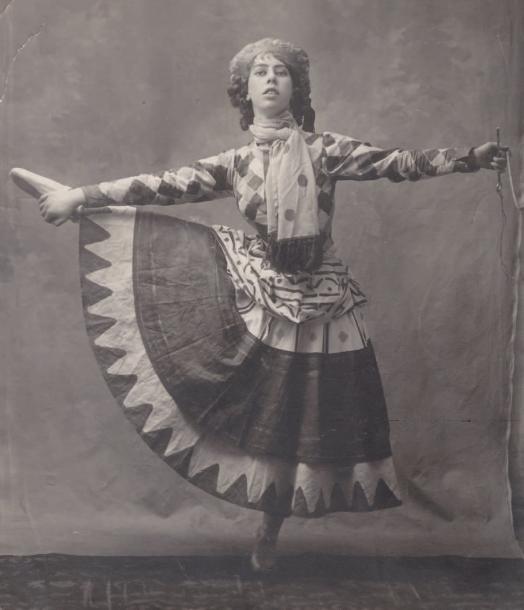
The great ballerina and choreographer Bronislava Nijinska performing in Stravinsky‘s Petrushka.
A sweet text message and a post on Facebook from my mentee reminded me early this morning that it’s International Women’s Day. With her example of accomplishment — and Suzanne’s and my daughter-in-law’s — an old-fashioned grandma like me is starting to pay attention to the issues behind the need for an International Women’s Day.
It isn’t news to me, of course, that women have long taken a back seat, but I have “leaned in” to the idea that one can make a virtue of invisibility. I’d make a good spy.
Even so, I feel a bit outraged that I’d never heard of the subject of today’s post, only her famous brother. Nadia Beard at the Calvert Journal enlightened me.
“Dancer and choreographer Bronislava Nijinska, a Minsk-born Pole, was an instrumental force in redirecting the choreographic cannon towards a vision of process and motion. Despite her pioneering choreography, Nijinska’s legacy is often overshadowed by that of her brother, ballet dancer and choreographer Vaslav Nijinsky. …
“The Nijinsky name, however, does not belong to him alone. In an era where static positions were the marrow of classical dance, Nijinska envisioned a modernist ballet, one which saw focus shift towards the movement which connected these positions.
Ultimately, she believed it was not the final posture that encapsulated the beauty of ballet, but the spaces in between.
“The daughter of two Polish dancers, Bronislava Nijinska was born in Minsk on 8 January 1891, and accompanied her parents to shows across provincial Russia even as a baby. It was through their parents that both Nijinska and her brother, Vaslav, first absorbed dance, learning movements outside of ballet’s traditional canon — Polish folk steps danced by her parents and acrobatics from the circus performers they met on their travels — which would influence the subversive, minimal choreography of their later years.
“Later in life, Nijinska’s contributions to performance and choreography would be dominated by her brother’s, but at the turn of the century, the pair both joined the Imperial Ballet School in St Petersburg, briefly graduating from the Imperial Ballet (now known as the Mariinsky) in 1908 before leaving together for Paris to join the Ballet Russe.
“The radical, itinerant ballet corp, founded by Russia-born arts impresario Serge Diaghlev, became legendary, a crucible for the radical performance that encapsulated the strange daring seen across the artistic spectrum of the time.
“Nijinska helped her brother choreograph some of the Ballets Russes’ earliest controversial works: L’Après-midi d’un Faune, premiered in Paris in 1912, and 1913 ballet Le Sacre du Printemps. Marriage and pregnancy precluded Nijinska from starring in some of Diaghlev’s ballets, much to the dismay of her brother, but where her brother’s creative life was cut short by deteriorating mental and physical health, Nijinska’s endured alongside family life, until she had made her mark on both sides of the Atlantic. …
“Her 1920s treatise on ballet, The School of Movement (Theory of Choreography), now lost to posterity, foregrounded the idea that movement is the essence of dance. Today this seems an obvious point, but it is so only because of the legacy of fringe luminaries like Nijinska; in early 20th century Europe, movement in dance was largely auxiliary, used in service to the final aim of achieving a complete position which could be held and admired. For Nijinska, motion became more important.”
More at the Calvert Journal, here, where you can watch a video of Nijinska’s dark choreography for Stravinsky’s Les Noces. Talk about women’s issues!




 Suzanne's Mom's Blog
