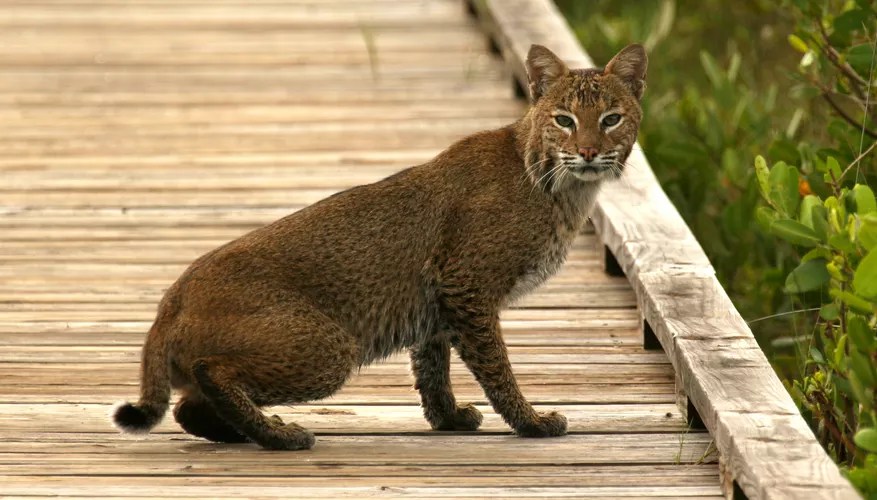
As boa constrictors from Latin America increase in Florida, bobcats that love boa eggs may help to keep them in check.
Story lovers of a certain age assume that the champion snake challenger of all time is the mongoose — to be precise, a brave cobra-fighting mongoose in India called Rikki-Tikki-Tavi.
But in Florida, where non-native boa constrictors are increasing, other snake predators are gaining attention. Recently, scientists were surprised to learn that one of them is the bobcat.
Matt Kaplan reports at the New York Times, “The voracious appetite of the invasive Burmese python is causing Florida’s mammal and bird populations to plummet. With little natural competition to control the big snake’s numbers, the situation looks desperate. But new observations suggest that the bobcat, a wildcat native to Florida, might be able to help.
“A team of ecologists collected evidence recently of a bobcat devouring python eggs in the Big Cypress National Preserve in Florida, and last month reported their findings in the journal Ecology and Evolution. It’s hard to say whether this individual cat was more adventurous than the average bobcat, but it suggests one potential way the python’s proliferation could be limited — by other animals eating their unhatched young.
“The event was captured by a motion sensitive camera that a team led by Andrea Currylow, an ecologist at the U.S. Geological Survey, deployed in June 2021 near the nest of a large female Burmese python. The camera had been put in place to better understand the reproductive biology of these huge snakes. A few hours after installation, the snake slithered away and the camera snapped shots of a bobcat arriving and eating python eggs during the early evening. …
“Apparently the feline decided that it rather liked what it had found because it came back for another snack three times that night. The next morning the bobcat returned to cache uneaten eggs in the ground to consume at a later date. That evening the bobcat returned again, but, this time, the python was back on her nest. Weighing about 20 pounds, the feline was clearly aware that the 115-pound python posed a serious threat and, rather than trying to eat more eggs, it padded around the nest at a safe distance for a few minutes before leaving.
“The next night the camera took a photo of the two predators in a face-off. Apparently, the bobcat felt the clutch was worth fighting for because it returned in the morning and aggravated the python enough to prompt an attack. …
“Precisely how the duel ended is unclear but when the researchers arrived that evening to collect the camera, they found the snake sitting on a badly damaged nest.
“ ‘We thought the snake must have caused the damage herself by somehow crushing her own eggs,’ Dr. Currylow said, ‘but then we saw the photos and, well, it was just incredible.’ …
“While it is possible that this interaction was just an isolated incident, it is also possible that native species are beginning to respond to the presence of the python. …
“Reptile eggs are already a part of the Florida bobcat diet. Bobcats are known to eat sea turtle eggs, and these may have similarities to python eggs. …
“Of course, the big difference between python nests and those of sea turtles is that the snake nests are usually guarded. But Dr. Currylow also points out that female pythons typically go without food until their eggs are about to hatch. That might be the main reason the bobcat survived its adventure.”
We’ll see. The boa may adapt, too. I remember how the mother cobra, Nagaina, felt about her eggs in the Kipling story.
More at the Times, here. For more on the boa invasion, check out the Smithsonian, too.


 Suzanne's Mom's Blog