Feeds:
Posts
Comments

Posts Tagged ‘monotype’

A collection of fonts from Nap Time Alternative.

When I was a kid and my father was a reporter for a Rockland County paper called the Journal News, he took me once to see how type was laid for printing. The newspaper was still using metal type. The typesetter explained how he had to think “mirror image” for the words to come out right when printed. I have been interested ever since.

The days of metal type are gone except among artisans, but the topic of type is still interesting to me. Sara Friedman at Hustle has a story on some new fonts and the struggle of independent “foundries” to get visibility.

“Ten years ago, Cindy Thomason was walking down the stairs at home when she heard her phone ring.  On the other end was an executive from Warner Bros. Entertainment, calling to let her know that a font she designed would be featured in the upcoming blockbuster adaptation of the Great Gatsby.

“ ‘I had to sit down,’ Thomason says. ‘I’m just somebody who decided to design a font on a whim.’

“A nurse in suburban Virginia, Thomason began tinkering with fonts in her free time using a software package she bought for $100. She’d listed the font, which she named Grandhappy, on an online marketplace called MyFonts

“That’s where producers from Warner Bros. found it, and bought it to use as Jay Gatsby’s handwriting in the 2013 film.

It should have been a dream come true, a big break for a hobbyist font designer. But Thomason’s cut for her design’s feature-film cameo was a whopping $12 — not even enough to recoup what she paid for her design software. 

“Thomason’s story isn’t an anomaly. … With 4.5k independent artists selling on MyFonts today, many struggle to attract customers and to make a living in an oversaturated market.  

“It’s only getting harder, as designers must compete with and abide by the terms of one company that’s approaching behemoth status: Monotype. The company owns not only many of the world’s most popular fonts but also exchanges like MyFonts where font designers bring their work to market. 

“The industry is inching toward a monopoly, and it’s leaving independent designers with fewer places to go. …

“Monotype arrived at the end of the 19th century. The company was founded in Philadelphia by Tolbert Lanston, whose monotype machine invention allowed for increased speed and efficiency when producing type. Over the next few decades, Monotype, by then with branches in the US and the UK, developed popular typefaces such as Gill Sans, Perpetua, and Times New Roman. 

“In the last half of the 20th century … the mechanized process of Monotype’s signature machine faded out, replaced by phototypesetting and then digital typesetting, bringing fonts to screens. …

“Monotype [went] public with stock-ticker name TYPE in 2007. The retooled Monotype saw its annual revenues climb from $107m in 2010 to $247m in 2018 and became a powerhouse. …

“Monotype has claimed its purchases made life better for customers, who only have to navigate a licensing agreement from one company to access a bevy of fonts. But one font designer believed the acquisition of Hoefler & Co. felt like ‘a kraken eating up the industry.’

“MyFonts is known in the industry for being the gold standard for audience reach. Ellen Luff, who runs Ellen Luff Type Foundry and whose Larken font (starting at $42) is a MyFonts bestseller, told the Hustle there’s little choice but to use the site.

“ ‘When you’re independent, you’ve got your freedom, which is great. But then you have to balance being overlooked.’ …

“The power of Monotype and MyFonts isn’t the only obstacle for independents. Luff has spotted her fonts being used by corporations such as Apple and NASA, sometimes without her permission.  Luff says half of her clients come from retrospective licensing agreements made after she’s found her designs being used illegally. But going up against large companies is no easy feat for independent designers who have no legal teams to support them in negotiations.”

More at the Hustle, here. No paywall. Interesting pictures.

Read Full Post »

Facebook can be annoying, but I guess it does sometimes pay to be on it.

After “liking” a number of my cousin Sally Frank’s nature photos and art over the years, I finally figured out via Facebook that much of her work is on a WordPress blog — and she has had the blog longer than I have had this one.

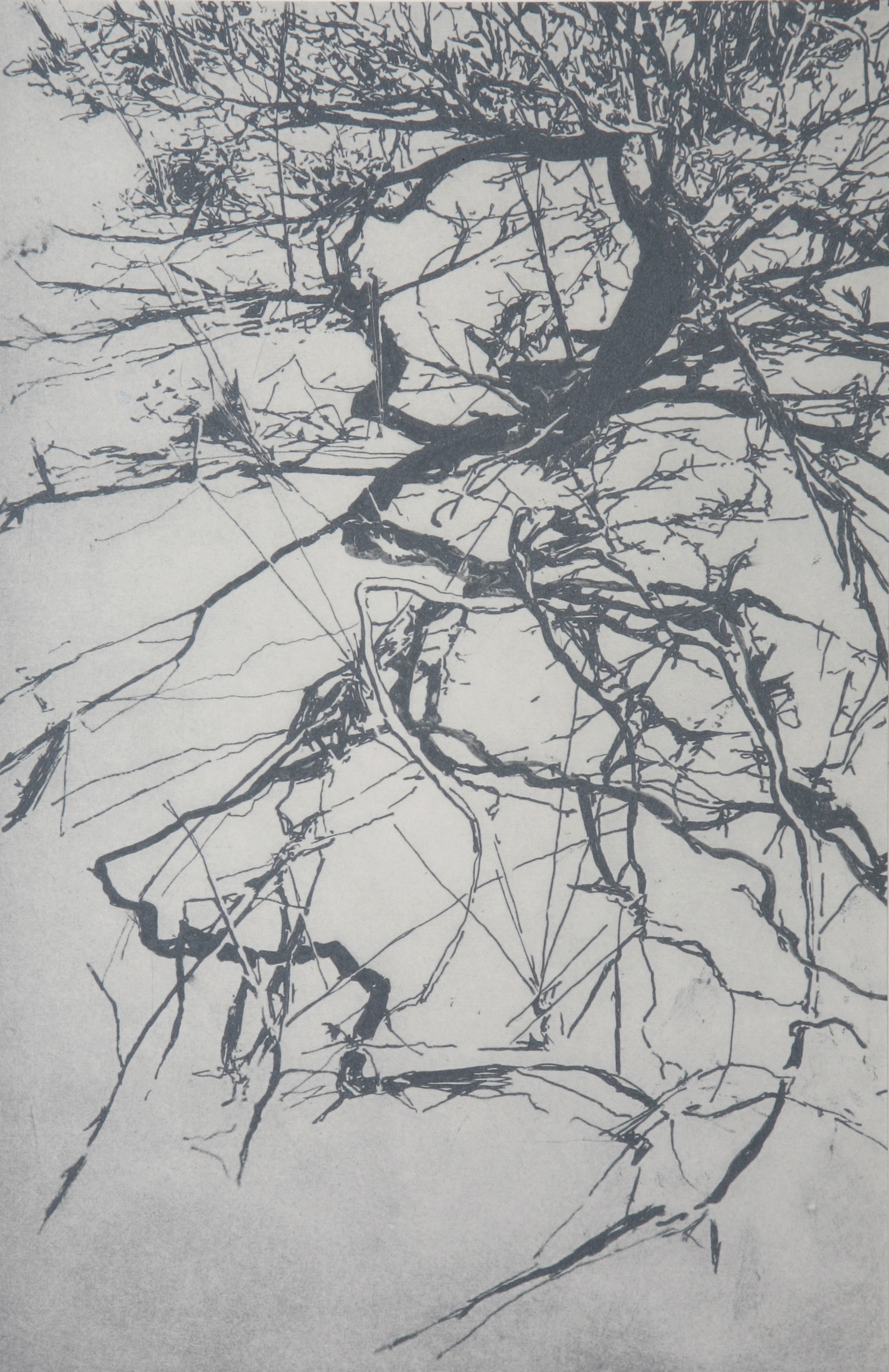
Trees are a specialty. Often she will start with a photograph like the one below for inspiration. She then turns to printmaking, which you can learn about at her blog.

“Ms. Frank uses centuries-old printmaking techniques like etching and aquatint on copper plates, as well as innovative methods like solarplate intaglio. She says that although her work is grounded in drawing, she finds the unpredictable nature of printmaking inspirational and exciting.” More.

This photo reminds me of the strangler fig that I saw years ago in Costa Rica, a tree that wraps itself around a host and literally loves it to death. The host tree crumbles, and only the strangler is left — with an empty space inside.

Sally’s photo probably has a happier story — perhaps a nymph turned into a tree to escape danger.

Photo called “bound”: Sally Frank

Read Full Post »

She doesn’t do only trees, but she knows trees inside and out.

Katherine Pacchiana has a nice update in the Daily Voice, a newspaper in North Salem, New York.

Sally Frank was in the middle of the Maine woods as she talked, via cell phone, about her collection of tree art, now on display at the Ruth Keeler Library.

“ ‘Most of what I do is make prints,’ she explained. ‘Unfortunately, I have a day job, but I like to do monotypes which are spontaneous and don’t take a long period of time.’ Monotypes are a form of prints, dating back to the 17th century. Each is made individually.

“Frank has been drawing all her life and has trained in many places, including Simon’s Rock in Great Barrington, Mass., and Long Island University, where she earned a master’s in fine arts. At the age of 19, she was apprenticed to Tom Bostelle, the American painter and sculptor who was a colleague of Andrew Wyeth.

“ ‘I’ve always drawn trees and the natural landscape. I went from focusing on the architecture of a tree – its sturdy trunk and the strong presence it has on the landscape – to what is left when a tree dies away and leaves forms behind.

“ ‘I’m fascinated by the texture and light that trees create, the  patterns – a tree’s essence.’ ” Read more.

Today I happened to be in Great Barrington for a work conference on affordable housing in rural areas. It was my first visit since Sally’s parents’ wedding, which I remember as being in a Unitarian church. I was hoping to get a picture I could post, but I saw only St. Peter’s and the Congregational church.

The Red Lion Inn in Stockbridge looked vaguely familiar, and I wondered if that was where we were staying when my father, as best man, realized he’d forgotten the wedding ring and raced back to fetch it while Uncle Jim paced anxiously, muttering words I recall as, “He always does this”!

Read Full Post »

The first art opening of the season at Jessie Edwards Studio is great not only for the art but for catching up with friends after the long winter.

I greeted David and asked why he hadn’t been at the 350th anniversary festivities, given that his family goes back so far on the island. He said he had been putting in lobster pots that day. He has put in 30 this year. Last Saturday he pulled 11 lobsters, which he doesn’t think is much for 30 pots. His extended family eats them all.

Another friend is writing a biography of his parents, which he intends to self-publish. He hopes the cost doesn’t keep him from getting the words that he wants on his tombstone: “I broke even.”

Given the crowds at openings and all the catching up, you have to be pretty determined to see the art. I nudged my way through temporary gaps and checked out everything.

Kathleen Noonan Lang was showing her island monotypes. See them here. I especially liked her “Sailor’s Delight,” with its rosy evening sky reminiscent of the weather rhyme “Red sky at night, sailor’s delight.”

When my cousin Sally had a show of her monotypes in Connecticut, I asked her to describe her approach. She wrote:

“To make a monotype, you basically create an image on a sheet of plexiglass and run it through a press. There are dozens of techniques but my tools of choice are primarily paper towels and Q-tips; very sophisticated. I roll on a layer of ink on the plate and then push it around with the paper towels and Q-tips, run it through a press and then work on the plate again and print another layer. Often I’ll develop several prints at one time, working on the ghost impression left over on the plate, rolling on a transparent base to raise the viscosity of the remaining ink (as my father would have said), and print it again. That’s the short version. Most of my monotypes have 3-4 layers. It is a very exciting process and there is always an element of surprise as when the paper is pulled from the plate.”

I like that sort of surprise.  It’s kind of like writing a blog post and being surprised by where your train of thought leads you. In playwriting class we are encouraged to surprise ourselves that way.

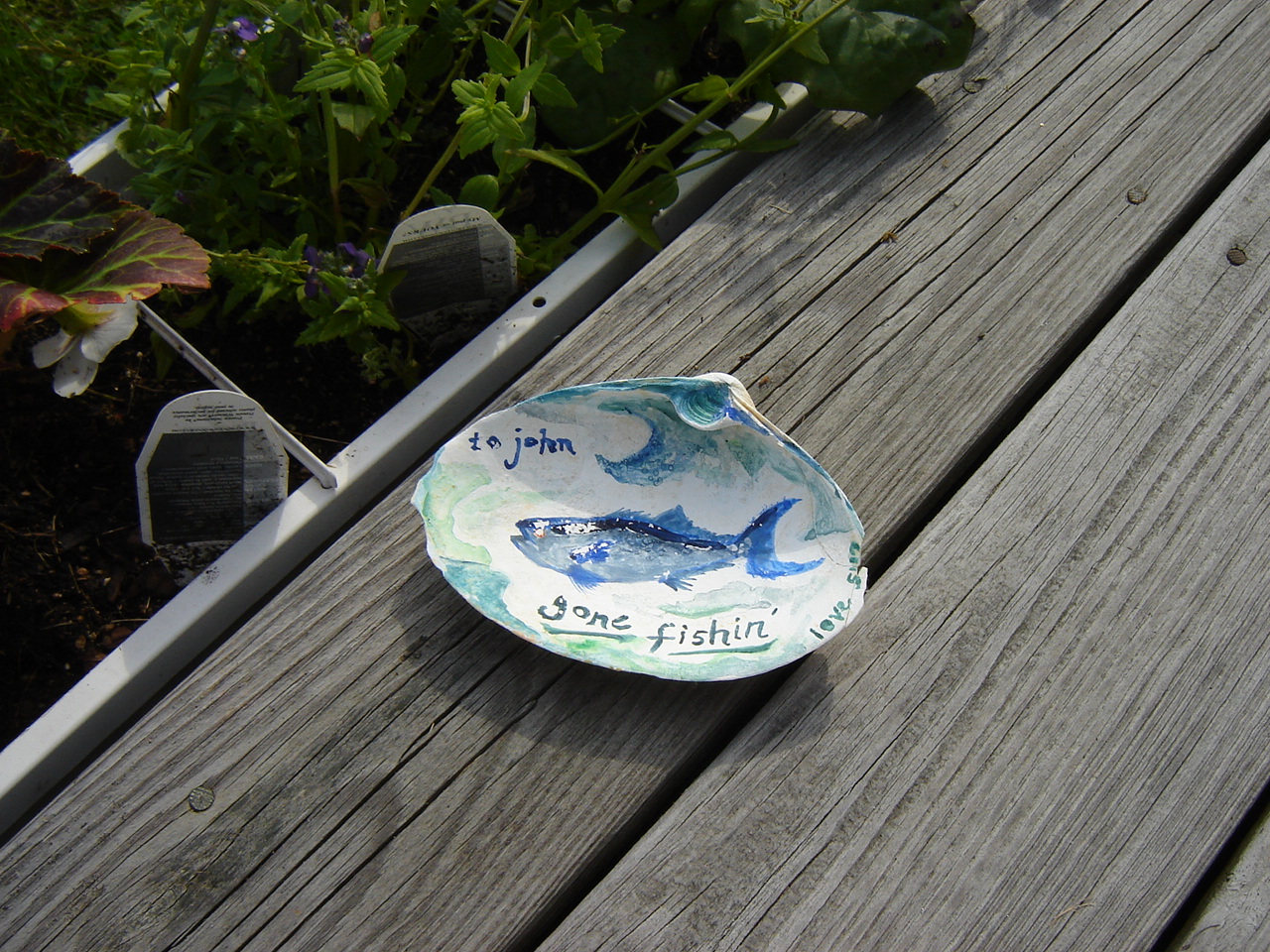
I wanted to include some clay art from Suzanne here, but she says she hasn’t been taking pottery long enough to have anything to display. Her brother said, “How about the shell she painted for my birthday?”

Read Full Post »

I think that my cousin Sally has been an artist ever since she first picked up a crayon.

Today she works in monotype and other advanced media. Her work has appeared in solo and group shows. Read about the current one in Lakeville, Connecticut, here.

Sally has become a bit of an expert in beautiful, bare trees and branches. Whether or not this focus has anything to do with my Uncle Jim having been a supreme gardener and nature aficionado, I am not prepared to say, but if you read about Sally Frank here and look at some of her art, you will likely find that the trees speak to you in their subtle tree language.

Here Sally captures the intricate expressions of a beach plum bush.

Also, a lovely crabapple with a serene Asian vibe.

Read Full Post »