Feeds:
Posts
Comments

Posts Tagged ‘namibia’

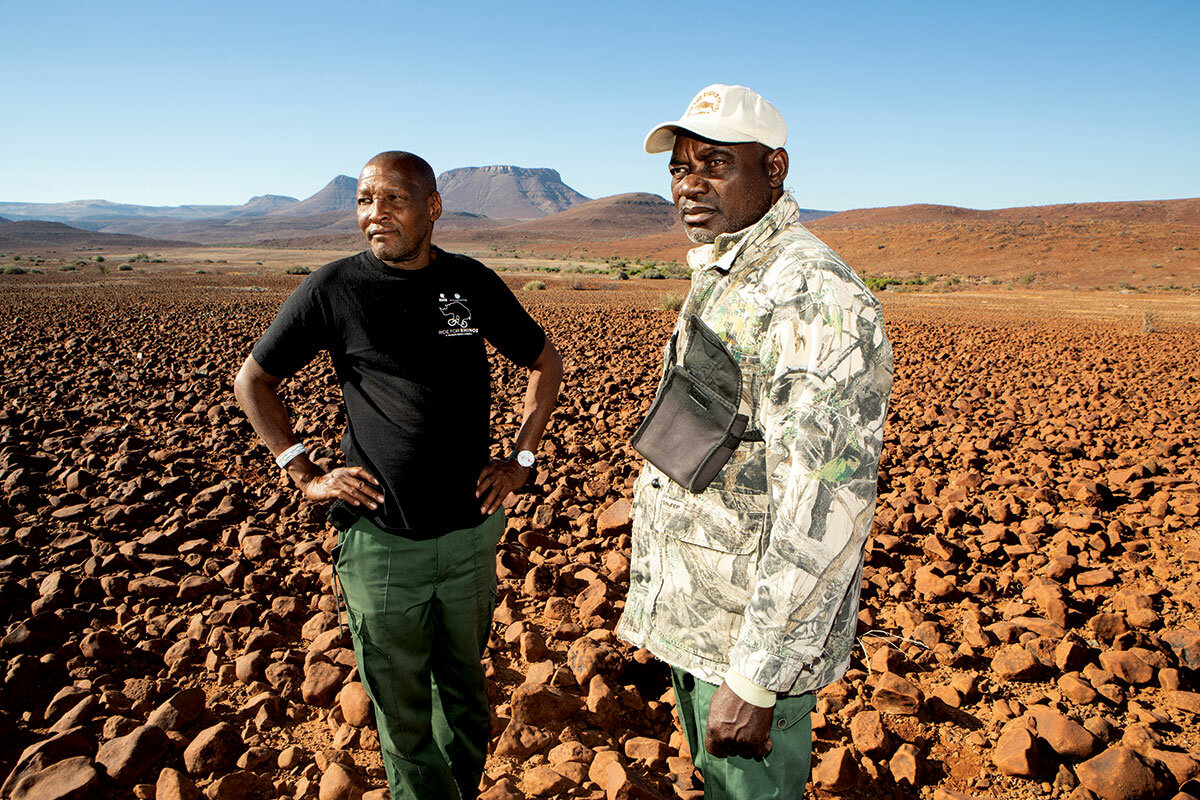
Photo: Melanie Stetson Freeman/CSM.
Ebson Mbunguha (right) and Sebulon Hoeb track endangered black rhinos in the Torra Conservancy near Palmwag, Namibia.

On Facebook and Instagram this past week, I’ve been following the adventures of an intrepid high school classmate who is in Africa for up-close and personal encounters with lions and elephants. I’m impressed at what a good traveler she is at our age, when I would be stressing over the time change, Covid exposure, what foods I can digest — every little thing. But, oh, the wonders she is seeing in Tanzania!

Today’s article is about one African wonder, the threatened black rhino. The people of Namibia truly love their rhinos and are doing all they can to protect them.

Sara Miller Llana writes at the Christian Science Monitor, “The rhino trackers trek a mile into the open desert plains of northwest Namibia. They stop 300 feet from a desert-adapted black rhinoceros grazing on the rocky hillside.

“Rhinos have poor eyesight, so the windy day works in the trackers’ favor, making it harder for the animals to locate them by sound or smell. Sebulon Hoeb, the principal field officer of Save the Rhino Trust Namibia, wants to get closer, but his partner today, Ebson Mbunguha, has his binoculars trained at the distance. He tells the group to back away. He has identified this rhino: Matty 2. She is 4 years old, which means her mother probably has a new baby and could appear on the open plain at any moment. There are no trees to climb if the crew is suddenly surrounded by creatures that can weigh as much as 3,000 pounds. Plus, they’ve identified her. Their job is now done. 

“Every day and every night, trackers from Save the Rhino Trust, alongside rangers from the local community, patrol 25,000 square kilometers (just under 10,000 square miles) in Namibia’s northwest, the only place in the world where this desert-adapted subspecies of the black rhino is still truly wild. Even if these animals are spotted from a distance, the trackers know them so well that they can identify them from their behaviors, roaming patterns, and physical features like birthmarks. It’s all documented on small pieces of paper that pile up back at Save the Rhino Trust headquarters in the pinprick of a town, Palmwag.

“The trackers are not just building a living database of conservation or scientific study; patrolling is the best tool they have against rhino poaching. And the work is paying off. 

“Rhino conservationists discourage publishing the price of horns on the black market, in order to deter criminal activity, but rhino horns are in high demand, especially in China and Vietnam. After years of successfully clamping down, Namibia saw rhino poaching increase by 93% last year over the year before, according to the Ministry of Environment, Forestry and Tourism. But here the community hasn’t logged a rhino poaching in three years. That’s because, within the structures of Namibia’s community conservation model, safeguarding the animals is more lucrative than selling them on the illegal market. …

“The desert-adapted rhino, one of the oldest mammals on Earth, has roamed this arid, red-earth region that glows at sunrise and sundown for millennia. Its presence is depicted in the ancient cave art found in nearby Twyfelfontein, a UNESCO World Heritage Site. But in the 20th century, European hunting all but eradicated its numbers. Between 1960 and 1995, black rhino numbers dropped by 98% to fewer than 2,500. 

“Save the Rhino Trust was established in 1982, when only 50 black rhinos roamed this area. Forty years later, Namibia hosts almost 35% of the world’s remaining black rhino population, although the exact number is tightly guarded. ‘That’s a state secret,’ says Simson Uri-Khob, the CEO who has dedicated his career to saving the rhino. 

“When Namibia gained its independence in 1990, it became the first country in Africa to protect the environment in its constitution. It also created community conservancies – lands with defined borders and governances outside the national park structure, where the communities themselves benefit from the resources, including animals, on their homelands. Today the government counts 86 communal conservancies covering more than 20% of the country’s territory. Many of these conservancies thrive by running lodges that draw tourists to see wildlife, in turn fueling local economies.

“Steve Galloway, chairman of the Community Conservation Fund of Namibia, says community conservation represents the best of both worlds. It puts large tracts of land under environmental protection – but not at the expense of people. ‘You bring in tourists, and you grow vegetables for those tourists and curios for those tourists. You do hiking trails, and you create a whole ecosystem,’ he says. …

“The rhino rangers start the day under a starry southern sky in the Namibian desert. … It’s no easy job. A 24/7 operation demands that the rangers live in tents for three weeks at a time, doing most of their tracking on foot. They get a bonus for how many kilometers they walk and how many sightings they log. It can be dangerous. ‘I’ve had to run for my life many times,’ says Mr. Hoeb.”

More at the Monitor, here. Good pictures. No firewall, but are subscriptions encouraged.
Read Full Post »

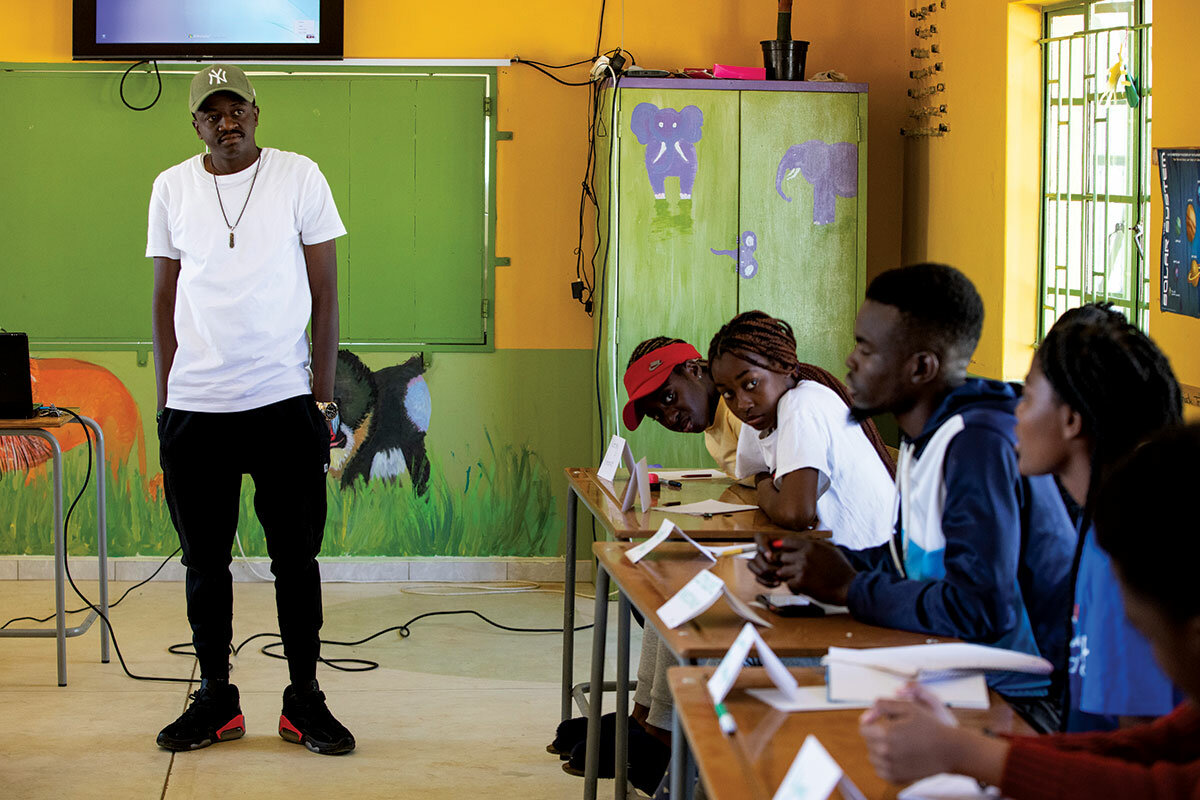
Photo: Melanie Stetson Freeman/CSM Staff.
The Christian Science Monitor says, “Deon Shekuza is a peripatetic presence at climate summits as well as at the grassroots – like the class on green hydrogen he taught to young teens in an informal settlement in Windhoek, Namibia, last July.”

Climate activism is no longer mainly the purview of the industrialized Northern Hemisphere or those with enough income and time to worry about it. Now people on the front lines are leading the way. For them it’s a matter of survival.

Sara Miller Llana writes at the Christian Science Monitor about Deon Shekuza, a climate influencer in Namibia, who is “as comfortable proselytizing green energy to youth on the hardscrabble roads and villages of this former German colony as he is in Namibia’s government ministries and the halls of United Nations conferences.

“Paid with respect if not a salary, he’s part of a rising breed of young climate activists across the Global South whose work, suggests one climate expert, may well determine the temperature of your world.

“Africa, which has contributed least to climate warming, is the continent most threatened by the droughts, floods, and heat intensified by climate change. In that extremity, the relentlessly positive Mr. Shekuza sees great opportunity for progress for Namibia.

“In the dusty chaos of an informal settlement on the edge of this capital city one recent morning, he faces his biggest challenge: capturing the imaginations of young teens on a complex topic. The kids have gathered in a bright community center classroom, not for school credit and certainly not for fun on their Saturday off, but to hear Mr. Shekuza teach green hydrogen 101. Namibia has staked its future on this next big solution for a global clean energy transition. …

(The process, simply put, would use solar or wind power to extract hydrogen molecules from desalinated seawater, producing green ammonium that would be used for regional and global fuel markets to power transportation and electricity production.)

“No one here knows what green hydrogen is, let alone how it might be the route to social justice that Namibia’s leaders proclaim.  Grasping for something understandable, Mr. Shekuza gestures out the window at the ancient and humble street scene of women laden with bushels of branches gathered from the forest for heating and cooking fuel. ‘This is exactly what we do not want for our people, right? Some energy sources keep you in the past, and some energy sources move you into the future. This is why we are here talking about green hydrogen.’

“After 90 minutes, Mr. Shekuza is satisfied. These kids might not exactly understand Namibia’s renewable energy policy, but they understand green hydrogen potential: jobs for them in a new economy that could turn Africa’s perpetual sunlight into clean fuel for electricity and transportation here and for export. …

“For activists across Namibia – like the Inuit in the Arctic, or youth from small island nations – caring and conserving is the easy part. These youth grew up living sustainable lives well before it was trendy. Many were born on the land, in the bush, on the coast, with no playgrounds except the natural environment around them. They conserved not for environmentalism, but for survival. …

“Mr. Shekuza and young African activists like him across the continent who are part of the Climate Generation, as we’re calling it, see a chance – the kind Mr. Shekuza tells the children in the informal settlement to seize, the kind he has seized for himself. …

“Mr. Shekuza can barely afford to do the work he has cut out for himself. For all his social confidence, he hesitates at the doorstep of his home before inviting visitors in for the first time ever. Descending from sunny daylight down a step at the side of a large old house, he enters the tiny basement space he shares with his mother.

“With a revealing flourish of humility, he pulls the worn blue curtain separating his mother’s bed from his floor space: ‘This,’ he says, ‘is climate activism in Africa.’

“In his windowless corner lies his bed. … On the chipped yellow paint of a cement wall are dozens of badges from U.N. conferences. A single business suit hangs from the curtain rope.

“This is the headquarters of his nongovernmental organization. With just the grants and fees he cobbles together from government and U.N. funding, the 33-year-old college dropout educates himself, hatches ideas for mentoring youth, and speaks via Zoom to august groups, all on the floor here. For an online speech on climate justice for a British Museum conference, he had no option but to give his speech right there, cross-legged on his sleeping pad, dressed in a traditional African tunic, surrounded by clothes, caps, shoes, and [policy] documents. …

“The environment, he says, was always a part of his interest: Nature was his escape from the noise and dilapidation of poverty in his rural hometown of Grootfontein. … ‘We are people who never look at the environment like something that is separate, because you grew up looking at it as part of you,’ he says. …

“He co-founded the NGO Namibian Youth on Renewable Energy (NAYoRE); gave himself the title ‘youth advocate for sustainable development’; worked with other organizations and networks on biodiversity, farming, and climate change; and started crisscrossing the globe on invitations to attend and address government, U.N., and private conferences. …

” ‘[Young people] may see me with a fancy English up here, but my lifestyle is no different from that kid in the shack. So when I speak for the youth, I’m coming from experience and I’m speaking something solid.’

“He pulls out a binder on agriculture in Namibia and how to use regenerative practices in one of the most water-stressed nations on the planet. It’s the latest document he’s read, and he’s read all of it: ‘I have dedicated hours and hours and hours … like trying to upgrade and up-skill myself. And I did that in and out of school, but I found the most benefit came out of it.’ …

“On a late Friday afternoon, Mr. Shekuza meets at a cafe with Micky Kaapama, whom he has been tutoring to be a climate activist, or, as they put it, a ‘biodiversity enthusiast.’ The glamorous fashion model studied biology and, crucially, has 12,000 Instagram followers. …

“As if trying to convince her of what she has to gain, he pulls out his phone to show an invitation from the Namibian president’s office that he’s just received. Addressed to Deon Shekuza, ‘Youth Advocate for Sustainable Development,’ it’s for a luncheon with Hyphen, a German- and British-financed Namibian company that signed a deal last May with Namibia to build the largest green hydrogen project in the country. It’s an $11 billion agreement.

“But there’s a hitch in the impressive invite. He has no idea how he can even afford to get to the event five hours away in Keetmanshoop.”

Find out what happens at the Monitor, here. No firewall.

Read Full Post »

Photo: Thorsten Becker via Wikimedia.
Fairy circles in Namibia, Africa. According to the New York Times, Namibia’s fairy circles may become “embedded within a matrix of fresh green grasses” during the rainy season.

Have you ever wondered about “fairy circles”? So have a lot of other people, scientists included. If you search on the term at this blog, you can see that I have been trying to keep readers abreast of the latest news about fairy circles as it becomes available. Today’s report is by Rachel Nuwer at the New York Times.

“The strange, barren spots pepper the vast Namib Desert, which stretches from southern Angola to northern South Africa. They are known as ‘fairy circles,’ and for a natural phenomenon with such a whimsical name, scientific debates over their origins have been heated.

“ ‘The to and fro between opposing camps has often been nothing less than vitriolic,’ said Michael Cramer, an ecophysiologist at the University of Cape Town who has studied fairy circles.

“Despite decades of research, no consensus exists about the origin of the mysterious formations. Theories have included poisonous gases, noxious bushes and plant-killing microbes or fungi. Two of the explanations — the circles are made by termites, or they result from plants competing over limited water — have dominated the scientific debate. …

“A rigorous study published in October will not end this fight, but it does seem to give the water-related hypothesis a clear lead over the termite theory.

“ ‘Plants are forced to create these circles to redistribute water to maximize their chances of survival,’ said Stephan Getzin, an ecologist at the University of Göttingen in Germany and an author of the study. ‘We call it ecosystem engineering.’

“The Namib Desert is one of the driest places in the world, usually receiving only a few inches of rain each year. Researchers first proposed in 2004 that plants, in competition for water in this harsh ecosystem, may self-organize into fairy circles — an idea originally adapted from pattern-formation theory developed by the mathematician Alan Turing.

“Over the past decade, Dr. Getzin and others have published more than a dozen papers in support of the hypothesis, known as plant water stress.

“For their latest study, Dr. Getzin and his colleagues spent three years examining fairy circles at 10 study sites across 620 miles of desert. One of those years, 2020, was a drought, while 2021 and 2022 were exceptionally rainy — a lucky break that permitted the researchers to compare different conditions, Dr. Getzin said.

“They used soil moisture sensors to collect continuous readings every 30 minutes of water content in the sand in and around fairy circles. They also examined hundreds of individual grass shoots and roots excavated at various intervals from within the circles and the surrounding areas.

After rain, the researchers found that grasses germinated both inside and outside fairy circles, but that within about 20 days virtually all of the young shoots inside a circle had died.

“They also found that the top eight inches of soil within fairy circles quickly dried out, something they hypothesize is caused when established plants surrounding fairy circles actively draw water toward them.

“Plants are constantly transpiring — or losing water — through their leaves. Their roots, meanwhile, take water in. In Namibia’s sandy soil, this creates a vacuum effect that moves water from the interior of fairy circles toward the plants’ roots at the circle’s fringe and beyond. …

“The new paper also speaks to the termite hypothesis, which has been championed by Norbert Jürgens, an ecologist at the University of Hamburg in Germany. He reported in 2013 that fairy circles were in fact generated by sand termites that damage grass roots.

“In the new paper, Dr. Getzin and his colleagues noted that termites were conspicuously missing from their study sites, and that they found no signs of root damage in grass that died after rainfall.

“ ‘We can say the reason is not termites, because there were no termites present at all,’ Dr. Getzin said. ‘The reason is desiccation.’

“Dr. Jürgens declined a request to comment.

“Walter Tschinkel, an entomologist at Florida State University who was not involved in the research but who has published papers in support of the water-stress hypothesis, said the new findings provided ‘more nails in the termite coffin.’ …

“Yvette Naudé, an analytical chemist at the University of Pretoria in South Africa who was not involved in the research, agreed that the new study seemed to confirm that, ‘contrary to popular belief, termite activity does not cause the fairy circles.’ …

“Advocates of the water-stress hypothesis still need to contend with other explanations, Dr. Naudé said. She continues to suspect, based on earlier studies, that something about the composition of fairy circle soil is inhibiting plant growth. …

“One of the reasons so many different fairy circle theories persist, Dr. Cramer said, is that it is exceedingly difficult to prove causation for ‘a long-lived ecological pattern that cannot be replicated in the lab.’ To finally put the debate to rest, he called for ‘some manipulative experiments to test the ideas in the field.’ “

Ready to take sides? Read more at the Times, here. Personally, I will always believe the circles are created by fairies, and no amount of rigorous science will change my view.

Read Full Post »

Following up on my 2012 post about fairy circles.

Rachel Nuwer writes at the NY Times, “When Stephan Getzin, an ecologist at the Helmholtz Center for Environmental Research in Leipzig, Germany, opened the email, his heart began to flutter. Attached was an aerial image of fairy circles, just as he had seen in countless photos before. But those images were always taken along long strips of arid grassland stretching from southern Angola to northern South Africa. These fairy circles — which looked nearly identical — came from Australia, not Africa. …

“The emailed photo came from Bronwyn Bell, who does environmental restoration work in Perth. She had read about Dr. Getzin’s research in Namibia and made a connection to the odd formations in her home state, Western Australia. …

“Scientists have been interested in fairy circles since the 1970s, but have not been able to agree on what causes the patterns to form. Researchers generally fall into two groups — team termite and team water competition — but there are other hypotheses as well, including one involving noxious gases.

“Dr. Getzin, like others on team water competition, explains the circles through pattern-formation theory, a model for understanding the way nature organizes itself. The theory was first developed not by biologists, but by the mathematician Alan Turing. In the 1990s, ecologists and physicists realized it could be tweaked to explain some vegetation patterns as well. In harsh habitats where plants compete for nutrients and water, the new theory predicts that, as weaker plants die and stronger ones grow larger, vegetation will self-organize into patterns …

“In the case of African fairy circles, the bare patches act as troughs, storing moisture from rare rainfalls for several months, lasting into the dry season. Tall grasses on the edge of the circles tap into the water with their roots and also suck it up with the help of water diffusion through the sandy soil.

“Although similar in appearance, Australian fairy circles turn out to behave differently, Dr. Getzin and his colleagues have found. … Aussie circles feature a very hard surface of dry, nearly impenetrable clay, which can reach up to a scalding 167 degrees during the day. Despite the differences, though, they believe the fairy circles’ function remains the same. When the researchers poured water into the circles in a simple irrigation experiment, it flowed to the edges, reaching the bushy grass …

“The new research ‘moves us closer toward a unifying theory of fairy circle formation,’ said Nichole Barger, an ecosystem ecologist at the University of Colorado, Boulder.

“It could be that more fairy circles are yet to be discovered in arid environments around the world, she said.

“According to Walter Tschinkel, an entomologist at Florida State University, the findings strengthen the claim that the circles are a result of self-organization by plants. He cautioned, though, that to be more certain, scientists would need to control environmental factors — water and termites, for example — to see which produce the predicted outcome.”

More here.

Photo: Norbert Jürgens
Tracks of Oryx antelopes crossing fairy circles in Namibia.

Read Full Post »

Doubtless you know about fairy circles, also called fairy rings. According to Wikipedia, they’re a “naturally occurring ring or arc of mushrooms. The rings may grow to over 10 metres (33 ft) in diameter, and they become stable over time as the fungus grows and seeks food underground.

“They are found mainly in forested areas, but also appear in grasslands or rangelands. Fairy rings are detectable by sporocarps in rings or arcs, as well as by a necrotic zone (dead grass), or a ring of dark green grass. If these manifestations are visible a fairy fungus mycelium is likely to be present in the ring or arc underneath.

“Fairy rings also occupy a prominent place in European folklore as the location of gateways into elfin kingdoms.”

But in Africa, there is a different kind of fairy circle that doesn’t seem to have anything to do with mushrooms.

Did you catch the article by Sindya Bhanoo in the NY Times?

“The grasslands of Namibia — and to a lesser extent its neighbors Angola and South Africa — are speckled with millions of mysterious bare spots called ‘fairy circles,’ their origins unknown.

“Now, a study based on several years of satellite images describes the circles’ life span as they appear, transform over decades, and then eventually disappear.

“Writing in the journal PLoS One, Walter R. Tschinkel, the study’s author and a biologist at Florida State University, reports that the circles can last 24 to 75 years.

“The circles, which range from about 6 to 30 feet in diameter, begin as bare spots on an otherwise continuous grass carpet; after a few years, taller grass starts to grow around the circle’s perimeter.”

The reader is left with the question, Are these circles gateways to elfin kingdoms? What kind of elves are in Namibia?

I don’t understand why scientists don’t investigate matters like that.

Update July 13, 2012: Asakiyume has been tracking down stories about African fairy circles. Read this.

Update March 30, 2013: NY Times has fingered a particular species of sand termites, Psammotermes alloceru. Read this.

Photograph: Walter R. Tschinkel

Read Full Post »