Feeds:
Posts
Comments

Posts Tagged ‘Nazi’

Photo: Christie’s Images Ltd. 2025.
Eva Hesse, “Landscape Forms” (1959).

If you found a painting you loved in some cheap second-hand shop, what would you do with it? Even if it turned out to be valuable? I think if I bought it because I loved it, I’d want it on my walls. Everything in the world is not valued only in terms of gold.

In April, Laurie Gwen Shapiro reported at Hyperallergic about a brother-sister team who are in it for the gold.

“One afternoon last fall, 55-year-old Kara Spellman was working from her Upper East Side apartment when her phone pinged. Her big brother Glenn, 58, a longtime licensed appraiser and self-described ‘picker,’ who lives in the same building, had texted a photo and a short message: ‘Take a look at this.’

“The image was of a small abstract painting — 30 by 24 inches — titled ‘Landscape Forms’ and newly listed on ShopGoodwill.com, the online auction wing of the national thrift store chain. The brushwork was gestural, the color palette felt just right, and in the lower-right corner, a signature: E.H.

“Glenn had a hunch. Kara, director of Estates and Acquisitions at Hollis Taggart Gallery in Chelsea, had a stronger one.

“ ‘We both have a good eye,’ she told Hyperallergic, laughing. ‘The brushwork looked too specific to be a copy.’

“But instinct wasn’t enough. The siblings, who’ve teamed up before on treasure hunts, needed the catalogue raisonné — the official compendium of an artist’s authenticated work.

“Kara emailed the Watson Library at the Metropolitan Museum of Art and begged them to pull the volume by the end of the day. Miraculously, someone she knew replied right away: They’d do it. She jumped in a cab.

“ ‘There it was,’ she said. ‘Landscape Forms’ (1959). Signed. Documented. And officially marked: ‘Whereabouts Unknown.’

“The only visual in the book was an off-color image made from an unmarked slide in the artist’s papers at Oberlin College’s Allen Memorial Art Museum. In fact, as noted in the catalogue raisonné, it’s ‘one of 15 paintings known only by unmarked slides’ included in that archive. But it matched exactly. And it was lost for decades until it popped up at a Goodwill warehouse in Frederick, Maryland.

“The Jewish artist Eva Hesse, born in Hamburg in 1936, escaped the Nazis as a child via the Kindertransport to London with her sister. Their desperate parents followed soon after, and the family eventually resettled in New York. Hesse would go on to become one of the most influential figures of the postwar American avant-garde. Best known for her radical, impermanent sculptural work in materials such as latex, fiberglass, and cheesecloth, she died in 1970, at just 34. Fragile and emotionally charged, her most important pieces helped define Post-Minimalism and, though rarely offered at auction, have sold for millions. Most are held in the collections of major museums.

“But before all that, Hesse painted. ‘Landscape Forms,’ made while she was an MFA student at Yale under Josef Albers — who affectionately called her ‘my little colorist’— is part of that rare early body of work. …

“And then one day, it was gone. Was it lost? Stolen? A gift quietly passed along, then forgotten?

“ ‘I’m not an artist,’ Glenn said in a phone call late at night after a grueling 10-hour day looking at estates. ‘I’m a treasure hunter. A detective.’ …

“ ‘Once or twice a year, something outstanding shows up there,’ he said of ShopGoodwill. ‘You just have to know what you’re looking at.’ …

“For bigger finds, Glenn often partners with Hollis Taggart, his former boss and longtime friend. They agreed it was worth pursuing together. After winning the lot for $40,000 — not exactly a steal, but Hesse’s auction record is above $4 million — Glenn drove to Frederick, Maryland, himself. …

“Back in New York, Glenn brought the painting to Hollis Taggart Gallery. There, it underwent conservation: surface cleaning, minor restoration, and re-stretching.

“It was shown at two major art fairs, including the Armory Show last September. There was interest — almost a sale — but no one bit. …

“Now, after regrouping, ‘Landscape Forms’ is headed to Christie’s Post-War and Contemporary Art Day Sale in May, with an estimate of $60,000–$80,000. [Update: It sold for $107,100.]

“The Spellman siblings, Gen Xers who’ve been in New York for decades, grew up in Ballston Spa, near Saratoga Springs, and got their start as bottle diggers.

“ ‘There was an old slaughterhouse near the creek bed,’ Glenn recalled. ‘We’d find colored, hand-blown bottles and sell them downtown, because there was also a one-cent candy store in town. If we sold an old bottle for a quarter, we’d get 25 pieces of candy. A home run would be a dollar bottle, which equaled 100 pieces of candy!’ …

“Both are longtime fans of American Pickers (2010–), the History Channel’s reality TV series whose hosts travel across the country in search of valuable artifacts. ‘I still watch it religiously,’ Glenn added. ‘You pick up more than you’d think.’

“When asked how it felt to hold the Hesse in his hands for the first time, Glenn got quiet.

“ ‘It was very exciting,’ he said. ‘You get the thrill when you win it, but when you finally handle it, when you know it’s real, that’s the magic.’ ”

More at Hyperallergic, here. No paywall, but your donation helps keep great art coverage going.
Read Full Post »

Photo: rkd/Mauritshuis.
Wilhelm Martin, the director of the Mauritshuis museum, quietly resisted by removing artworks from the museum during the Nazi occupation. And he hid people.

Today we go back to WW II to gather new information on the difficult choices that people had to make under Nazi occupation and how some Dutchmen practiced resistance while hiding in plain sight.

The Guardian‘s Senay Boztas reported the story from the Netherlands.

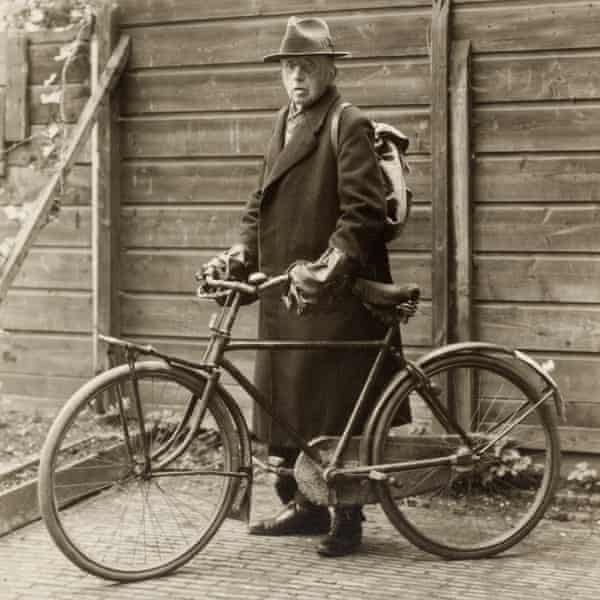
“The 13-year-old boy answered the doorbell,” she begins. “ ‘Tell your dad I’m here,’ said a man, who stored his bicycle and then disappeared upstairs.

“It was 1944, and right under the noses of Nazi command, people were hiding in the attic of The Hague’s Mauritshuis museum from forced labour conscription – Arbeitseinsatz – under which hundreds of thousands of men from the Nazi-occupied Netherlands were conscripted to work in Germany.

“The memories of 93-year-old Menno de Groot – a Dutch-Canadian who was that young boy – form an extraordinary part of a book and an exhibition of the secret history of the Dutch museum during the second world war.

“ ‘He must have gone all the way to the attic,’ De Groot tells his granddaughter Kella Flach in a video for the exhibition, referring to the man who he assumed had arrived to go into hiding. ‘I don’t know how many were up there. I have no idea how they lived up there, how they got there.’

“The chance find of a logbook by De Groot’s father, Mense de Groot, an administrator who from 1942 lived in the Mauritshuis museum with his wife and children, including Menno, inspired researchers to examine the museum’s history.

“ ‘People were hiding in November 1944 because of the Arbeitseinsatz, but hiding in the Mauritshuis was hiding in plain sight,’ Quentin Buvelot, a researcher and curator, said. ‘It was a house in the storm.’

“Art from the museum, including Johannes Vermeer’s Girl With a Pearl Earring, was first hidden in a bomb-proof bunker underneath the building and later stored in locations around the Netherlands. The German-born museum director Wilhelm Martin played a careful role, allowing the Nazis five propaganda exhibitions while also quietly resisting.

“A newly discovered note on Martin’s retirement in 1953 revealed he was involved in supporting people who had gone undercover on Assendelftstraat and in the museum. ‘Martin doesn’t say how many, but he says that on a daily basis, 36 loaves of bread were delivered. …

“Secret concerts were also held in the museum’s basement between 1942 and 1944, according to Frank van Vree, an author and researcher at the NIOD institute for War, Holocaust and Genocide Studies. ‘They were held to support musicians who were cornered by their resistance to German measures, especially compulsory membership of the Nazi Kultuurkamer,’ he said. …

“Mense de Groot, who was hired to work at the museum when the janitor retired, also worked for the resistance. ‘He usually got Trouw, an underground newspaper,’ Menno de Groot says in the exhibition. ‘And my dad, he copied them, made more copies. …

“Life under occupation was a series of difficult choices, according to Eelke Muller, a historian and NIOD specialist in looted art. ‘There was little knowledge [before this research] about how culture could be a political instrument for resistance from the Netherlands but also a strong ideological instrument for the occupier,’ she said. ‘Every museum, every civil servant in times of war was confronted with huge dilemmas: do you choose principled resistance, enthusiastically get behind Nazi ideas, or are you somewhere in the middle?’ More at the Guardian, here. No paywall.

Nina Siegal at the New York Times adds details about the famous Vermeer that Martin also hid.

“At first it went to a bomb shelter in the basement of a museum, then an art bunker built into the dunes on the North Sea in the Netherlands. Toward the end of the war it was hidden in a secured cave in Maastricht, a Dutch city near the Belgian border.

“Starting in 1939, as war in Europe spread and the Nazi invasion of the Netherlands loomed, leaders of the Mauritshuis, the jewel box museum in The Hague, took extraordinary steps to protect Johannes Vermeer’s ‘Girl With a Pearl Earring’ and other works central to its collection.

“Wilhelm Martin, the museum’s director at the time, removed it and other famous works … before the Germans arrived because he understood that they would be in peril, both from bombardments and from potential Nazi looting afterward.

“The survival of these works, through strategic planning, diplomatic appeasement and the German affinity with the conquered Dutch as ethnic brethren, is now the subject of an exhibit at the Mauritshuis. ‘Facing the Storm: A Museum in Wartime,’ which is on view until June 29, coincides with the 80th anniversary of the liberation of the Netherlands in 1945 and is based on extensive new research.”

I hope blogging chefs Michiel and Jeen in the Netherlands get to see this.

Read Full Post »

Now is the winter of our discontent.

For some reason, I thought today might be a good day to talk about the women of the French Resistance and the power of flying under the radar.

The Library of Congress research guide on the French Resistance says, “Women had a unique ability to serve as Resistants, in some part due to views among many Nazis that women were harmless and non-threatening. … Women were by default granted much greater latitude in moving around — and when apprehended were much more likely to convince officers or soldiers of their innocence.

“Often overlooked, they served as consummate spies. Often speeding along by bicycle, women devised all manner of ways to hide items in their purses and baskets. They used baby carriages as a sort of camouflage to transport goods. …

“Women were invaluable as messengers and couriers; they carried everything from arms and ammunition to intelligence and Resistance propaganda. They also rescued airmen shot down … and operated what were called ‘escape lines’ that served to usher US and British servicemen into safety. They gathered military intelligence (some of these women even worked with Madames in brothels … where information could be gathered secretly), decoded messages, managed underground publications, ran guns, provided support for strikers, and carried out sabotage of German communications. They [worked] as typists and counterfeiters, and proved themselves brave and extraordinarily wily. …

“Recent scholarship has finally brought women Resistants out from the shadows. Women were often slower than men to write about their experiences, but as decades went on, and in some cases archives opened, more of these stories came to light.

“[One] valuable source of material are the témoignages — statements made by individuals during interviews conducted immediately after the War. Some such interviews were under the auspices of the Comité d’Historie de la Deuxième Guerre Mondiale in Paris. Many of these sources can be found at the Bibliothèque nationale de France or the Bibliothèque Marguerite Durand in Paris. …

“Some accounts of these women and their activities can be found in reports from those U.S. servicemen, which are available in the National Archives, Washington National Records Center in [Maryland]. There are firsthand accounts of downed American airmen who were assisted by Resistants. Many of these accounts talk about being fed, given medical attention and shelter, and even being shepherded to a safehouse. For safety reasons, these women did not usually give their real names, thus they will forever remain anonymous.

“As Margaret L. Rossiter notes in her study, Women in the Resistance, some women that have gained attention for their heroic acts managed to preform them while nonchalantly preforming their day jobs.

“Jeanne Berthomier, who was a civil servant in the Ministry of Public Works in Paris, managed to deliver top-secret information typed on tissue paper to the Alliance chief, Marie Madeleine Fourcade. Mme Paule Letty-Mouroux used her position as a secretary at the Marine de Toulon in order to report the repair status of Axis ships. Mme Marguerite Claeys collected information from agents who posed as customers at the company she owned with her husband — all without his knowledge.

“Simone Michel Lévy used her job in the Postal, Telegraph, and Telephone Service (PTT) to obtain intelligence [that] she managed to send to London under the code name of Emma. These women all took enormous risks and many of them were eventually caught and arrested. …

“Women from a variety of countries, including Britain and the US, served in the French Resistance. Isabel Townsend Pell … was an American socialite who joined the French Resistance during World War II — one of the few women who was part of the Maquis — purportedly due to her good aim. Going by a code name of Fredericka … she was imprisoned twice during the war, and subsequently decorated with the Legion of Honor for her service.

The stories of these women and countless others stand as testaments to the fact that no matter what role you have or where you find yourself, there is often a way to contribute to a larger cause. …

“Eighty years after their Liberation, France continues to commemorate French Resistance fighters and Allied veterans from WWII. … On May 27th, 2024, in the presence of the family of Alice Arteil, a secondary school in Le Mayet-de Montagne, was renamed in honor of French Resistant Alice Arteil. Arteil was one of the only women to command her own Resistance group. Her knowledge of the mountainous and woody terrain was invaluable for the rescue missions and the general activities of the group.” More at LOC, here.

At the website, there are other women, listed alphabetically. I loved reading about Pippa the “knitting spy,” who hid her information within a knitting kit by knotting codes onto silk. Was she thinking about Madame Defarge? What a testament to fiction being as real as real life — and sometimes more influential!

“ ‘En 1940, il n’y avait plus d’hommes. C’étaient des femmes qui ont démarré la Résistance.’ 
-Germaine Tillion, quoted in Femmes de la Résistance: 1940-1945.”

Read Full Post »