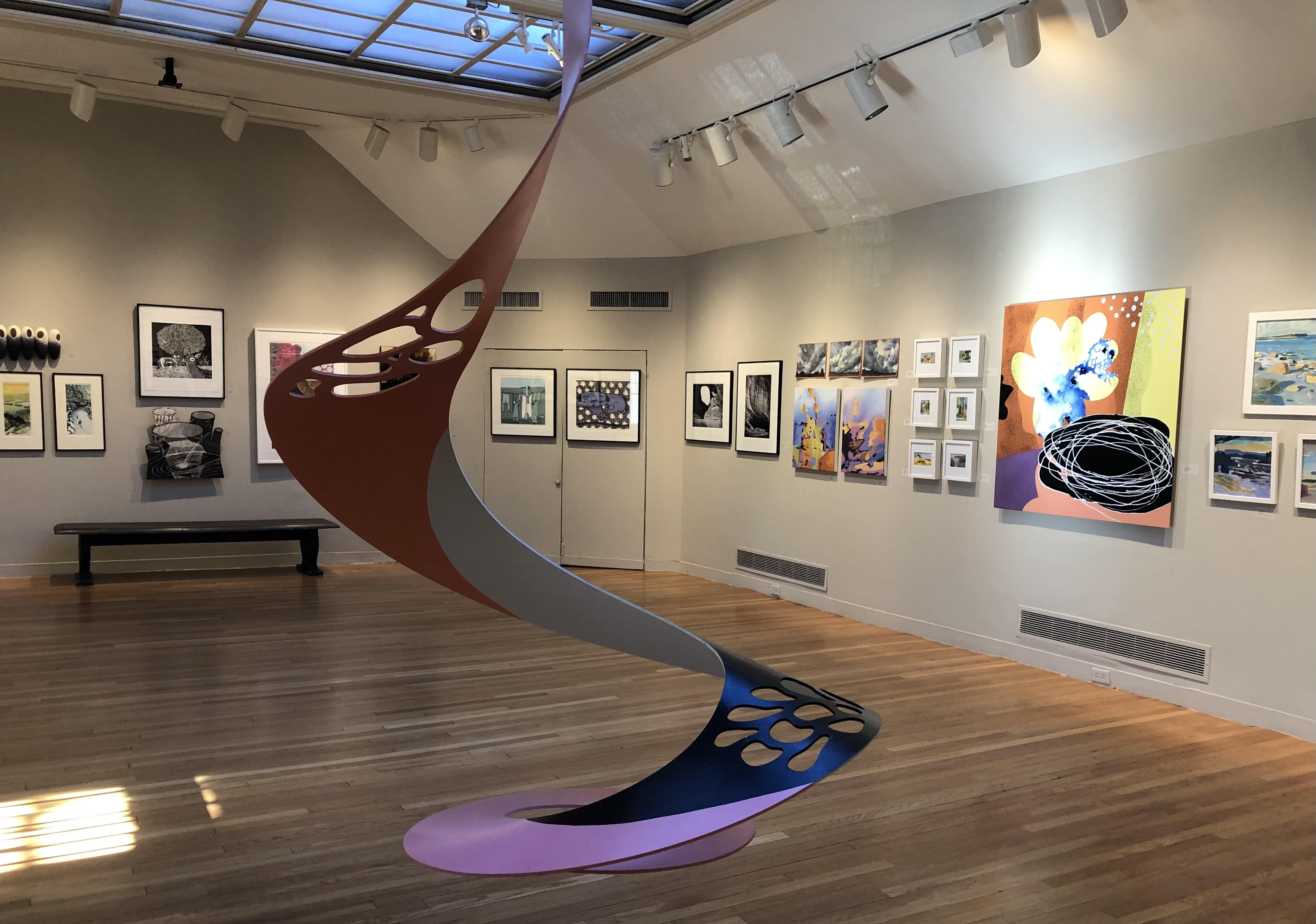
Photo: Suzanne and John’s Mom.
Exhibit at Concord Art, November 30, 2021. Researchers have found that visiting galleries and museums to look at original art is good for your nervous system.
The other day, I was talking with a staff member here about her plans for the weekend, and she told me she wanted to go into Boston Sunday and visit an art museum or gallery. I am always impressed when anyone drives to Boston: the one-way streets are confusing and the parking is awful. She surprised me by saying, “Parking’s the easy part. There’s a lot of free street parking on Sundays.”
After reviewing today’s articles, I can hardly wait to tell her that what she was doing for fun is also good for her health.
Rhea Nayyar wrote recently at Hyperallergic about new research suggesting that museums and galleries are “non-clinical spaces for preventive health promotion. … Supporting existing research on the benefits of viewing original artwork versus reproductions, a new study found that seeing authentic art can help drop cortisol levels, among other positive effects on the nervous system. …
“ ‘The Physiological Impact of Viewing Original Artworks vs. Reprints: a Comparative Study‘ was conducted by researchers from the Department of Psychological Medicine at King’s College in London working in collaboration with the Courtauld Institute of Art.
“Fifty adults between the ages of 18 and 40 participated in the experimental study — one half was made to view five authentic paintings with their wall labels in a gallery setting for a 20-minute period, while the other half was shown high-quality reproductions of those paintings in a similarly curated setting. All participants had their heart rate and skin temperature monitored, and they provided saliva samples before and after the viewing sessions.
“The selected works (and subsequent reproductions) were all late 19th-century figurative paintings by European artists from the Courtauld’s collection: ‘Jane Avril in the Entrance to the Moulin Rouge‘ (c. 1892) by Henri de Toulouse-Lautrec; ‘A Bar at the Folies-Bergère‘ (1882) by Éduoard Manet; ‘Banks of the Seine at Argenteuil‘ (1874) by Éduoard Manet; ‘Self-Portrait with Bandaged Ear‘ (1889) by Vincent van Gogh; and ‘Te Rerioa (The Dream)‘ (1897) by Paul Gaugin.
“The recorded data showed that those who viewed original artwork had higher heart rate variability patterns compared to the reproductions group, indicating that authentic viewing experiences contribute to a more receptive and adaptable nervous system. The post-viewing saliva samples also yielded a 22% cortisol decrease among the original art group, as well as a measurable drop in two of four recorded inflammatory proteins. …
“[The researchers likened] the stimulated but calming response elicited to that provoked by exercise or meditation.”
That supports University of Pennsylvania research described by Hyperallergic‘s Elaine Velie in 2022.
“ ‘Art museums have great potential to positively impact people, including reducing their stress, enhancing positive emotional experiences, and helping people to feel less lonely and more connected,’ researcher Katherine Cotter told Hyperallergic.
“The study, titled ‘Art Museums As Institutions for Human Flourishing,’ was published in the Journal of Positive Psychology by Cotter and James O. Pawelski of the University of Pennsylvania. Their work is encompassed in the burgeoning field of positive psychology, which studies ‘the strengths that enable individuals and communities to thrive.’ Drawing on research from different academic disciplines, the study is part of an initiative that examines how the arts and humanities affect ‘human flourishing’ — a comprehensive framework that takes into account both ‘ill-being’ (living with disease, disorders, or in negative states) and ‘well-being’ (practicing positive health habits). …
“Cotter and Pawelski compiled and reviewed over 100 research articles and government and foundation reports. They discovered that visiting a museum reduced stress levels, frequent visits decreased anxiety, and viewing figurative art lowered blood pressure. They also found that museum visits lowered the intensity of chronic pain, increased a person’s life span, and lessened the likelihood of being diagnosed with dementia.”

 Suzanne's Mom's Blog