Feeds:
Posts
Comments

Posts Tagged ‘nest’

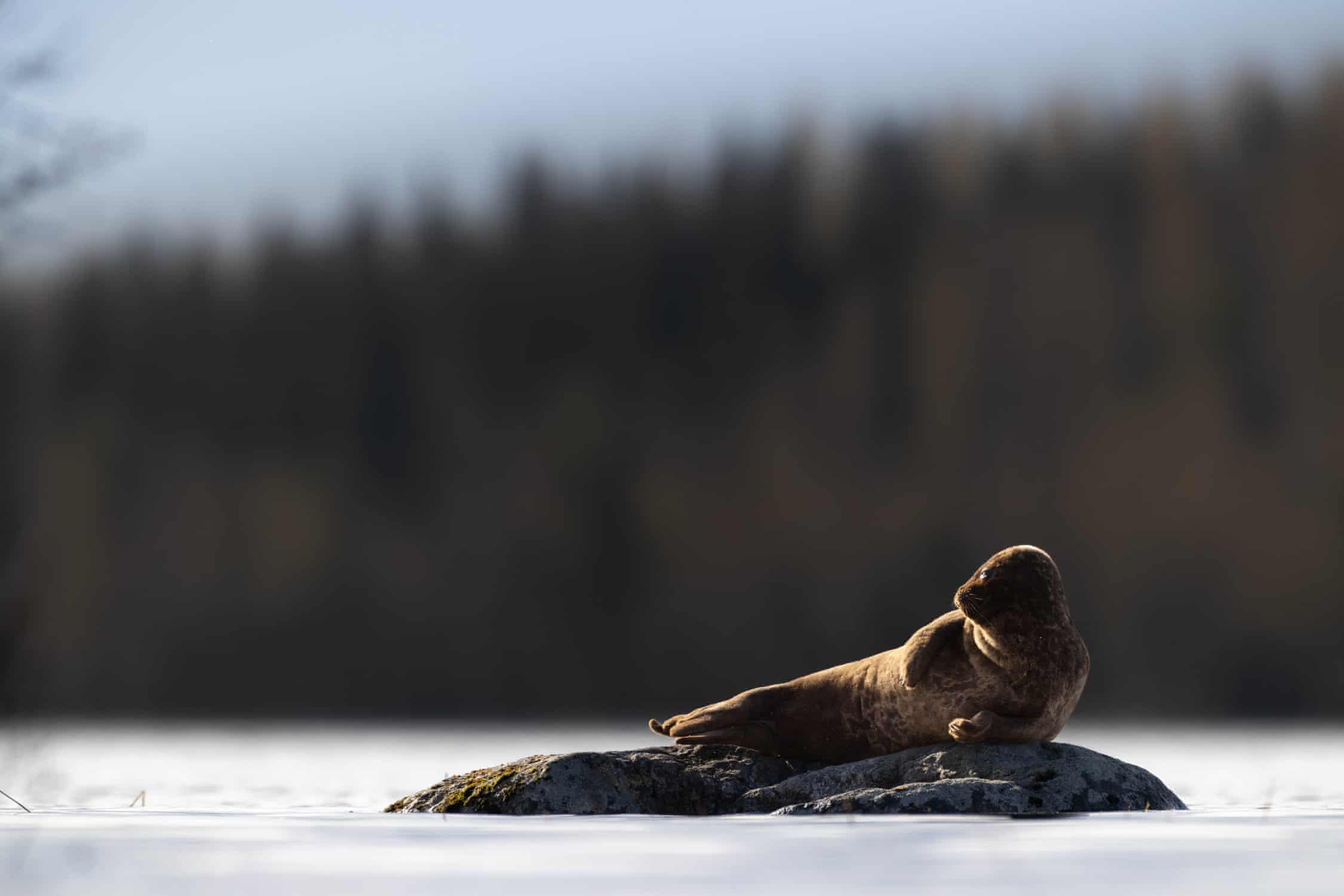
Photo: Samuel Bloch.
Saimaa ringed seals are very sensitive to disturbance, and it is forbidden to deliberately approach them without a permit.

I once wrote here about one of John’s a Ukrainian employees who told me that in Soviet days it was dangerous to read certain books. People read The Master and Margarita, for example, under the library table with a flashlight if no one was around.

I don’t think we are there yet, but I do have a sense that a whole segment of our society will be living an alternate life and trying not to draw attention. That might include people who care about wildlife and global warming, like the Finns in today’s story.

Phoebe Weston writes at the Guardian, “Eight hours shoveling snow in -20C [-4 F] might not sound like the ideal day out, but a committed team of volunteers in Finland are working dawn to dusk building enormous snow drifts for one of the world’s most endangered seals.

“The Saimaa ringed seal was once common around Lake Saimaa in the south-east of the country, but only 495 of them remain.

“The seals make ‘snow caves’ inside snow drifts where they raise their young and protect them from the elements and predators such as red foxes – but as the climate warms, the snow is disappearing. To save these rare seals, 300 volunteers spend days shoveling snow into piles [23 feet long] around the edge of the frozen lake. Last winter they made 200, and the seal population is growing as a result. …

Volunteers meet at first light and work until dusk. [Vincent Biard, a PhD student and volunteer from the University of Eastern Finland] describes the day as ‘kind of fun,’ and adds, ‘you actually have an impact, which is nice. If we don’t do it, then they would just go extinct quite quickly.’ …

“Saimaa seals are less than 1.5 metres long and each one has a unique fur pattern – individual to each animal, like human fingerprints. In the late 1980s their population dwindled to its lowest point, with fewer than 200 left, driven by hunting and deaths caused by fish traps. Accidental deaths in fishing nets remain a challenge.

“Now, the seals are fully protected but the threat of the climate emergency looms large. Between 1925 and 2002, the maximum thickness of the ice decreased by 1.5cm [~i/2 inch] a decade. In mild winters the ice caves can collapse, leaving the pups exposed, with up to 30% of them dying.

“Human-made snow drifts are larger and ‘more durable than natural snow drifts,’ says [Jari Ilmonen, coordinator of Our Saimaa Seal Life, which is an EU-funded program]. …

In the future, ice cover is expected to disappear before the pupping season has ended.

“There have already been some winters where there has not been enough snow to create an artificial drift. In some cases the seals have been known to breed elsewhere, but with no snow ‘just a few would hang on,’ says Ilmonen.

“However, scientists from the University of Eastern Finland are working on plan B. They are creating artificial dens, or nest boxes, that mimic the real thing, with preliminary research showing the seals use them for resting, giving birth and nursing their young. The nest boxes could be used in ice-free winters, researchers say. …

“There are about 40 dens on the lake, where three pups have already been born, but Ilmonen wants to get more out there. ‘If you think that there are maybe 500 seals and maybe 100 pups born each year, you’d need a lot of the boxes,’ he says.

Find more of the Guardian’s age of extinction coverage here, and follow the biodiversity reporters Phoebe Weston and Patrick Greenfield in the Guardian app for more nature coverage.

More at the Guardian, here. No firewall, but voluntary subscriptions support responsible news.
Read Full Post »

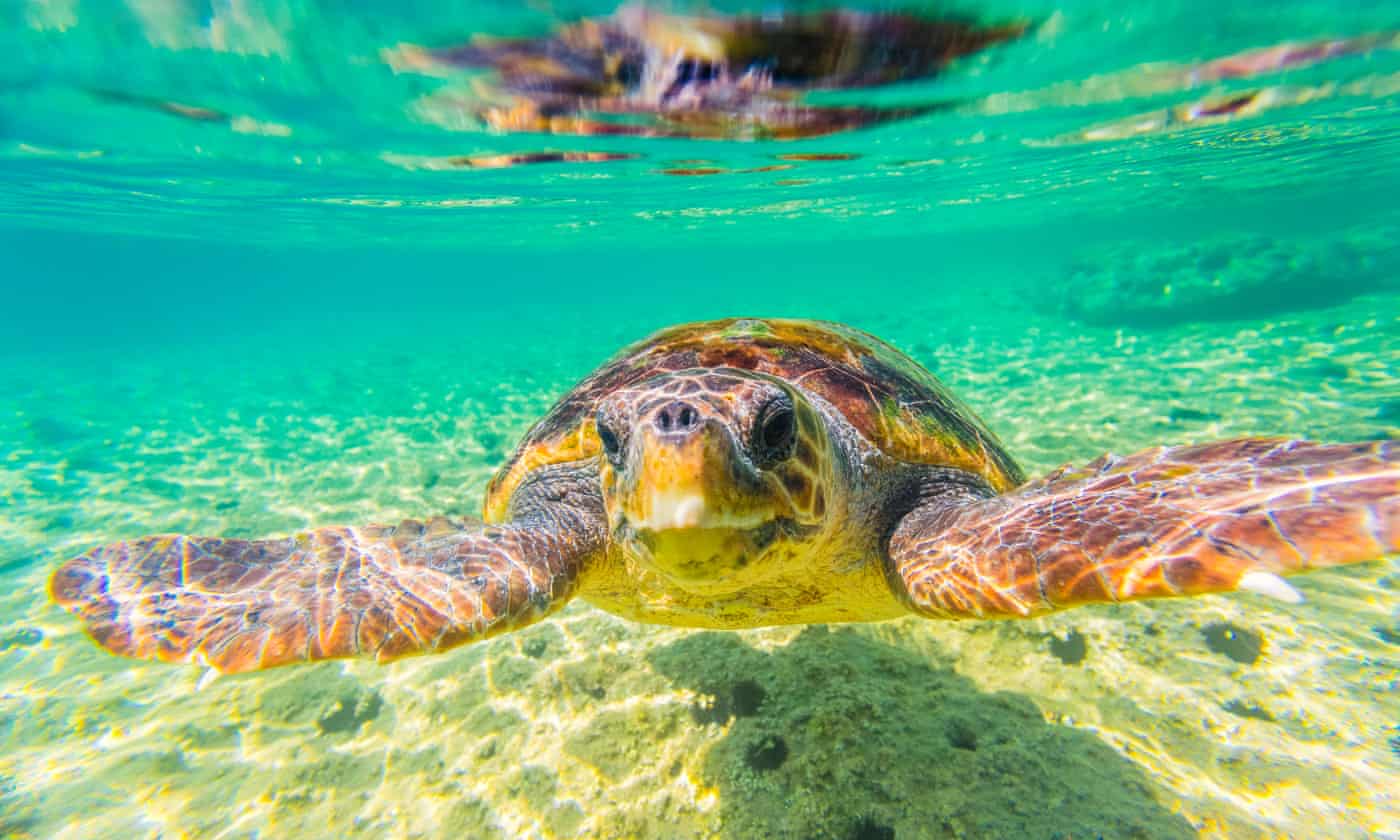
Photo: Giacomo Augugliaro/Getty Images.
A loggerhead turtle (Caretta caretta) off Elafonissos island in Greece, where the rebound in population has been called “phenomenal.”  

Today’s article is about the resurgence of turtles in Greece. But before I get into it, I need you to indulge my current train of thought about turtles.

There are the chocolate, caramel, and pecan-footed “turtles” that my sister-in-law makes every Christmas, turtles that this week have gotten certain farflung relatives wildly excited.

There are songs about turtles like one I just found out my exercise teacher made for a fundraiser years ago, here.

And there are turtle fans all over the world who are bringing real turtles back from the brink of extinction. Slowly but surely.

Helena Smith writes for the Guardian about that.

“After nearly a quarter of a century observing one of the world’s most famous sea turtle nesting grounds,” she reports, “Charikleia Minotou is convinced of one thing: nature, she says, has a way of ‘sending messages.’

“Along the sandy shores of Sekania, on the Ionian island of Zakynthos, what she has seen both this year and last, has been beyond her wildest dreams. The beach, long described as the Mediterranean’s greatest ‘maternity ward’ for the Caretta caretta loggerhead sea turtle, has become host to not only record numbers of nests, but record numbers of surviving hatchlings as the species makes an extraordinary resurgence.

“ ‘The message sea turtles are sending is very clear,’ said Minotou, who coordinates the WWF program in the protected area. ‘And that is the measures we have taken over the past 25 years to ensure conditions are right for the marine turtles to nest here are working … It’s fantastic.’

“One of the oldest living species, sea turtles are believed to have existed for more than 100m years. Although highly migratory – over a lifetime, the reptiles cross thousands of miles of seas and oceans – female turtles always return as mature adults, about 20 to 25 years later, to the habitat where they were born to lay eggs. It is a reproductive cycle that happens with perfect synchronicity. In Sekania and other nesting grounds in Zakynthos and around Greece, turtles tagged at birth by conservationists a quarter of a century ago are now reappearing to nest.

“ ‘It’s hugely moving,’ says Minotou, a sustainable development expert who highlights the importance of technological advances, including the installation of CCTV cameras, in helping to ward off seagulls, ghost crabs and other predators. ‘This year more than 1,200 nests have been recorded in Sekania, which is one every 50cm [~20 inches] of beach. An amazing number.’

“From Spain in the west to Cyprus in the east, the Mediterranean has witnessed a record rise in sea turtle nesting – testimony to the painstaking efforts of environmentalists determined to save an ancient mariner that not that long ago was on the verge of extinction. Only one in 1,000 turtle hatchlings makes it to adulthood, making the turnaround even more remarkable.

“In Greece, which hosts 60% of Caretta caretta nests, the rebound has been phenomenal: from an average of 5,000 to 7,000 nests per year, since 2023 over 10,000 nests have been recorded annually, according to Archelon, the Sea Turtle Protection Society of Greece. …

“Thirty years ago, before the creation of a state-funded marine park on Zakynthos – the country’s biggest sea turtle nesting ground after the bay of Kyparissia in the Peloponnese – Greek authorities appeared oblivious to the plight of a species whose survival is now widely recognized as vital for marine ecosystems and the region’s ecological biodiversity.

“Few have more vivid memories of the dangers the creatures once faced than Lily Venizelos, who founded the UK-based Mediterranean Association to Save the Sea Turtles (Medasset) in the 1980s.

“The doughty campaigner, now in her 90s, spent years lobbying successive Greek governments to legislate policies to protect Caretta caretta from the then nascent threat of tourism and other perils posed by speedboat propellers, beach furniture and human activity in marine turtle habitats, conservationists say. …

“ ‘It’s been the most wonderful news, at my age, to find out that the Caretta caretta are no longer so threatened, but it’s crucial protective measures continue to be enforced. One false move and everything could be lost.’ ”

Do you have any thoughts on why turtles are so beloved? I think for me it’s their patience, the way they get everything done that they need to do while moving slowly.

More at the Guardian, here. No firewall.

Read Full Post »

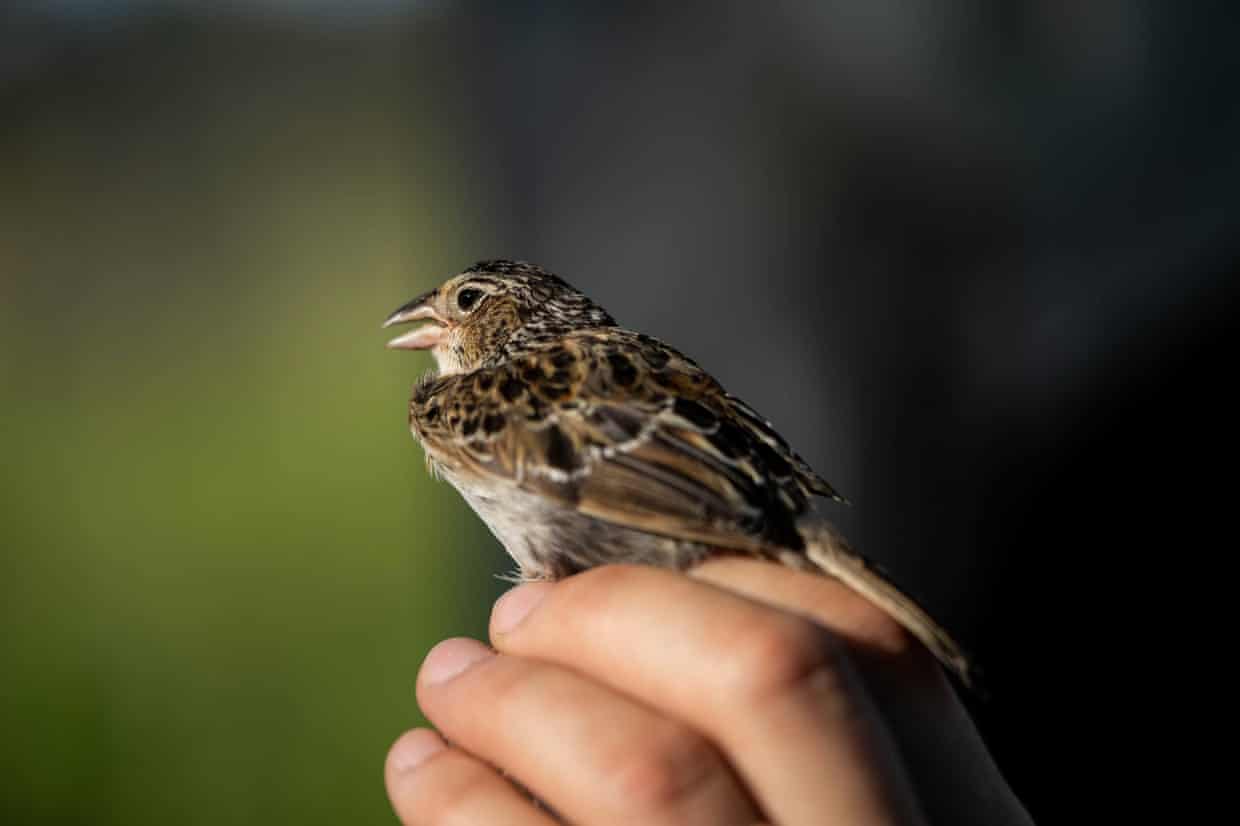
Photo: Carlton Ward Jr.
A grasshopper sparrow in Florida. 

Continuing on the subject of endangered birds, let me introduce Florida’s grasshopper sparrow. Now, you may think that with all the troubles in the world, the future of the grasshopper sparrow is the least of your worries.

But I like how the story represents bigger things — how we can make the world better if we try, how there are people who devote their lives to some small area that has big implcations.

Richard Luscombe writes at the Guardian, “Scientists in Florida are hailing the landmark release this week of a tiny bird only 5 inches tall as an oversized success in their fight to save a critically endangered species.

“Numbers of the Florida grasshopper sparrow, seen only in prairies in central regions of the state, dwindled so severely by 2015, mostly through habitat loss, that authorities took the decision to remove remaining breeding pairs into captivity. Their wager was that a controlled repopulation program would be more successful than leaving the birds to their own devices.

“[Their] gamble was rewarded. Partners joined the Florida Fish and Wildlife Conservation Commission (FWC) to release into the wild the 1,000th bird bred under controlled conditions, adding to an increasingly stable population that researchers believe has turned the tide towards the species’ survival.

“ ‘The recovery and release program diverted the extinction of the Florida grasshopper sparrow,’ said Adrienne Fitzwilliam, lead sparrow research scientist at the FWC’s fish and wildlife research institute.

“The fear was we might just be expediting their demise by bringing in proven breeders, so to see these birds making it in the wild, breeding with wild birds and other release birds, and their offspring going on to breed, has just been incredibly rewarding.’ …

‘Releases, which began in 2019, have taken place at three sites, with the newly freed birds monitored by patient teams of observers with binoculars and lawn chairs at two more. Birds are released in batches at about 40 days of age and, Fitzwilliam said, quickly set about setting up their ‘territory.’

“ ‘There’s a lot of sitting and waiting and watching because their nests are incredibly hard to find,’ she said.

“At the Avon Park military range south of Orlando where the milestone release took place this week, researchers have this year recorded 16 nesting pairs and 30 ‘singing’ males looking for a mate.

“At Three Lakes wildlife management area, the program’s first release site where once only 11 pairs were present, the observers found 40 pairs and 68 males, and are hopeful of more with the breeding season still in progress. …

“ ‘These numbers mean released birds successfully survive, breed and raise young in the wild, which is a huge success,’ Fitzwilliam said. ‘It has diverted extinction and allows partners to research possible landscape-level solutions.’

“Grasshopper sparrows, per their name, eat mostly grasshoppers and seed, and according to the FWC, the loss of large areas of prairie habitats to agriculture fields has vastly reduced their range and numbers. … FWC’s program partners, which include Audubon, White Oak Conservation and the Fish and Wildlife Foundation of Florida (FWF), are researching potentially beneficial land management practices such as roller chopping, which prepares land for controlled burns and speedier regeneration of native grasses. …

“News of the recovery of grasshopper sparrow numbers follows an upbeat report by a coalition of prominent universities for the future of Florida’s wildlife, if the climate emergency is mitigated properly.

“Andrew Walker, FWF president and chief executive, said: ‘These little birds represent a big beacon of hope that our commitment, partnership and holistic approach can save vulnerable wildlife from the brink of extinction.’ “

More at the Guardian, here.

Read Full Post »