Feeds:
Posts
Comments

Posts Tagged ‘new jersey’

Photo: Inside Climate News.
Children play with a water fountain at a park in flood-prone Hoboken, New Jersey. The playground doubles as storage for stormwater runoff.

Yay for humans who come up with ingenious ways to mitigate the effects of climate change! Here’a a clever idea from Hoboken, New Jersey.

Victoria St Martin reports at Inside Climate News (via the Guardian), “For a city that is almost small enough to fit inside Manhattan’s Central Park just a few miles away, a lot of history has played out within the narrow borders of Hoboken, New Jersey.

“It was the site of the first organized baseball game in 1846, home of one of the US’s first breweries in the 17th century and the place where Oreo cookies were first sold in 1912. And, as any Hobokenite will tell you, the Mile Square City, as it is called, is also known for something else.

“ ‘Everything floods up here,’ Maren Schmitt, 38, said with a nervous chuckle on a Tuesday afternoon as she watched her two boys climb at a city playground.

“Nearly four-fifths of the land area in Hoboken – which sits on the western banks of the Hudson River – rests on a flood plain. And its intense susceptibility to flooding has probably never been more apparent than it was during Hurricane Sandy in 2012, when 500m gallons of storm surge flooded the city.

“But now … Hoboken officials have put in place a series of measures designed to mitigate the destructive effects of storms that are driven by climate change, including one innovation that the city hopes may become known as another Hoboken first.

“Located at the corner of 12th and Madison streets, one of Hoboken’s newest playgrounds, known as ResilienCity Park, [is] doubling as a storage area for roughly 2m gallons of stormwater runoff. …

“The park, which sits on five acres barely a mile and a half from the Lincoln Tunnel into Manhattan, features swing sets, slides, a basketball court and an athletic field – and, underneath it all, a below-ground tank capable of holding hundreds of thousands of gallons of stormwater that city officials say would have otherwise spilled on to the streets or streamed into the basements of Hoboken homes and businesses.

“Building climate-resilient – or climate-smart – playgrounds is part of a growing movement among municipalities and environmental advocacy groups in the US. … The Trust for Public Land, a nonprofit conservation group, estimates it has helped fund the construction of more than 300 such play spaces in communities around the country, including Philadelphia, New York and Los Angeles. …

“Some spaces, like those in Hoboken, utilize an underground tank, porous artificial turf and scuppers or openings on a basketball court to store excess stormwater. Others increase resilience with newly planted trees that can absorb carbon dioxide and airborne pollutants; once they mature, those trees also provide shade cover that can reduce the heat island effect of urban areas, a problem intensified by the traditional black asphalt playgrounds commonplace generations ago. …

“ ‘Every geography is going to have slightly different stressors,’ [Daniella Hirschfeld, an assistant professor at Utah State University who studies environmental planning] said. ‘Hoboken is a place that used to be an island. And the amount of water that it needs to store is very different than where I am here in Utah. But ultimately, you know, places can perform both as a safe haven for stormwater and, hypothetically, can even be a safe haven for fire, which is another threat that we’re facing.’

“Caleb Stratton, Hoboken’s chief resilience officer, recalls how city officials asked him to lead the rebuilding and recovery efforts after Hurricane Sandy. The park, one of four planned resiliency sites in the city, was primarily paid for with infrastructure replacement grants, including roughly $10m from the Federal Emergency Management Agency. Stratton said a key element of the park’s design was its multipronged approach to flood mitigation.

“ ‘It’s a park, stormwater pumping station, the whole thing,’ Stratton said during an interview at the park while a cluster of summer campers squealed on a playset nearby. ‘This is all the strategies mixed up into one.’ …

“In addition to the underground stormwater detention tank, which holds 1m gallons of water, Stratton said above-ground infrastructure including rain gardens could hold a million more. An above-ground pump can also send water back into the Hudson.

“ ‘What we’re doing is creating places for the water to go so that we can manage it and keep it off the streets, keep it out of people’s buildings, and get prepared for the uncertain future, which we’re kind of experiencing in real time.’ …

” ‘They need more like this, for sure, so the kids can get outside,’ said Tyrik Davis, 26, a resident of nearby Fairview, New Jersey, who was visiting the park with his children, Naylani, six, and Tyrik Jr, three. ‘Especially this generation. There’s no more kids at the parks. They’re all inside with their phones.’ ”

More at the Guardian, here. No paywall.

Read Full Post »

Photo: Alex Bakley via Washington Post and Italy 24.
Herman Cruse is a school bus driver who is a regular volunteer in classes at Middle Township Elementary No. 1 in Cape May Court House, N.J.

I like that every week the Washington Post sends subscribers a collection of upbeat stories it calls “The Optimist.” It’s good to be reminded that there are people doing kind and generous things every day. We just don’t hear about them often.

Today’s story, by Cathy Free. is about a school bus driver who was concerned when a child on his bus was discouraged about reading. It’s about how his decision to help out led to a whole new avocation.

“New Jersey school bus driver Herman Cruse noticed that a kindergartner seemed a little sad and out of sorts during one morning ride to Middle Township Elementary #1.

“ ‘Bus drivers are the eyes and ears of students when they’re away from home,’ said Cruse, 55, who drives students of all ages for Middle Township Public Schools in Cape May Court House, N.J.

“ ‘We have an uncanny gift to discern what kids are feeling,’ he said.

“When Cruse asked the kindergartner what was wrong, he said the boy explained that he wasn’t able to complete his reading assignment because his parents were busy with his four siblings at home. It was hard to find one-on-one time to practice reading with his mom or dad, he told Cruse.

“Cruse said an idea popped into his mind.

‘I told him, “Listen, I have some free time, and if you don’t mind, I’d like to come to the school and read with you,” ‘ he said.

“Cruse received permission from the 6-year-old’s teacher, Alex Bakley, to show up at her kindergarten classroom the following week. When he walked in, he said the boy shouted, ‘Hey, that’s my bus driver!’

“ ‘We went into a quiet corner and began reading together,’ Cruse said. … ‘So he read to me, I read to him and we read together, and from there, it took on a life of its own. … A second student wanted to read to me, then a third. All these kids were going to the teacher asking, “Can I read with Mr. Herman?” ‘

“Almost two years later, Cruse now volunteers to help Bakley’s 18 kindergarten students and another kindergarten class with reading two days a week, and on a third day, he tutors the school’s first- and second-graders. After dropping the kids off at school, of course. …

“Middle Township Elementary Principal Christian Paskalides said every child at the school looks up to Cruse, both on and off the school bus. … ‘Positive adult interactions can sometimes dictate a child’s day, and a bus driver is the first and last adult interaction for most students other than family,’ Paskalides added. ‘This is more than just a job to Herman — he’s a great role model and mentor.’

“Cruse said he’s never wanted to be anything other than a bus driver. … Because he lives in Egg Harbor City, N.J., about 40 miles away, it didn’t make sense for him to drive home after delivering students to high school, middle school and elementary school, he said. … ‘Instead, I’d hang out at the gym, go the library or sit in my car and go to sleep to fill up the time,’ Cruse said.

“It wasn’t until he offered to help the kindergartner on his bus last year that he realized there was something more rewarding he could be doing, he said. Cruse had spent a lot of time reading to his own five children when they were growing up.

“ ‘They’d say, “Dad, how come you read so much?” and I’d say, “Come on over and find out,” ‘ he said. ‘I’d tell them, “The book is always better than the movie.” There’s nothing better than time spent with a good book.’ …

“When Bakley showed him the round table where children would read to him in her classroom, he pulled up a small chair and made himself at home, he said. … He spends about 20 minutes reading books with each child on a rotating basis, and he also challenges them to word games like alphabet bingo.

“LaCotia Ruiz said her son Kingsly, 5, is more excited about books since he started reading with Cruse.

“ ‘Kingsly had a rough time with reading at the beginning of the school year, but he’s doing much better because of this fun one-on-one time,’ Ruiz said. ‘In the morning he wakes up excited and says, “I’m going to read with Mr. Herman!” ‘ she said. …

“ ‘There’s now another bus driver who wants to help me out between his routes,’ [Cruse] said. “What started out as a way to kill time has now blossomed into a way to make a difference in the heart of a child.’ ”

Props to him and props to that first kindergartner, too. I’m going out on a limb here and opine that the little boy sensed he could reveal his problem to this adult and maybe have something good happen. More at the Post, here.

Read Full Post »

Photo: Katherine Rapin.
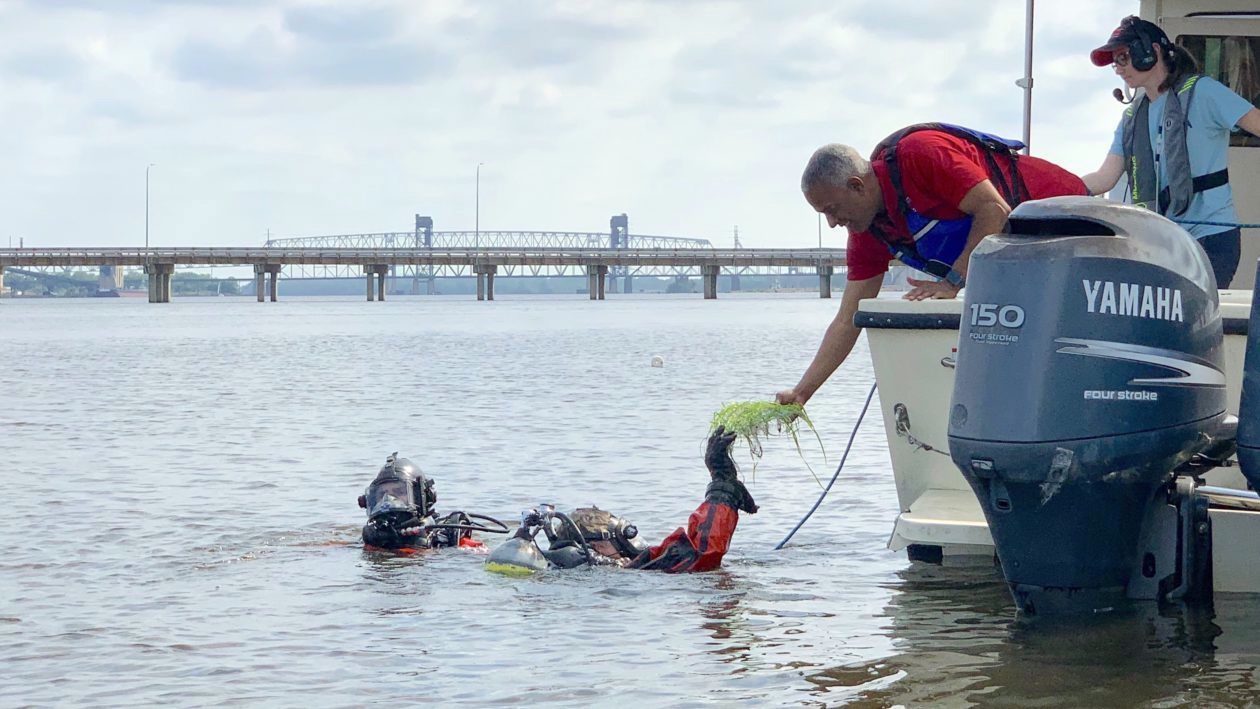
Camden Mayor Vic Carstarphen hands a flat of wild celery to an EPA diver for transplant. Local grasses and oysters are bringing hope to rivers.

We can rescue our environment if we try. Even the infamous city Camden is getting into the act.

Katherine Rapin writes at YaleEnvironment360, “On a recent summer morning near Camden, New Jersey, two divers from the U.S. Environmental Protection Agency hovered over a patch of sediment 10 feet below the surface of the Delaware River. With less than two feet of visibility in the churning estuary, they were transplanting a species crucial to the ecosystem: Vallisneria americana, or wild celery grass. One diver held a GoPro camera and a flashlight, capturing a shaky clip of the thin, ribbon-like blades bending with the current.

“Watching the divers’ bubbles surface from the EPA’s boat was Anthony Lara, experiential programs supervisor at the Center for Aquatic Sciences at Adventure Aquarium in Camden, who had nurtured these plants for months in tanks, from winter buds to mature grasses some 24 inches long. …

“This was the first planting of a new restoration project led by Upstream Alliance, a nonprofit focused on public access, clean water, and coastal resilience in the Delaware, Hudson, and Chesapeake watersheds. In collaboration with the Center for Aquatic Sciences, and with support from the EPA’s Mid-Atlantic team and the National Fish and Wildlife Foundation, the alliance is working to repopulate areas of the estuary with wild celery grass, a plant vital to freshwater ecosystems. It’s among the new, natural restoration projects focused on bolstering plants and wildlife to improve water quality in the Delaware River, which provides drinking water for some 15 million people.

“Such initiatives are taking place across the United States, where, 50 years after passage of the Clean Water Act, urban waterways are continuing their comeback, showing increasing signs of life. And yet ecosystems still struggle, and waters are often inaccessible to the communities that live around them. Increasingly, scientists, nonprofits, academic institutions, and state agencies are focusing on organisms like bivalves (such as oysters and mussels) and aquatic plants to help nature restore fragile ecosystems, improve water quality, and increase resilience.

Bivalves and aquatic vegetation improve water clarity by grounding suspended particles, allowing more light to penetrate deeper

“They also have exceptional capacity to cycle nutrients — both by absorbing them as food and by making them more available to other organisms. Thriving underwater plant meadows act as carbon sinks and provide food and habitat for scores of small fish, crabs, and other bottom-dwellers. Healthy bivalve beds create structure that acts as a foundation for benthic habitat and holds sediment in place.

“ ‘Why not take the functional advantage of plants and animals that are naturally resilient and rebuild them?’ says Danielle Kreeger, science director at the Partnership for the Delaware Estuary, which is spearheading a freshwater mussel hatchery in southwest Philadelphia. …

“One hundred miles north of Philadelphia, the Billion Oyster Project has been restoring the bivalves in New York Harbor since 2010, engaging more than 10,000 volunteers and 6,000 students in the project. [See my post on that here and search on ‘oyster’ for related posts.] Oyster nurseries are being installed in Belfast Lough in Northern Ireland, where until recently they were believed to have been extinct for a century. And a hatchery 30 miles west of Chicago has dispersed 25,000 mussels into area waterways, boosting the populations of common freshwater mussel species.

“Underwater vegetation restoration projects have been underway in the Chesapeake Bay and Tampa Bay for years, and more recently in California where seagrass species are in sharp decline. (Morro Bay, for example, has lost more than 90 percent of its eelgrass beds in the last 15 years.) The California Ocean Protection Council’s 2020 Strategic Plan to Protect California’s Coast and Ocean aims to preserve the mere 15,000 acres of known seagrass beds and cultivate 1,000 more acres by 2025.

“Scientists stress that these projects must be implemented alongside strategies to continue curbing contaminants, mainly excess nutrients from sewage and fertilizers, flowing into our waterways — still the most critical step in improving water quality. After several decades of aquatic vegetation plantings in the Chesapeake Bay, for example, scientists say that the modest increase of plants is largely due to nature restoring itself following a reduction in nutrient pollution.

“And any human intervention in a complex ecosystem raises a host of compelling concerns, such as how to ensure sufficient genetic diversity and monitor competition for food and resources. Scientists say that, in many cases, they’re learning as they go.

“Still, in areas where the natural environment is improving, bringing back bivalves and aquatic plants can create a lasting foundation for entire ecosystems. And restoration initiatives are an active form of stewardship that connects people to their waterways, helping them understand the ecosystems we depend on for our survival.”

More at YaleEnvironment360, here. No firewall.

It’s surprising what can happen when people who didn’t care in the past start to care.

Read Full Post »

merlin_163865472_330a0776-0a88-4fa0-bbca-c08b12292a1c-jumbo

Photo: Bryan Anselm for the New York Times
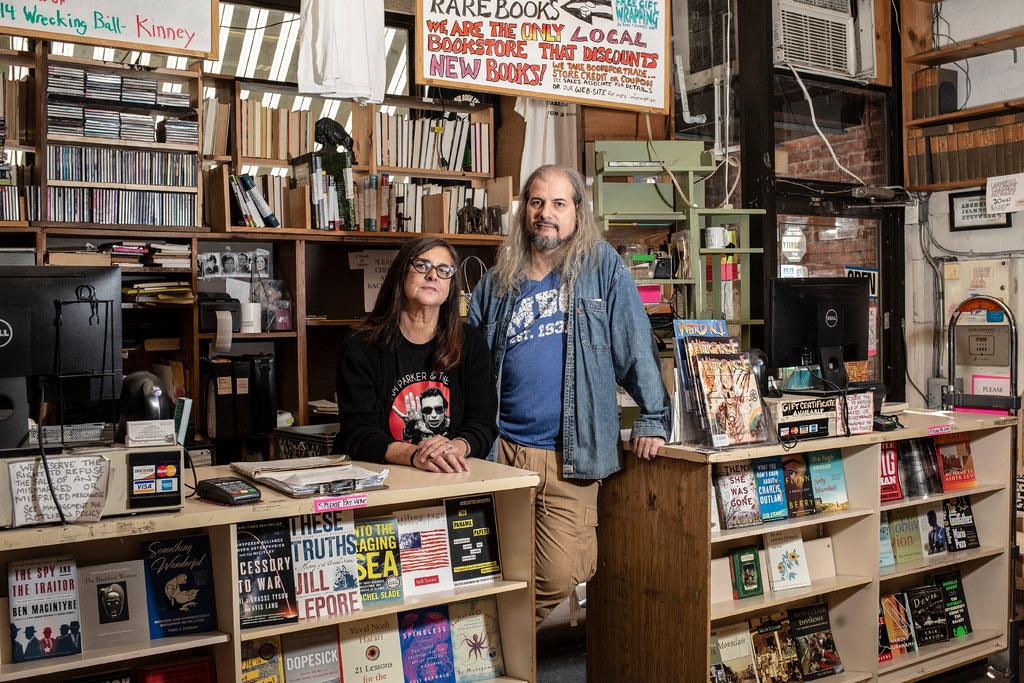
Co-managers Maureen Disimile and John D. Ynsua at the employee-owned Montclair Book Center in New Jersey innovate to keep the magic going.

Who doesn’t find a bookstore magical — especially an independent bookstore? It takes a certain amount of flexibility and creativity to keep one going and not get plowed under by a certain online billionaire. If we all look for books first at our local indy, we can help keep the magic alive.

In New Jersey, Montclair Book Center has found that employee ownership, ability to improvise, and independent-minded customers are critical.

Dana Jennings writes at the New York Times, “Montclair Book Center is 35 years old, going on eternity. A ramshackle throwback to a funkier, more literary time, the store has shelves handmade from raw lumber. And its customers and clerks are often just as eccentric as the shelves.

“I’ve been shopping and snooping there since 1995 and still haven’t exhausted all of this biblioscape’s labyrinths and warrens — some of which, I suspect, lead to C.S. Lewis’s Narnia or Mervyn Peake’s Gormenghast. …

“I’ve stumbled across Italo Calvino limited editions, a hardcover of William Burroughs’s ‘Naked Lunch,’ and a stash of musty, black-and-white comics magazines from the 1960s and ’70s that included ‘Eerie, Creepy and Savage Tales.’ …

“The place is suffused with the sweet reek of ink, decaying pulp and vintage book dust — seductive scents that are like pheromones to book lovers.

“ ‘Unless you work at a bakery, you don’t get many customers talking about how good your store smells,’ said Pete Ryby, who has worked there since it opened in 1984 and is now the store’s primary owner. (Other employees own smaller stakes.)

“The pre-World War I building itself is so cockeyed that it looks set to pratfall down the street, as in some silent Buster Keaton two-reeler. … Still, the store is orderly if not antiseptic. Signs are hand-lettered; there are plenty of chairs for contemplation and ladders for climbing; and, whether by accident or puckish design, the crime section stops short at a fittingly dead end. …

“When I tell people about Montclair Book Center, I almost always mention Ynsua, a friendly 56-year-old filigreed with tattoos and earrings who started there in 1999 and who embodies its eclectic vibe. He owns five kilts and hundreds of vintage T-shirts — Count Chocula, the Emma Peel and John Steed ‘Avengers’ — and his passions as a bibliophile include comics, science fiction and pre-Renaissance European history. He’s also the store’s resident carpenter and a talented cartoonist who once studied at Joe Kubert’s cartooning school in Dover, N.J.

‘I’ve tried not to work for corporations,’ Ynsua said. ‘I like bosses who own their businesses. I like jobs where I can improvise.’

“There’s plenty of that at the Book Center. Indeed, improvisation has helped the store stay in business. Since it started selling used vinyl in 2014, for example, the records ‘have brought in a lot of new customers and increased foot traffic,’ said the co-owner Maureen Disimile, who manages the music side of the business. …

“A quick look at the records revealed a healthy infestation of Beatles; ‘Together,’ by Marvin Gaye and Mary Wells; the musical ‘Hair,’ in the ‘version originale française”’; and even the 1960s British blues rockers Blodwyn Pig. There was also a strong dose of 45s.

“Still, the store comes down to what employees call ‘book people.’ ‘I like being around literature, art and music, and the people who like that stuff,’ said Ynsua, who doesn’t own a computer or subscribe to cable TV. ‘My brain isn’t calcifying here.’

“Lucas McGuffie, a clerk since 2014, added:

‘The attraction is the books, and the book people. They aren’t stupid. They’re more open-minded. They’re smart enough to know that they don’t know all there is to know.’ “

More at the New York Times, here. By the way, if you love vintage vinyl records like the ones at the Montclair Book Center, check out a great R&B collection on my nephew’s site, here. For listening only.

Read Full Post »

Photo: NJ Advance Media
Rodin sculpture of Napoleon turns up in a New Jersey town hall. Drew University grad student Mallory Mortillaro did the legwork to authenticate it. She is pictured here with Rodin expert Jérôme Le Blay.

Sometimes lost treasures actually get found. In this story, a bust by famed sculptor Auguste Rodin turned up in a New Jersey town hall, thanks to a determined grad student.

Justin Zaremba wrote about the discovery at NJ Advance Media.

“The art world lost track of acclaimed sculptor Auguste Rodin’s bust of Napoleon in the 1930s, but it’s apparently been on display for the past 85 years in the most unlikely of places — the council chambers in Madison [New Jersey] Borough Hall. …

” ‘Napoléon Enveloppé Dans Son Rêve’ (‘Napoleon Wrapped in his Dream’) was ‘long rumored’ to be Rodin’s work but the borough and the Hartley Dodge Foundation, which owns the sculpture, didn’t know for certain until about two years ago … [when] Drew University graduate student Mallory Mortillaro was hired by the foundation to go through the various art pieces at the Hartley Dodge Memorial Building.

“The bust was able to hide for so long, he said, because it weighs 700 pounds and requires about five people to move it and its attached pedestal. Rodin’s signature had been hidden from view for decades because that side of the sculpture was pushed against the wall. …

“The building and the artworks inside it were deeded over to Madison by Ethel Geraldine Rockefeller Dodge in the 1930s as a memorial to her son, Marcellus Hartley Dodge Jr., who died in a car accident at the age of 22. The foundation’s sole focus is on preserving the art and architecture of the building. …

“Mortillaro began her detective work by researching every book on Rodin she could find, doing online searches, visiting the Rockefeller archives and contacting officials in the art world.

“Mortillaro, now a teacher at Lawton C. Johnson Middle School in Summit, pursued the case despite receiving the brush off from various art experts.

” ‘No one was being very receptive,’ she said.

Nevertheless, she persisted.

“Mortillaro got in touch with the world’s leading Rodin expert, Jérôme Le Blay, formerly of the Rodin Museum in Paris. …

“According to Mortillaro, when Le Blay walked into the council chambers he turned and said ‘Hello my friend, so is this where you have been hiding?’ …

“The bust had originally been conceived and begun in 1904 at the behest of New York collector John W. Simpson in 1904, but the commission wasn’t completed. Four years later, Thomas Fortune Ryan saw the unfinished piece in Rodin’s studio and acquired it. Rodin completed the piece in 1910. …

“[Hartley Dodge Foundation trustee Nicholas] Platt said the borough and the foundation kept the bust’s identity hidden until now because the insurance company wouldn’t insure the piece for its value and allow them to have the bust open to the public. That’s why for a limited time, it’ll be open to the public — though protected by security — before it leaves the Garden State.

“Platt estimated the piece was worth anywhere from ‘the mid-millions to the 10 million’ range depending on the market.”

The bust will go out on loan to the Philadelphia Museum of Art for a year.

More here.

Read Full Post »

Someone who used to know her well alerted me to the story of the Mystery Grammy Nominee. At 51 and without a record label, she has managed to get a remarkable burst of attention for her music.

Writes Christopher Morris at Variety, “Linda Chorney used the Recording Academy’s Grammy 365 website to connect with voters.

“Armed only with a computer and some chutzpah, a longshot snuck through the back door and into the Grammy Awards competition this year.
The resourceful Linda Chorney secured a Grammy nomination in the category of Americana album for her self-produced, self-released ‘Emotional Jukebox’ by taking her mission directly to voters, employing the peer-to-peer function of the Recording Academy’s own site for members, Grammy 365.

“Many in the tight-knit Americana community have reacted quizzically, and sometimes vehemently, to Chorney’s nomination, which trumped several well-known artists in the genre. The virtually unknown Sea Bright, N.J.-based musician will face off on Feb. 12 against a field of nominees that has collectively garnered a total of 23 Grammys. And while some question her methods, her online campaign falls completely within the academy’s parameters for acceptable self-promotion.” Read more.

There are several videos on YouTube. What do you think? Leave a comment.

Follow us on twitter @LunaStellaBlog1.

Update: Chorney didn’t win a Grammy, but she has been invited to sing the national anthem at Fenway Park before an April 2012 Red Sox game, another item on her “bucket list.”

Read Full Post »