Feeds:
Posts
Comments

Posts Tagged ‘new species’

Photo: California Academy of Sciences.
A potentially new species discovered.

Looking ahead at some of the activities scheduled in my retirement community, I see that in February we can attend a lecture by Prof. Peter Girguis, co-director of the Harvard Microbial Sciences Initiative.

The announcement in our app says, “In this presentation, I will take you on a trip through the deep sea, learning about the extraordinary animals and microbes that thrive therein and about their adaptations to this environment. We will also touch on humankind’s relationship with the ocean, the birth of deep-sea biology, and the technological innovations that first took humans into the deep and how we still have time to turn the tide.”

Sounds pretty good, huh? And I think today’s article will have been the perfect preparation for the talk.

Chandelis Duster reported recently at National Public Radio [NPR] that “scientists believe they have discovered at least 20 new species in a deep part of the Pacific Ocean.

“The discoveries were found after researchers from the California Academy of Sciences retrieved 13 reef monitoring devices that had been placed in deep coral reefs in Guam, which had been collecting data since 2018. The devices, known as autonomous reef monitoring structures or ARMS, were placed up to 330 feet below the surface, an area of the ocean that receives little light.

“Over two weeks in November, scientists retrieved 2,000 specimens, finding 100 species in the region for the first time. Luiz Rocha, California Academy of Sciences Ichthyology curator, told NPR after more analysis is completed, scientists expect to discover more than 20 new species. Rocha was also part of the diving exhibition that placed and retrieved the devices.

” ‘It’s probably going to be higher than that because one of the things we do is we confirm everything with genetics. So we sequence the DNA of the species before we even really make absolutely sure that they’re new,’ Rocha said. ‘And during that process sometimes what happens is what we thought was not a new species ends up being a new species because the genetics is different.’

“He estimates that some of the potential new species could include crabs, sponges, ascidians or sea squirts, as well as new gorgonians, a type of coral.

Deep coral reefs live in an area of an ocean, nicknamed the ‘twilight zone,’ which receives little sunlight.

“Known as the mesopelagic zone, it is a difficult area for some scientists to reach because of pressure and requires specialized diving equipment. Rocha’s team studied the ‘upper twilight zone,’ which sits at 180-330 feet below the surface.

“Finding new species in that part of the ocean was not a surprise for Rocha, who said he and his team were expecting to make new discoveries. But Rocha said he was surprised to see a hermit crab, which usually make their homes in abandoned snail shells, attached to a clam.

‘When they first showed me the picture of it, I’m like, “What, wait, what is that?” I couldn’t even tell what animal it was. And then I realized, oh, it’s a hermit crab, but it’s using a clamshell,’ he said. ‘The species has a lot of adaptations that allows it to do that, and it was really cool and interesting.’

“Rocha and his team have also started a two-year expedition to retrieve 76 more deep reef monitoring devices across the Pacific Ocean, including in Palau and French Polynesia.

“Although studying deep coral reefs may be difficult and challenging, Rocha said it’s crucial to learn more about the reefs and their habitat.”

More at NPR, here.
Read Full Post »

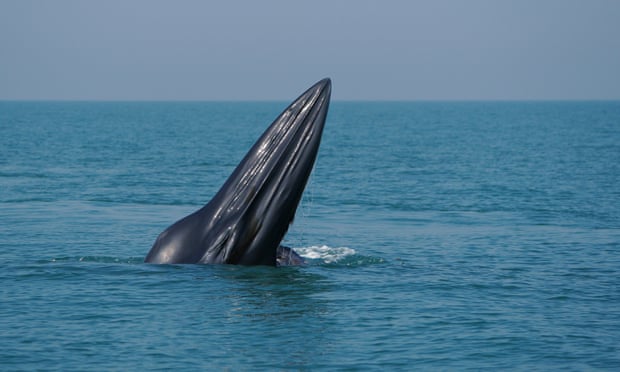
Photo: Xinhua/Rex/Shutterstock.
This is a Bryde’s whale, related to the newly described whale species called Rice’s whales. Rice’s whales were previously believed to be a population of Bryde’s but were recently found to be a whole new species.

Lately, I’ve noticed how many mainstream publications reuse stories from other publications, which helps me feel less guilty sharing others’ work at Suzanne’s Mom’s Blog. As a former magazine editor myself, I am pretty scrupulous about providing links and credits and not using the whole original piece.

And if the use of a photo is blocked, I try to find a different photo elsewhere. But I must say that blocking your photo reduces the number of ways people online can find your article.

In an article from Hakai magazine (an online publication about science and society in coastal ecosystems), Joshua Rapp Learn reported on a unique whale. I learned about it from a reprint at the Guardian.

“Genetic analysis and a close examination of the skulls from a group of baleen whales in the north-eastern Gulf of Mexico have revealed that they are a new species.

“ ‘I was surprised that there could be an unrecognized species of whale out there, especially in our backyard,’ says Lynsey Wilcox, a geneticist with the US National Oceanic and Atmospheric Administration who helped uncover the new species. ‘I never imagined I would be describing a new species in my career, so it is a very exciting discovery.’

“The newly described whales weren’t exactly hiding in plain sight. With a population estimated at fewer than 100, the new whales – which researchers have dubbed Rice’s whales after American biologist Dale Rice – aren’t commonly seen even in the corner of the Gulf of Mexico they call home. It doesn’t help that the whales, previously believed to be a population of Bryde’s whales, have a feeding strategy that takes them deep under the water around DeSoto Canyon, about 100km south of Mobile, Alabama.

“Researchers have long known that this group of Bryde’s-like whales in the Gulf of Mexico was different. They seemed to mostly stay put in the north-eastern corner of the gulf, and didn’t mingle with Bryde’s whales, which … typically forage near the surface.

“But it’s difficult even for experts to tell large baleen whales apart in the field – so much so that Bryde’s whales sometimes get confused with fin whales, says John Hildebrand, a biological oceanographer at Scripps Institution of Oceanography at the University of California San Diego who was not involved in the recent study. …

“Wilcox’s colleagues first began collecting tissue samples from Rice’s whales in 2000, eventually collecting samples from 36 different individuals.

Comparing their genes with Bryde’s whales, Wilcox says she and her colleagues ‘noticed that they weren’t quite what was expected.’

“To compare their morphologies, the scientists inspected skeletons held in museums. Then, in January 2019, an 11-meter-long Rice’s whale washed up on a key in the Florida Everglades. Examining the whales’ skulls revealed some differences in the shape and size of the bone material around the blowhole. …

“Rice’s whales are already considered endangered by the United States. They were listed under the Endangered Species Act as a population of Bryde’s whales in April 2019, and the discovery that they are a distinct species is unlikely to change much – other than requiring an update of their name. Living in the Gulf of Mexico, the whales face threats from oil spills, ship strikes, ocean noise and entanglement in fishing gear.

“Hildebrand says the whales are particularly vulnerable to ship strikes because they have the ‘unfortunate habit’ of sleeping at night just under the sea’s surface. … Hildebrand speculates that the whales might once have been more widespread in areas with deeper water, but they are now holing up in an area that sees less ship traffic.

“ ‘They are the most endangered, or nearly the most endangered, baleen whales in US waters,’ Hildebrand says. ‘In terms of the responsibility for the health of the whale, it really does fall on us.’ ”

Read some really wonderful stories about sea life at hakaimagazine.com.

Read Full Post »

If you can’t photograph the ivory-billed woodpecker in Louisiana or Cuba or wherever it is rumored to have survived, the next best thing is to find a brand new species. That’s what Simon Mahood did in Cambodia.

Thomas Fuller writes about it in the NY Times. “The discovery of new fauna conjures up images of Livingstone-like explorers trekking through malaria-infested jungles. But scientists working in Cambodia have reported a new species of bird in a decidedly less remote environment: the outskirts of Phnom Penh.

“Simon Mahood, the lead author of an article released Wednesday in the Oriental Bird Club’s journal Forktail, says the bird’s primary habitat is about a 30 minutes’ drive from his home in Phnom Penh, ‘allowing for traffic.’

“ ‘I’ve always wanted to discover a bird species, but I never expected it would happen like this,’ Mr. Mahood, who works for the Wildlife Conservation Society in Cambodia, said by telephone from Phnom Penh. ‘I certainly didn’t expect to be standing in flip-flops and shorts a half an hour from home.’

“Roughly the same size as a wren, with white cheeks and a cinnamon cap, the bird was named the Cambodian tailorbird by the team that documented the discovery. Tailorbirds get their name from the way they build their nests, by threading spider silk or other fibers through a leaf, creating a sort of cradle.” More.

Photo: Ashish John/Wildlife Conservation Society
The Cambodian tailorbird was found near Phnom Penh.


Read Full Post »