Feeds:
Posts
Comments

Posts Tagged ‘No Mow May’

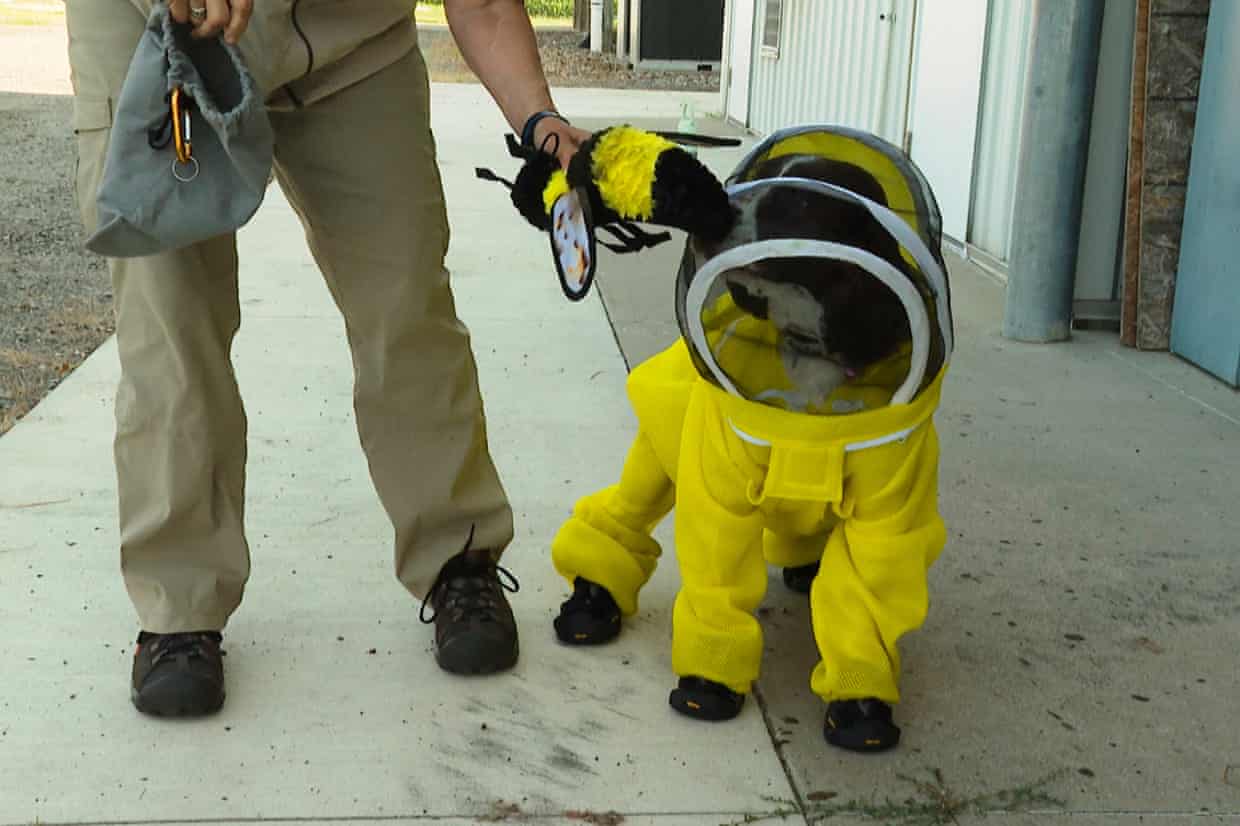
Photo: Mike Householder/AP.
Sue Stejskal lets Maple, an English springer spaniel, sniff a bee-themed dog toy at Michigan State University’s Pollinator Performance Center. Maple is part of an effort to screen and diagnose diseases that sicken honeybees.

It seems that over the past few years, I’m hearing more and more about bees — their importance to the food chain, their worrisome diseases. On Instagram I’ve been following the intrepid Erika Thompson @texasbeeworks, and after Sandra told me about an inspiring bee tour, I added @bodhis.bees in Rhode Island. Then, there’s my friend AJ, who shares honey from his hives when the black bear leaves them alone.

Keeping bees and other pollinators healthy is an important job that’s getting increasingly difficult as unaware humans damage their environment. In today’s story, a specially trained dog is helping protect bees.

Ramon Antonio Vargas reports at the Associated Press via the Guardian, “Maple, a springer spaniel aged nine, is earning news headlines by helping Michigan State University (MSU) researchers identify bacteria that is harmful for bee colonies. …

“Maple landed the role after spending seven years detecting human remains for a sheriff’s office. She had to retire from the sheriff’s office after suffering an injury on the job – leaving her handler, Sue Stejskal, in search of something to keep Maple busy.

“ ‘She’s a very over-the-top, enthusiastic, sometimes hard-to-live with dog because of her energy level,’ Stejskal, who has been training dogs for law enforcement and other uses for more than 25 years, said to the AP.

“Fortunately for Stejskal, MSU professor Meghan Milbrath was seeking out tools to screen and diagnose diseases that sicken honeybees, which her lab studies. A veterinarian who had taken part in a training about honeybees later put Stejksal and Milbrath in touch.

“And soon, the pair hatched a plan by which Stejskal taught Maple to apply her police canine detection methods in beehives to uncover American foulbrood – a bacterial disease that poses a deadly threat to honeybee larvae.

“The work Maple has since done for MSU’s Pollinator Performance Center has been crucial, with bees and other pollinators in a years-long decline stemming from diseases, insecticides, a lack of a diverse food supply and climate change driven by human emissions of greenhouse gases.

“ ‘American foulbrood [harms] young developing bees, and when a hive gets infected, it actually basically leads to death,’ Milbrath, an assistant professor in MSU’s entomology department. …

” ‘Beekeepers have had to burn tens of thousands of dollars of equipment due to this disease,’ Milbrath said to WILX.

“Maple carries out her duties in a distinctive, yellow protective suit. Her gear includes a veil for her head and four bootees worn on her paws to shield Maple in case she steps on a bee. …

“About 465 bee species are native to Michigan alone. Among the goals of training Maple to spot American foulbrood for the Pollinator Performance Center was to create a guidebook with which other dogs could be similarly taught, WILX noted.

“Stejskal told the AP, ‘I was over-the-moon excited because my dog would have joy in her life and would still be able to work,’ Stejskal said.” More at the Guardian, here.

You probably know there are things we can all do to help bees.

Many homeowners, for example, are giving up pesticides and herbicides. They are leaving the leaves on their lawns in fall to provide pollinator habitat in spring, and they’re committing to No Mow May. After all, as Bee City tells us, “The start of the growing season is a critical time for hungry, newly emerged native bees. Flowers may be hard to find. By allowing it to grow longer, and letting flowers bloom, your lawn can provide nectar and pollen to help your bee neighbors thrive.”

Please add bee tips if you know of some not covered here.
Read Full Post »

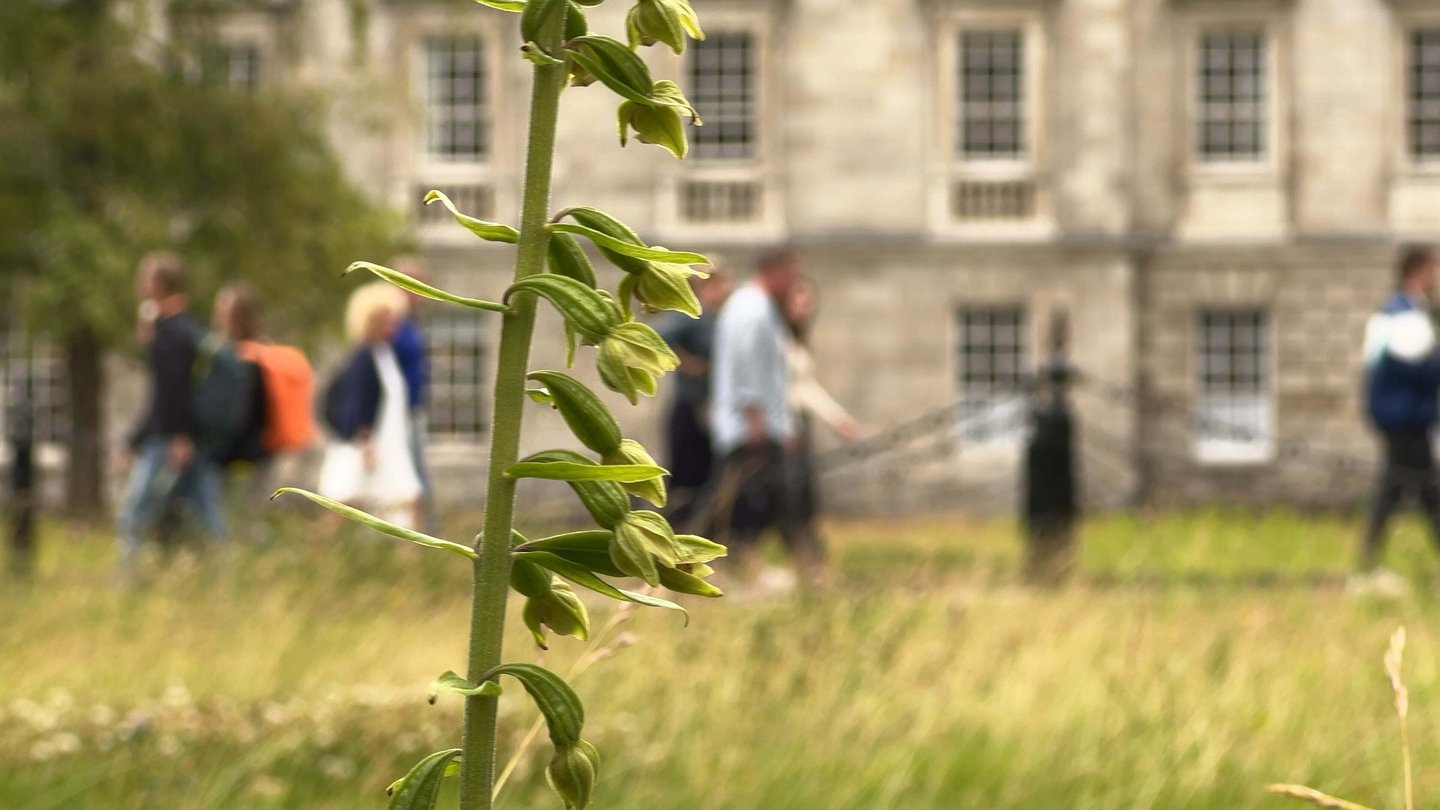
Photo: RTÉ.ie (Raidió Teilifís Éireann), Ireland’s National Public Service Media.
One of the broad-leaved helleborines near the front arch of Trinity College in Dublin. Good things are growing in the city after No Mow May.

John made a good point about No Mow May the other day. The initiative to give a chance to plants that pollinators love has been growing, but why destroy the improved ecosystem by mowing in June?

Philip Bromwell writes at RTÉ (Ireland’s National Public Service Media) about an approach in Dublin.

“Two species of orchids have been discovered growing on the campus of Trinity College in Dublin city centre, much to the surprise and delight of botanists.

“The wild plants — a broad-leaved helleborine and a pyramidal orchid — have popped up in a lawn next to Trinity’s iconic Front Arch.

“Inspecting the 60cm [~2 foot] broad-leaved helleborine, Professor Jennifer McElwain, from TCD’s School of Natural Sciences, said … ‘It’s really unusual to find this orchid anywhere. It’s rare. It’s extra unusual to find it in the middle of Trinity, right in Front Square, in the middle of the city.’

“There are around 30 different species of wild orchids in Ireland. Some thrive in fields, others prefer bogs, woods or mountains.

“Professor McElwain believes the appearance of the orchids in Trinity are the result of the university’s participation in ‘No Mow May’ – the annual campaign that encourages gardeners to not mow their lawn during the month of May so that plants and pollinators benefit.

” ‘We wanted to implement a positive measure for biodiversity. So, we just simply stopped mowing this lawn in May. And that was difficult to do, because a lot of people really like finely cut lawns. But we stopped mowing, and this wonderful orchid began to emerge. And there’s not just one — there are three orchids, including another species. So, we actually have an orchid-rich meadow.

‘That’s a botanist’s dream and our only intervention has been to stop mowing the lawns.’

“Orchids have the smallest seeds of all flowering plants, with a typical seed the size of a speck of dust.

” ‘A seed could have blown in by wind. It could have come in on the feet of people, or been brought in by a bird,’ Professor McElwain explained. ‘Alternatively, this seed could have been in this lawn for decades. Underground, just waiting for the right conditions to allow nature to thrive. And the right conditions in this case happened to be not mowing the lawns.’

“Flower-rich, grassland habitats are rapidly disappearing from the island of Ireland and one third of our wild bees are threatened with extinction.

“Trinity installed wildflower meadows on College Green in 2020 after thousands of students, staff and members of the public voted to replace the manicured lawns at the front entrance to the university with the more nature-friendly alternative. …

” ‘I think this a really hopeful demonstration that biodiversity and nature can thrive if we just give it time and space. We are in the midst of biodiversity and climate crises. It can seem overwhelmingly complex to solve it, but it’s our responsibility to show what’s possible.

” ‘In this lawn alone, more than 35 plant species have come up. And if you think each one of those plant species supports one or two species of pollinators, that’s 90-odd species. If this lawn was a mown, clipped lawn, you would have a species diversity of one.

” ‘This demonstrates how simple measures can lead to really spectacular results. Never in our wildest dreams did we expect this,’ she said.”

More at Ireland’s National Public Service Media, here. No firewall. For more insight on the importance of meadows, see my friend Jean’s Devine Native Plantings, here.

How do you feel about giving up lawns? We have not had one for years, initially because neighborhood dogs kept destroying ours, but nowadays because we like the look of vinca. I do think that while a family’s kids are young, a lawn for outdoor games is pretty necessary, but not with weed- and bug-killers.

Read Full Post »