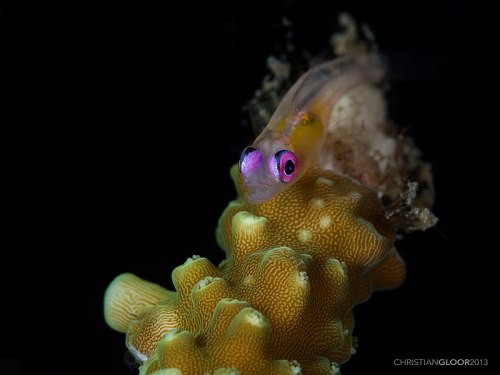
Photo: Christian Gloor
By living fast and dying young, red eye gobies fuel reef fish biomass production, which helps explain why reefs can flourish in nutrient-poor waters.
You don’t have to be big to be important. Consider the tiny red-eyed goby, a fish that is vital to coral reefs. For years, scientists couldn’t figure out how there could be such lush biodiversity on coral reefs in clear, low-nutrient waters.
Turns out the answer was hiding under their noses.
Leila Miller writes at the Los Angeles Times, “It’s one of the enduring mysteries of marine biology: How can coral reefs sustain such diverse ecosystems when they are surrounded by clear, low-nutrient waters? Now scientists think they’ve found the answer, and it’s been hiding in plain sight all along.
“The coral reef food chain is powered by some of the ocean’s smallest vertebrates — tiny fish that are gobbled up so quickly they’ve been easy to overlook.
“These fish are small enough to fit in the palm of your hand, but they play an almost heroic role in sustaining coral reefs, according to a study published this month in the journal Science. In fact, these little swimmers account for almost 60% of the fish flesh eaten on reefs, researchers found.
“ ‘They’re really like high-octane fuel for larger fish,’ said study leader Simon Brandl, a marine ecologist at Simon Fraser University in Burnaby, Canada. …
“Coral reefs are like underwater rain forests — they’re incredibly diverse and are home to more than 6,000 species of fish, Brandl said. Yet the nutrients needed to maintain this abundance of life seemed to be lacking. …
“Brandl and his colleagues make a strong case that high turnover of tiny fish is an important part of the story, said Douglas McCauley, a marine biologist at UC Santa Barbara who did not work on the study. …
“The tiny fish hatch from eggs, and within a day or so, the larvae are old enough to find their own food. Then they have to grow up and reproduce within a month or two — before they get eaten. …
“The females have another problem to contend with: low egg counts. Their small bodies can produce only about 100 eggs at a time, on average, while larger fish may lay tens or hundreds of thousands.
“ ‘It didn’t seem to add up,’ said senior author David Bellwood, a marine biologist at James Cook University in Townsville, Australia. ‘How on Earth did they survive?’
“In a word: larvae. … While the larvae of most coral reef fish wander out into the open ocean to escape predators on reefs, the larvae of cryptobenthic fish hang out near the reef as they mature. This seems to dramatically enhance their survival and return rates, Brandl said. …
“It may seem surprising that scientists didn’t know where more than half of the fish food supply was coming from, but at any given moment, the tiny fish make up only a minuscule percentage of the total fish flesh on a reef. The key was to see that the population replenished itself so quickly, [Luke Tornabene, a fish biologist at the University of Washington in Seattle who worked on the study] said.”
Read more at the Times, here.
Hat tip: Matt Stiles on Twitter.


 Suzanne's Mom's Blog