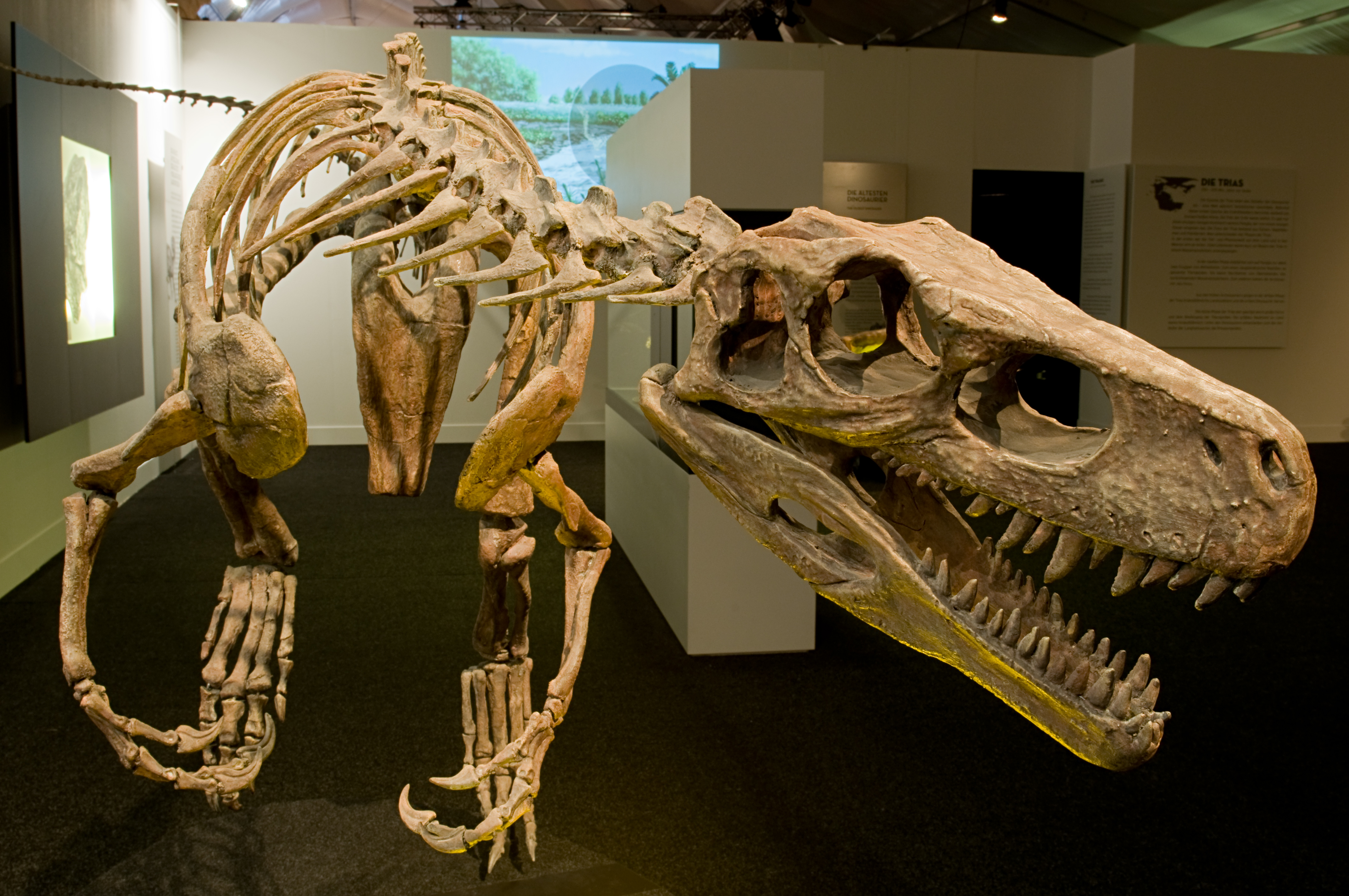
Photo: Eva K. via Wikimedia.
Herrerasaurus skeleton replica at a special exhibition of the Naturmuseum Senckenberg in Frankfurt am Main, the largest museum of natural history in Germany.
As we take in the horrendous flooding of two major hurricanes in the US this month, it’s hard to imagine that heavy rains and floods ever do anything beneficial. But last May in Brazil they added to human knowledge of dinosaurs, and that could be useful.
Eléonore Hughes wrote at the Associated Press, “A team of Brazilian scientists has discovered a fossilized skeleton of what they believe is one of the world’s oldest dinosaurs after heavy rains in the southern state of Rio Grande do Sul accelerated the natural process of erosion.
“The fossil found next to a reservoir in the municipality of Sao Joao do Polesine is [the oldest yet] according to paleontologist Rodrigo Temp Müller, who led the team from the Federal University of Santa Maria that found the bones in May. The claims have not been verified by other scientists or published in a scientific journal [as of this writing].
“The researcher believes the dinosaur lived during the Triassic period, when all continents were part of a single land mass called Pangaea. Dinosaurs are thought to have first evolved at that time.
“The apex predator discovered in Rio Grande do Sul belongs to the group known as Herrerasauridae — a family of dinosaurs that used to wander across lands that now make up present-day Brazil and Argentina, according to a fact sheet about the discovery shared with the Associated Press.
“The size of the bones reveals that the dinosaur would have reached around 2.5 meters (8.2 feet) in length, according to the document. …
‘Initially it seemed like just a few isolated bones, but as we exposed the material, we were able to see that we had an almost complete skeleton,’ Müller said. …
“Researchers will now try to determine whether the fossil belongs to an already known species or a new kind. That work is expected to take several months, as the process is meticulous to ensure no damaged is caused.
“Fossils are more likely to appear after rains, as water exposes the materials by removing the sediment that covers them, in a phenomenon known as weathering.
“Rio Grande do Sul saw record amounts of rainfall earlier this year. That caused devastating floods in May that killed at least 182 people, according to a toll published by the state’s civil defense on July 8. …
“Müller said that more fossils are appearing because of the heavy rains, which has launched a race against time to rescue the materials before they are ruined.
“In the field, his team observed ‘a leg bone and a pelvis bone in the pelvic region that were already being destroyed due to the rain,’ he said.”
More at APNews, here. If you’re keen on dinosaurs, check out the paleontologist’s diary of the excavation, here.


 Suzanne's Mom's Blog