Feeds:
Posts
Comments

Posts Tagged ‘olympics’

Photo: Sabine Glaubitz/dpa/picture alliance.
Notre Dame’s spire is visible once again following the partial removal of scaffolding.

After the Notre Dame cathedral in Paris burned, there were many suggestions for rebuilding it with lots of modern features, but tradition mostly won out. Ancient craft processes and materials were used whenever possible. People from all over pitched in.

Stefan Dege writes at DW, “The fire was still raging at the Notre Dame Cathedral on April 15, 2019, when French President Emmanuel Macron vowed to renovate and reconstruct the medieval monument within five years. Since then, work on the Gothic Episcopal church has been in full swing and is apparently on schedule.

” ‘We are meeting deadlines and budget,’ Philippe Jost, the head of reconstruction efforts, told a French Senate committee in late March. …

“The cathedral is officially scheduled to reopen on December 8, 2024. Though it will not be ready in time for the Summer Olympic in Paris, as was initially desired, visitors to the French capital can once again see Notre Dame’s towering spire following the recent removal of the surrounding scaffolding. The lead roof is also currently being installed. Fire-prevention features, such as a sprinkler system and compartmentalized sections, are also part of restoration efforts. …

“Exactly five years have passed since the fire, which partially destroyed the historic building. The Paris fire department fought for four hours before it was able to confine the fire to the wooden roof truss. The west facade with the main towers, the walls of the nave, the buttresses and large parts of the ceiling vault remained stable, along with the side aisles and choir ambulatories. Heat, smoke, soot and extinguishing water affected the church furnishings, but here, too, there was no major damage. …

“The extent of the destruction was not as great as initially feared. ‘Thank God not all the vaults collapsed,’ German cathedral expert Barbara Schock-Werner told DW at the time. Only three vaults fell in the end, and there was a hole in the choir. …

“French donors alone pledged €850 million ($915 million) to help restore the landmark. But money and expertise also came from Germany, with Schock-Werner taking over the coordination of German aid.

Cologne Cathedral’s construction lodge restored four stained glass windows that had been severely damaged by flames and heat. The four clerestory windows with abstract forms are the work of the French glass painter Jacques Le Chevallier (1896-1987), and were produced in the 1960s.

“In the glass workshop in Cologne, they were first freed from toxic lead dust in a decontamination chamber. The restorers then cleaned the window panes, glued cracks in the glass, soldered fractures in the lead mesh, renewed the edge lead and re-cemented the outer sides of the window panels. …

“As dramatic as the fire was, a discovery by French researchers at the fire site was just as sensational: iron clamps hold the stones of the structure together. Dating and metallurgical analyses revealed that these iron reinforcements date back to the first construction phase of the church in the 12th century. This may make Notre Dame the world’s oldest church building with such iron reinforcement.

“But more importantly, the mystery of why the nave was able to reach this height in the first place has also been solved. When construction began in 1163, Notre Dame — with its nave soaring to a height of more than 32 meters (about 105 feet) — was soon the tallest building of the time, thanks to a combination of architectural refinements. The five-nave floor plan, the cross-ribbed vaulting with thin struts and the open buttress arches on the outside of the nave, which transferred the load of the structure from the walls, made the enormous height possible. …

“In a stroke of luck, the cathedral’s showstoppers — the statues of the 12 apostles and four evangelists that architect Eugene Viollet-le-Duc grouped around the ridge turret he designed in the 19th century — survived the fire unscathed because they had been removed from the roof shortly beforehand for restoration.

“Some 2,000 oak trees were cut down for the reconstruction of the medieval roof truss. To work the trunks into beams, the craftsmen used special axes with the cathedral’s facade engraved on the blade. These can be seen in a special exhibition in the Paris Museum of Architecture. The show also details the painstaking work that was required to reinstall stones and wood in their original places to make the reconstruction as true to the original as possible.”

More at DW, here. No firewall.

Read Full Post »

Photo:CHHA.

I’ve always thought that housekeepers, whether in an office building, a home, or a hotel, know more about clients than almost anyone. In their quiet efficiency, they are practically invisible to other people, which is why mystery writers and movie makers have noticed they are perfect for providing some surprise clue.

Housekeepers don’t give themselves away. There is no public competition in the realm of intelligence gathering. But there is one in another realm.

At the Washington Post, Dan Michalski wrote in November about big hotel chains’ annual Housekeeping Olympics.

“The arena was bouncing. Screams, clappers and vuvuzela horns echoed from all directions as competitors below scrambled around six queen beds, vigorously flapping white sheets and stuffing pillowcases as the clock ticked.

“The Housekeeping Olympics, held [at] the Michelob Ultra Arena at Mandalay Bay, were back for the first time since before the pandemic. The event was hosted by the Indoor Environmental Healthcare and Hospitality Association.

“Febe Rodriguez was competing for the Bellagio in bed-making.

She faced off against teams from six other Las Vegas hotels, as well as a housekeeping team from the Defense Department and two groups of hospitality workers from Canada. …

“The race was watched by clipboard-carrying judges who assessed time penalties for imperfect hospital corners and ill-measured bedspread fold-overs.

“Her co-workers and their families started chanting ‘Fe-be! Fe-be!’ as she made final tucks and thrust her arms in the air at the finish of what would turn out to be a gold-medal-winning performance. …

“The 33rd running of the Housekeeping Olympics consisted of six events: bed-making, a mop race, vacuuming, a buffer pad toss, a spirit dance and the executive challenge, where hospitality team bosses navigated a slalom course driving floor scrubbers.

“But this year’s competition almost didn’t happen. After three years of coronavirus-related cancellations, this previously annual event put on by the Ohio-based IEHA ran into the possibility of a casino workers strike, potentially the largest in history, just days ahead of the 2023 opening ceremonies.

“The hotel housekeeping landscape has also changed since the last time the event was held. Hotels have dealt with labor shortages and have cut back on daily housekeepingHousekeepers have been hit by a cashless economy that has chipped away at tipping. …

“Just weeks earlier, many of these same housekeeping workers picketed outside Mandalay Bay, Luxor, Park MGM, Bellagio and other casino properties. The Culinary Workers Union, which represents some 53,000 Las Vegas casino workers, was coordinating a potential walkout ahead of the city’s F1 Las Vegas Grand Prix.

“But the casinos and union came to a deal [that] included significant pay increases, better job security and improved working conditions. …

“ ‘Last week, we were angry,’ Rodriguez said. ‘But now we have the contract, so that makes the spirit wake up.’ ”

More at the Post, here.

Read Full Post »

Photo: Wahrmund/ Wikimedia.
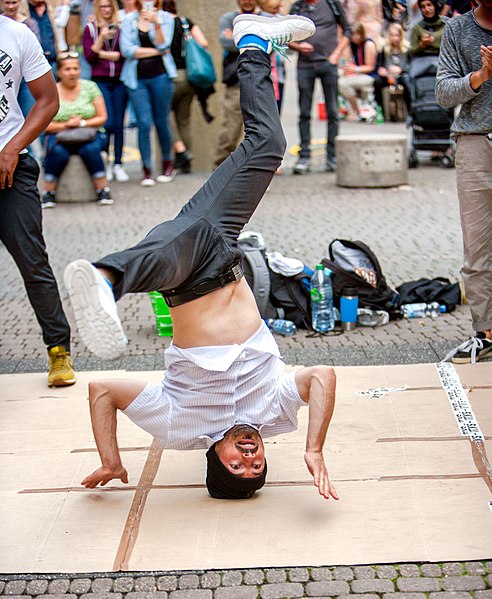
Break dancing in Cologne, Germany, 2017.

Back in the 1980s, John was really into break dancing. I think he mainly replicated what he saw other people doing, although he might have taken a class.

Today break dancing is considered athletic enough to be included as a competitive sport in the Olympics. Wow.

Rick Maese has the story at the Washington Post. “When her son had his fill of piano lessons, Ellen Zavian began looking for some other activity to keep him busy. She paid a visit to a dance studio in Washington that specialized in breaking — better known as break dancing to anyone who remembers the 1980s or simply breakin’ to many participants — and it didn’t take long before mother and son were hooked.

“Zavian is a sports law professor at George Washington University. … It didn’t take long before she started brainstorming about what was possible with breaking, an acrobatic urban dance style long associated with oversized boomboxes, hip-hop music, athletic spinning, whirling and ‘freezing.’

“ ‘I just thought: “My kid loves it. I work in sports. I’ve created associations. Why not? This is what I do,” ‘ Zavian said

“That was a full decade ago. The result was the United Breakin’ Association (UBA), an early step in organizing a sprawling, disorganized collection of young dancers, known as b-boys and b-girls, many of whom had no interest in formalizing and codifying their preferred form of self-expression. They were part of an anti-establishment counterculture that feared being co-opted by people who didn’t understand the dance or its dizzying band of denizens.

“The story of breaking’s meteoric rise to the Olympic stage — it’s set to make its debut at the Paris Summer Games in 2024 — involved an unlikely and reluctant partnership between street-savvy breakers and traditional ballroom dancers. …

“’Most of us knew that this could be big one day. We just didn’t really know how it would happen,’ said veteran b-boy Moises Rivas, who dances under the name ‘Moy.’ …. ‘We just had to deal with the misconceptions, negative connotations and people who didn’t always want to give it the credibility it deserves.’

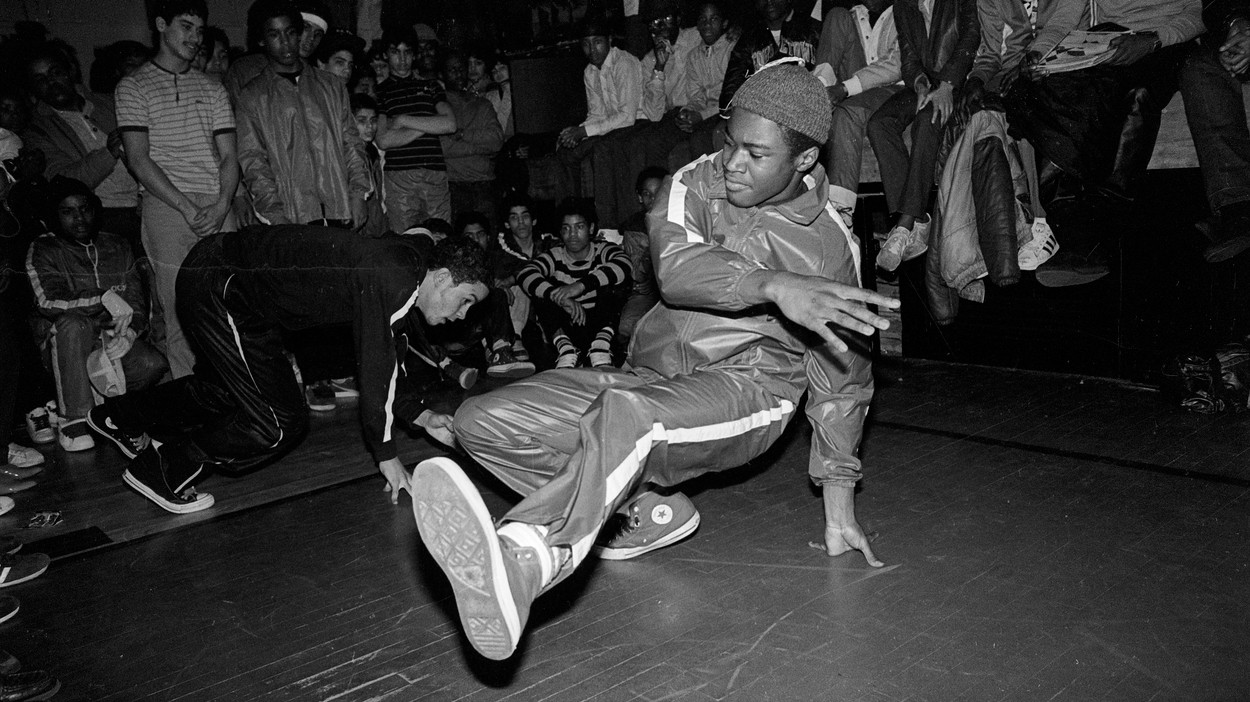
Photo: Ricky Flores.

“Born in the South Bronx nearly 50 years ago, breaking long ago had spread across the world. … From Los Angeles to Miami, there were parallel efforts to grow the sport but little coordination. Steve Graham had dabbled in breaking in college in the early 1980s. He worked on Wall Street and then established a successful private equity firm in Philadelphia. He gravitated back to breaking in his 50s, dancing alongside his children. He saw the potential for growth. The dance wasn’t just a form of expression; competition was baked into it with fierce dance battles between b-boys and b-girls.

“He ran a popular competition in Philadelphia and established a Pro Breaking Tour and a nonprofit membership organization called Urban Dance & Educational Foundation with a vision of drawing together the fragmented breaking world. Many of the competitions were spectacles, drawing large crowds with elaborate lights and window-rattling beats, but the sport was driven by independent event promoters without any movement trained on the Olympics.

“Far removed from booming bass notes and twirling young b-boys, however, serious efforts were afoot to get other forms of dancing on sport’s biggest stage. The global governing body was called International DanceSport, an umbrella organization for all dance disciplines, from Boogie Woogie to salsa. It was formally recognized by the International Olympic Committee in 1997, but officials there failed in their efforts to get ballroom dancing accepted into a Summer Games. Rather than pack up their tap shoes, they rebranded as the World DanceSport Federation (WDSF) and decided to double-down. …

“Breaking was far from the organization’s core when WDSF enlisted the help of Jean-Laurent Bourquin, an IOC veteran, in 2015, asking him for his help in wooing Olympic officials. The WDSF leaders were hopeful they could push specific styles of dance — either Latin or rock-and-roll — but after consulting with his colleagues in the Olympic world, Bourquin surprised them. …

“Dancing would be a viable candidate for the Olympics, he told them, but not the style they were used to.

“The WDSF’s top governing board included no breakers, so the proposition was something of a quandary: The organization could realize its Olympic dream, but only with a rogue, largely unfamiliar discipline.

“ ‘It was a bitter pill that was hard for everyone to swallow,’ recalled Ken Richards, who was on the board at the time and is now president of USA Dance. … ‘We had to come to this understanding and agreement that if dance can get a foot in the door with a style the IOC wants, then maybe the other dances aren’t as far behind as we feared.’

“Bourquin planted a seed with the IOC in 2016 and traveled to the Rio Olympics to chat up IOC members. [He] wanted to see breaking at the 2018 Summer Youth Olympics in Buenos Aires, a more apt platform and a friendly way to introduce the sport to Olympic officials, who skew older. For many in the Olympic world, it was the first time they considered dancing a true sport. And for many in the breaking world, it was the first time they considered the Olympics a realistic goal. …

“ ‘They didn’t view their talent as a sport,’ Zavian recalled, ‘so I had one of the skateboarders come to our meeting and talk about the difference between a sport and art. It was a very heated topic: “You’re going to take our culture away. You’re going to take our art away.” ‘ …

“But the ball was moving. While Graham provided much of the funding, the critical push for the Summer Youth Olympics was spearheaded by the larger dancing community, not the breakers.”

At the Washington Post, here, you can read what happened next.

Read Full Post »

Nicole Freedman is a woman with a mission. A professional bike racer from 1994 to 2005 and a competitor in the 2000 Olympics, she was appointed by Boston Mayor Menino in 2007 to move the city from the bottom of the bikable-cities list to the top. In a few years, much has changed. Protected bike lanes have appeared all around the Greater Boston area, citywide biking events have enticed everyone from beginners to experts, and new bike maps are widely available.

Now Freedman and the New Balance company have brought bike sharing to the Hub. It’s not just for Europe anymore.

“New Balance Hubway is your Boston bike sharing system. Launched in Boston on July 28, 2011, with 61 stations and 600 bicycles, with an eye towards expanding into Boston neighborhoods and surrounding communities, New Balance Hubway provides you with an accessible and green transit option. Rent a bike near your home or office and pedal your way to the next lunch meeting, errand or shopping trip, or to visit friends and family.”

Read more here. Learn how you can borrow bikes and where you can return them.

But BYO helmet because Boston drivers are still Boston drivers.

Read Full Post »

Chinglish

I first read about Oliver Radtke and his website dedicated to preserving Chinglish in around 2006. Radtke was alarmed that some of the more charming English translations of signs were disappearing in China prior to the Beijing Olympics. He elicited the help of international visitors to China, requesting them to e-mail their pictures to him for posting. As I went to Shanghai in early 2007, I was able to join the fun. Radtke used a photograph I took of an escalator sign in his first Chinglish book.

My sign said “Keep your legs.” Other samples included signs in parks, like “Show mercy to the slender grass.” Menus, of course, were great hunting grounds, and Radtke posted numerous examples, including “man and wife lung slice” and “advantageous noodle.”

Radtke doesn’t have a corner on the market,, though. Many people have been having fun with Chinglish over the years. Read more at Wikipedia.

Of course, I would sound much more ridiculous trying to speak or write Chinese — or any other language, for that matter. I admire anyone who launches into such foreign terrain. But I do think there is something fascinating and instructive about how speakers of other native tongues use one’s language. I always appreciate the more awkward translations for how they show a different culture’s thinking.

Read Full Post »