Feeds:
Posts
Comments

Posts Tagged ‘orca’

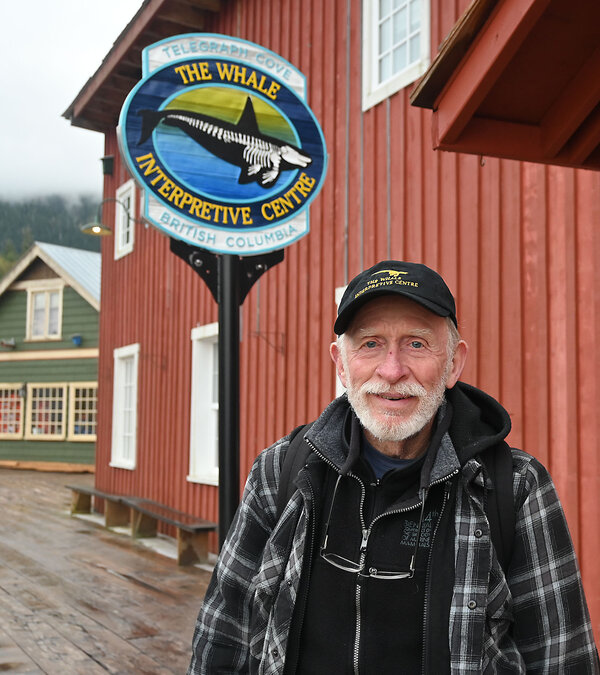
Photo: Jules Struck.
Jim Borrowman was part of a successful lobby to create an ecological reserve in western Canada’s Johnstone Strait in the 1980s.

Today’s story is about a few people whose determination helped to reverse the decline of a group of Orca whales — people who just don’t give up.

At the Christian Science Monitor, Jules Struck wrote recently about their work.

“Jim Borrowman cut the engine of the Nisku in the gray water of the Johnstone Strait, relinquishing his boat to an eastbound tide. He unraveled the line of a hydrophone – a cylindrical, underwater microphone – and dropped it portside.

“On the other end of the cord a pint-size Honeytone speaker in the cabin broadcast a conversation from the deep: the ethereal, two-toned call of an orca whale to her clan.

“ ‘I think they’re what we call “A1s,” ‘ said Mr. Borrowman, browsing a database of local orcas on his phone.

“Mr. Borrowman has been watching, and watching over, these whales for decades. He was one in a band of Vancouver Islanders who successfully lobbied in the early 1980s to set aside a protected area for Northern resident orcas, which lost a third of their population to hunting and capture in the 1950s and ’60s.

“This early act of ocean preservation laid a foundation from which decades of important research – and a deep local allegiance to the whales – have flourished. Galvanized by this data, environmentalists and First Nations just won a battle to evict commercial open-net fish farms from the area, which compete with the orcas’ food supply.

“With early signs of abundant salmon, and a small but decades-long uptick in Northern resident population numbers, it feels to some like nature rallying.

“ ‘You can see the whales coming back,’ says Alexandra Morton, an author and marine biologist who has studied salmon in the Johnstone Strait since the 1980s. She was part of a group that occupied a Vancouver Island fish farm in 2017 in protest of the industry.

“The A1s spotted by Mr. Borrowman from the bow of the Nisku are one pod of one type of orca, called Northern resident killer whales, which number some 400 and live along the coast of British Columbia.

“They’re doing particularly well, and have been growing by a handful of members each year since the ’70s. Northern residents are the most reliable visitors to the Robson Bight (Michael Bigg) Ecological Reserve, where Mr. Borrowman has served as a warden and run a whale-watching tour business with his wife, Mary, for decades until recently retiring.

“ ‘This is a beautiful, sensitive estuary at the terminus of a 100,000-acre watershed, the last untouched one on the east coast of Vancouver Island at the time,’ he says.

“It’s unique for another reason. At two known beaches at the mouth of the Tsitika River, Northern resident orcas rub gracefully along the seafloor pebbles in what scientists have dubbed a unique ‘cultural behavior.’

“It was this behavior, first captured in underwater footage by Robin Morton, Alexandra Morton’s late husband, that convinced the public, the press, and finally the federal government to set aside about 3,000 acres of water plus shore buffer as a protected area closed to boat traffic.

“Today, volunteer wardens with the Cetus Research & Conservation Society Straitwatch program monitor the reserve and gather population data on the whales and their pods. …

“Today, the whales’ major issues are food scarcity, noise, and chemicals in the water. But if the threats to orcas have become more complex, the responses have grown increasingly well-informed by a bedrock of research, much of which has come out of the ecological reserve and its orbit. …

“Decades of research have since shown that major pathogens and lice leak from [salmon] farms’ huge, suspended net pens straight into the paths of migrating salmon, ravaging their thin-skinned young and immobilizing the adults.

“Pacific salmon are also an important food source and cultural pillar for First Nations. They are intricately linked to the ecosystem, and scientists have even tracked nutrients from decomposed salmon high into the mountains.

“Ms. Morton campaigned for decades to close the fish farms. Nothing changed until she and Hereditary Chief Ernest Alexander Alfred, with a group of other First Nations people, peacefully occupied a Vancouver Island salmon farm owned by Marine Harvest.

“That protest led to a 2018 agreement with the British Columbia government requiring the consent of three First Nations – ‘Namgis, Kwikwasut’inuxw Haxwa’mis, and Mamalilikulla – for fish farms to operate around Vancouver Island.

“First Nations closed more than a dozen salmon farms in and near the strait. Then, the federal government announced it would ban all open-net farms in British Columbia by 2029.

“The decision is not universally supported by First Nations along the coast: 17 have agreements with salmon farming companies, which collectively employ around 270 Indigenous people, according to the Coalition of First Nations for Finfish Stewardship. Overall, open-net salmon farming accounts for 4,690 jobs and $447 million in gross domestic product across Canada, according to the BC Salmon Farmers Association.

“But for many, it was a turning point. Coho and especially Chinook salmon stocks spiked this year in Vancouver Island and its inlets, according to the Pacific Salmon Foundation, after years of downturn.”

Read more at the Monitor, here.
Read Full Post »

Photo: Minette Layne/Wikimedia Creative Commons.
Toothed whales like orcas can make astonishingly loud sounds in three vocal registers. How do they do it despite the tremendous pressure underwater?

Do you remember Rudyard Kipling’s Just So Stories? Our favorite growing up was “How the Elephant Got Its Trunk.” I still have a wonderful recording on cassette of my father reading it aloud in his stentorian voice. We loved Kipling’s robust language and used his expressions in daily life. For example, we always said that our Uncle Jim spoke just like the tale’s python rock snake, who lived “on the banks of the great grey-green, greasy Limpopo River, all set about with fever-trees.”

(Is Kipling PC these days? I hope we can take him with a grain of salt. I would hate to lose these stories.)

Hannah Devlin at the Guardian harks back to Kipling in her report on whales with voices.

“The question of how the whale got its voice has been solved by scientists, who have discovered how the creatures use ‘phonic lips’ in their nose to produce the loudest sounds in the animal kingdom.

“The research also reveals that toothed whales, a group that includes killer whales, sperm whales, dolphins and porpoises, use three vocal registers equivalent to vocal fry (a low creaky voice), a normal speaking voice and falsetto.

“The research [was presented] at the annual meeting of the American Association for the Advancement of Science (AAAS) in Washington DC. …

“Prof Peter Madsen, a whale biologist at Aarhus University in Denmark and lead author, said: ‘These animals are producing the loudest sounds of any animal on the planet while being at a depth of 1,000 metres [3,280 feet]. It just seems such a paradox.’

“A central puzzle was how whales manage to generate sufficient flow of air, given that at 1,000 metres below the surface the pressure is so great that the air in the whale’s lungs is crushed to 1% of the volume it would occupy at the surface.

“The latest work shows that as whales dive deep below the surface, their lungs collapse and air is compressed into a small muscular pouch inside the mouth. To make a click, the whale opens a valve on the pouch for about a millisecond causing a high pressure blast of air to pass through a vibrating structure in the nose, called the phonic lips.

“ ‘When the lips slap back together, that’s what makes the click,’ said Madsen. The clicks, used to navigate and hunt prey, can reach volumes equivalent to a very powerful rifle being fired.

“The study, carried out over a decade, used high-speed video recorded through endoscopes, and collected audio recordings, using electronic tags, from trained dolphins and porpoises, and sperm whales and false killer whales in the wild. The researchers approached the huge marine mammals at sea in small boats and waited for them to come close in order to attach lightweight recording devices.

“ ‘Many whales will come up to us and have a look and echo-locate on the boat,’ said Madsen. ‘I sometimes wonder who is studying who – except they don’t put a tag on us.’ The recordings revealed three distinct registers. …

“The analysis, published in the journal Science, showed the whales use two additional registers for social communication. Scientists know that toothed whales have sophisticated social communication abilities, ranging from cooperation during hunting to the signature whistle that dolphins use to identify themselves. Other species, such as killer and pilot whales, make very complex calls that are learned and passed on culturally like human dialects.”

More at the Guardian, here. No firewall. Donations solicited.

Read Full Post »

Photo: National Geographic for Disney+/Peter Kragh.
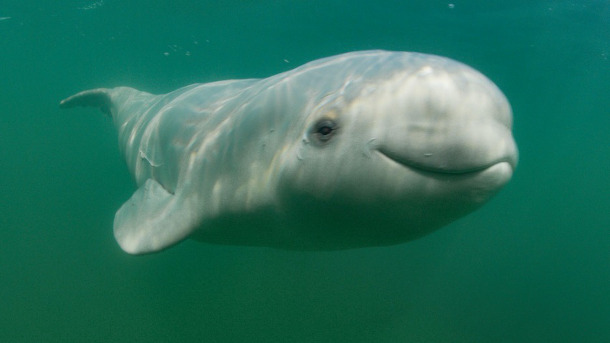
Baby beluga. Belugas are the only whale that can use their lips to form different shapes to communicate.

Many of us pay more attention to oceans in the summer as that is the time we go swimming, fishing, or boating in oceans. It’s the time we suddenly start talking about sightings of Great White Sharks or a deadly Portuguese Man-of-War. It’s when my surfer grandchildren report on huge fish they say are nibbling their feet, probably striped bass.

So today I want to share a story about ocean royalty, whales. It’s from the environmental radio show Living on Earth.

“On Earth Day 2021, National Geographic released Secrets of the Whales, a video documentary miniseries that seeks to unravel the secrets of whale behavior and understand whale cultures of orcas, humpbacks, narwhals, belugas, and sperm whales. National Geographic Explorer and wildlife photographer Brian Skerry joins host Bobby Bascomb to talk about the experience of filming this epic project and the breathtaking complexity of whale societies. …

“BASCOMB: A theme that comes up again and again in this series is culture: that whales have distinct cultures. And not just between different species of whales, but between different pods or families. …

“SKERRY: You’re absolutely right. When I created this, I saw this as a game changer that the latest and greatest science was revealing that these charismatic ocean animals are showing behaviors that are really cultures, not unlike humans. My friend, Dr. Shane Gero, who’s a sperm whale biologist, he defines it this way. He says behavior is what we do, culture is how we do it.

“So for example, most humans eat food with utensils, that would be behavior, but whether you use knives and forks or chopsticks, that is culture. So what we see in whales, you know, you might have a family of Orca that live in New Zealand, and their preference for ethnic food is stingrays. And they figured out how to eat those there. And the ones in the Norwegian Arctic, like to eat herring, and they figured out how to predate on herring. And the ones in Patagonia like seal pups, and they are the only ones in the world who have that strategy. They not only figured out this stuff, which is culture, but they pass it on to their children.

So they are not only teaching their offspring the skills that they will need to survive, but they’re teaching them their ancestral traditions, the things that matter to them.

“Whales have unique dialects. Sperm whales that Shane studies in the Eastern Caribbean, he’s identified about 24 families that all speak the same dialect or language, and they belong to a clan. But they don’t intermingle with other sperm whales that might come into those waters that speak another language. …

“BASCOMB: And during your time in New Zealand with orcas there, there was a moment in the series where you were invited to share in the spoils of their hunt. Can you tell us about that experience?

“SKERRY: I can. This was certainly one of the most extraordinary moments of my career of four decades of exploring the ocean. We worked in 24 locations collectively for this series worldwide over three years. And I had just come from six weeks in the Canadian Arctic and I had about 10 days in New Zealand. I was working with a researcher Dr. Ingrid Visser, who is the orca expert, lives in New Zealand, understands these animals. … We drove three hours to get there, got in the boat, went out, found the orca, they were hunting in shallow water. I got in the water and started swimming towards them. And lo and behold, here is this adult female swimming towards me with a stingray actually hanging out of her mouth. My mind is on overload now, I’m thinking, I can’t believe this. And then she drops it. …

“I swim down to the bottom and I knelt on the sandy floor next to the dead stingray just laying there. And then out of the corner of my right eye, I see this orca coming back, and she swings behind my back, I lose sight of her for a moment. And then she emerges on the left side of my view, she swings around directly in front of me.

“And now we’re staring at each other with a stingray between us. And she’s looking at me and looking at the ray looking at me looking at the ray as if to say, ‘Well, are you going to eat that?’ And when I don’t go for it, then she very gently just bends over, picks it up in her mouth and lifts it up in front of me. And then she turns and begins sharing her food with another member of her family. …

“BASCOMB: This series also documents the formation of a surprising cross species adoption between lost Narwhal, a youth, and a pod of beluga whales. …

“SKERRY: Yeah, that’s a really special situation. … I think it speaks to the empathy and the accepting nature of these beluga whale families. I mean, clearly, they know that that’s not one of their own. But yet they saw this narwhal that was alone, and just made it part of the family. They adopted it as one of their own. And, I mean, how wonderful is that?

“I think this is one of the messages that I’ve sort of taken away. You know, I spent three years working on this. As I’ve processed a lot of these moments that we witness in the series, it occurred to me that I’ve been reminded of things that I already knew, and that is that community matters, that family matters, that the whales make time for each other.

“A sperm whale for example, these are matrilineal societies led by the older, wiser females, they spend most of their life in the deep ocean foraging for squid. Life in the ocean is hard, but yet every day or every couple of days, they make time to come together and socialize. You see them rolling around and enjoying each other’s company, reaffirming their family bonds. And for me to reflect back on this was to be reminded of how important social creatures are, that humans and whales can’t do it alone. We need each other, we need family, we need community, and that that alone can bring us the greatest joy in life.”

Lots more whale cultures described at Living on Earth, here.

Read Full Post »

80ced23a-0936-4595-a3aa-f67f8329d099_750x422

Photo: NOAA
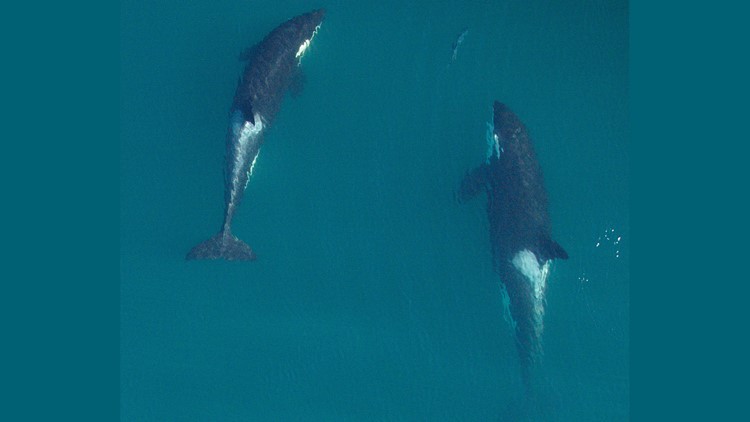
Aerial image of Granny J2 (right) and a juvenile orca, J45, chasing a salmon in September 2016. Ultimately J2 captured the salmon and presented it to J45.

Being a grandparent himself, my husband recently took note of some research on grandmothers in the animal kingdom and judged it blogworthy. This version of the story appeared online at King5News.

Michael Crowe reports, “A team of researchers have found having a young orca’s grandmother around improves survival of the offspring. A study published last week in the Proceedings of the National Academy of Sciences tests the ‘grandmother effect’ in Southern and Northern Resident killer whales off Washington state and British Columbia. …

“The study used decades of photo census records of the two populations to study survival of individual whales and connected family groups through observation. And they found if a grandmother whale died, it reduced the survival of her ‘grandwhales’ in the two years following her death.

“ ‘The statistics showed they were healthier and lived longer when they had a thriving grandmother,’ said Howard Garrett, co-founder of the Orca Network.

“Dr. Deborah Giles, a killer whale researcher at the University of Washington Center for Conservation Biology, said the study confirmed decades of observations.

“ ‘They’re incredibly socially bonded animals,’ Giles said. She said it’s a fascinating relationship, because whales can live decades after they cease reproducing – killer whales have evolved one of the longest post-reproductive spans outside humans.

“She recalled an aerial photo of J2 (also known as ‘Granny’) from 2016 sharing fish with J45 – her apparent great-grandson. J45’s mother had recently died, and he was not yet old enough to thrive without support. Though J2 was thin and towards the end of her life, she helped the younger relation.

‘It sticks out to me, because this is an animal in here late 80s, maybe old as early hundreds,’ said Giles. ‘She’s clearly trying to keep that fish in the pathway of her relative so he’ll eat it. …

” ‘She could have eaten that fish in one bite, but she chose to corral it toward him so he’d grab it.’

“The study also notes the importance of grandmother whales in lean salmon years when the female leaders serve as ‘repositories for ecological knowledge.’ …

“ ‘The grandmothers have that long perspective, the multi-decade look at where the salmon have been, the nooks and crannies,’ said Garrett. ‘… So they’re constantly in that role of guide, mentor, teacher. They share not only their food, but their traditions, their ways.’ …

“There are 73 Southern Resident whales we know of, Giles said, and of that, there are just four grandmothers remaining – one in J pod, one in K pod, and two in L pod. She worries that these grandmothers will only become more important to the endangered Southern Resident killer whales’ survival. …

“Garrett also hopes deeper knowledge of the whales’ behaviors will encourage people to help protect them.

“ ‘I think the study helps people learn more detail, more higher resolution if you will, of how they live and who they are,’ he said. ‘They really are individuals with their own identities, their own roles, their own place in their societies and in their families. And the more we get to know them in that kind of intricate detail, the more we feel close to them, and want to help them in any way we possibly can.’ ”

More here.

Photo: Shutterstock
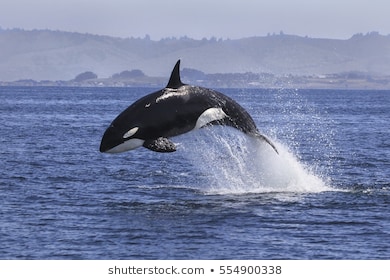
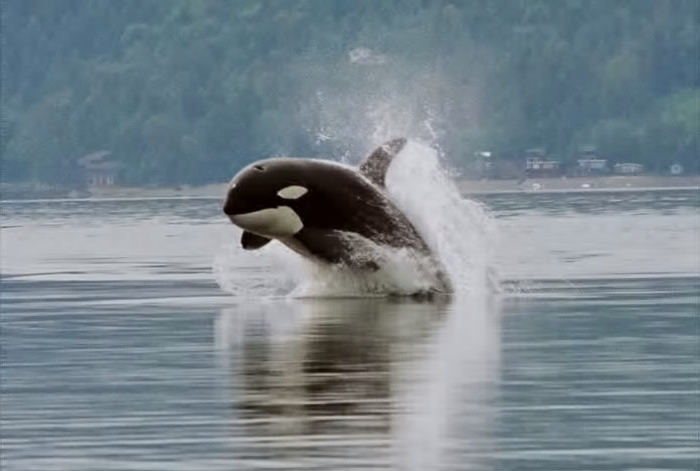
Another name for the orca is killer whale.

killer-whale-orcinus-orca-260nw-554900338

Read Full Post »