Photo: Erika Page/Christian Science Monitor.
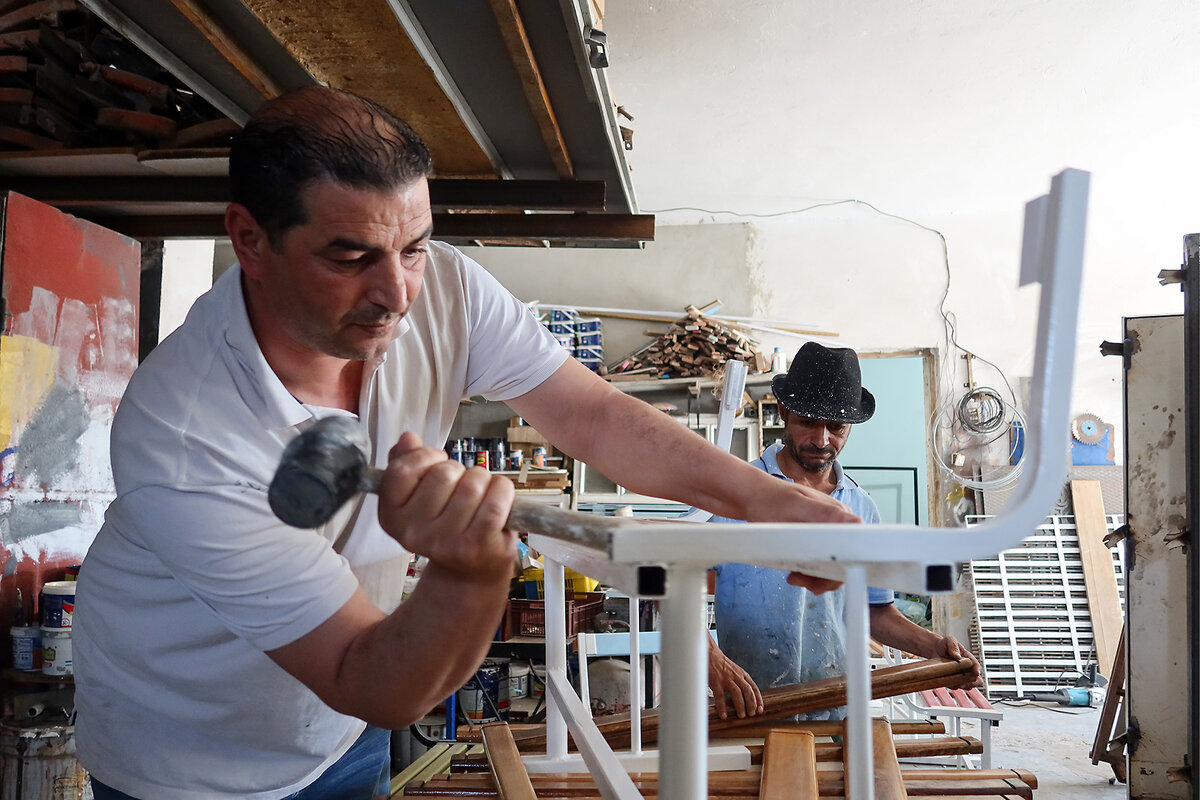
Karim Arfa (left) works on a bench in his workshop in El Mourouj, a neighborhood of Tunis, Tunisia. He often shoulders jobs that government should have been tackling.
You were thinking from this post’s title that it was about the US? No. Not overtly. I certainly am preoccupied with harnessing the power of ordinary people in the US these days.
But no, this post is about Tunisia.
Erika Page writes at the Christian Science Monitor about how good, no-nonsense people can — and do — take civic problems into their own hands. Just because the work needs doing.
“Chadia Jarrahi can still taste the sting of embarrassment she felt when the principal sent her young sons home from school, their clothes too wet and muddy to attend class. From that day on, whenever the river was high, Ms. Jarrahi took the two boys piggyback across the ravine separating her village from the main road on the other side. …
“It’s a common story in the mountainous, interior regions of rural Tunisia, where fewer government resources are directed to infrastructure and services than along the more urban coast. The residents of Al Taraiya, in the northwestern province of Béja, had been fighting since the 1990s for a bridge connecting their community to the only nearby school, mosque, grocery store, and hospital. [Local] officials deemed the project too expensive.
“Then Karim Arfa caught wind of the residents’ plight. In recent years, the building and painting contractor has made it his mission to take on just that sort of impossible-seeming project. Using mainly scrap metal and his own creativity in his workshop in Tunis, he has built much-needed infrastructure and equipment, from furniture for schools to pedestrian bridges.
“Mr. Arfa’s work serves to assure those who have long felt abandoned by their national and local governments that regular people can come up with solutions to entrenched problems – even where resources are scarce. …
“Today, a bright pink bridge stretches from the winding highway to the rolling hills on the other side of the river. Ms. Jarrahi’s children play with other kids along the walkway; neighbors lead donkeys and motorcycles to and from the homes that are just visible across the valley. Residents no longer worry about missing work, running out of places to buy food, or not being able to go to the hospital when rain makes the river swell. …
“The bridge will help reduce absenteeism and school dropouts in the area, predicts Mohamed Jouili, a professor of sociology at the University of Tunis, over email. He also says Mr. Arfa’s initiative ‘encourages other members of the community to recognize their own agency and actively contribute to improving their environment.’
‘If everyone does something small, we can do it all,’ says {Karim] Arfa.
“Mr. Arfa himself grew up in a rural area of Tunisia, some 100 kilometers (62 miles) south of Al Taraiya. He nearly dropped out of school because of the difficulty of getting to and from class. … He eventually opened his own workshop on the outskirts of Tunis. But he never turned away from his rural roots. ‘I wanted to do something to repair their situation, as if I was repairing something for myself,’ he says.
“He started with a school dormitory that burned down in 2018, redecorating the space and then building a new library for the school in an abandoned room. From there, he began repairing desks and chairs in schools and maintenance hole covers for roads. After hearing about a young girl who died crossing a river on foot in 2019, he and his team of volunteers began building their first bridge, in the province of Kasserine.
Steep mountains meant the machinery couldn’t get to the bridge site, so they had to dig out the base by hand.
“ ‘Karim goes to the places the government doesn’t go,’ says Cherif Ait Daoud, a Tunis-based architect who helped design the bridge. …
“The bridge in Béja, Mr. Arfa’s sixth such project, was finished in 2023. ‘One year, seven days, and two hours ago,’ recalls Ahmed Terroui, a resident of Al Taraiya. He and others spent two months helping Mr. Arfa assemble the bridge, often after working long shifts as day laborers on nearby farms.
“The bridge’s railings are made of rods from old school desks, refurbished and repainted at Mr. Arfa’s workshop. Three-fifths of the steel is recycled. Only the cement, gravel, sand for the foundation, and the rest of the steel had to be bought. Officials had predicted that construction could total 2 million dinar (about $635,000). … Mr. Arfa and his team pulled it off for 41,000 dinar. …
“So far, he has relied on donations alone, either in the form of scrap metal or money. But it has been difficult to secure stable funding.
“As trucks and motorcycles whir by, Basma Ammouri rolls dough into a ball, presses it into a wide circle, and sticks it on the inner wall of an open clay oven to bake. She set up her makeshift roadside bakery across the bridge from her home in Al Taraiya, just after it was inaugurated. She now has reliable access to customers who stop along the highway to buy her traditional tabouna bread. That income helps support her young children.”
When we think, “What can one person do?” it helps to remember people like Mr. Arfa. Even if you can’t build an actual bridge, you can build bridges to others. And then there’s the “stable funding” piece of the puzzle: even small monthly donations to worthy causes help people who do the work you value and lets them know how much they can plan for.
More at the Monitor, here.



 Suzanne's Mom's Blog