Photo: Alfredo Sosa/CSM Staff.
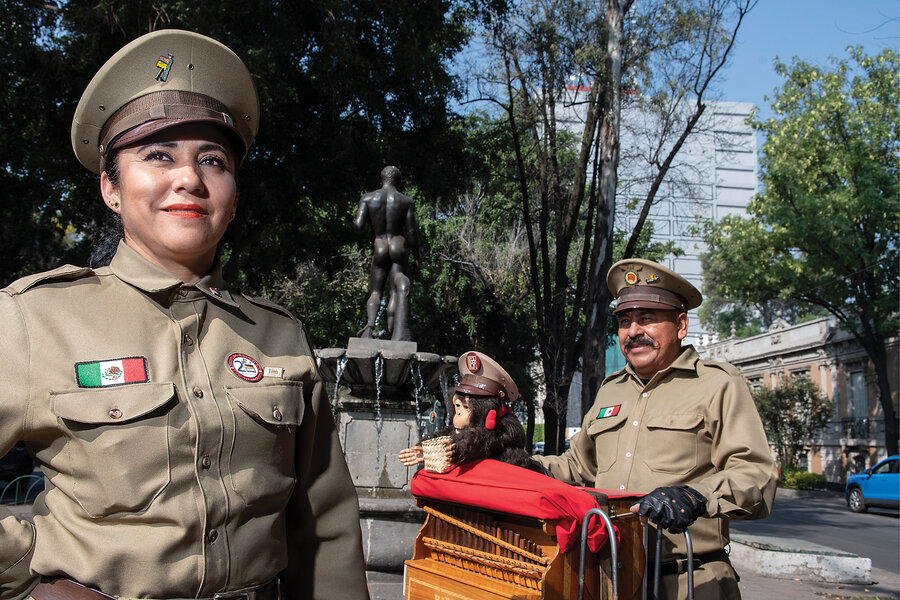
Elsi Sastre (left) and Cresencio Torres work as a team of organ-grinders in the Roma neighborhood of Mexico City.
Between the two of us, my husband and I can tell our grandchildren about having seen an ice-delivery man, a huckster selling vegetables door-to-door, a traveling knife-sharpening guy. Wouldn’t it be great to show such things in person once in a while, not just in historic villages with costumed interpreters?
Today’s article is about something we will need to hurry up to see before it fades into history: the traditional organ grinder in Mexico.
Whitney Eulich writes at the Christian Science Monitor, “Hunched over a weatherworn hand-crank organ in his repair shop, Roman Dichi explains why the work of Mexico’s organilleros has endured for a century and a half.
“ ‘This music evokes happiness, tradition, and childhood memories of going out to a plaza with Mom and Dad – or of falling in love,’ says Mr. Dichi, president of the organ-grinders union in Mexico City. …
“Organ-grinders, especially ubiquitous in Mexico City’s historic center, date back to the presidential administration of Gen. Porfirio Díaz in the late 1800s. The dictator’s adoration of all things European inspired Mexico’s elite to import organs into their homes. Eventually, the instruments moved out of private parlors and onto the streets as public entertainment. They were used to draw customers to circuses, with the help of monkeys, and to keep soldiers in good spirits. Over time, the European songs inside the machines were replaced with revolutionary ballads and local classics, such as ‘Las Mañanitas,’ the Mexican birthday song.
“Despite these deep roots, today the tradition is at risk. Not everyone is charmed by the tip-seeking musicians. A crank organ’s sound – akin to the pitchy puff of air from a slide whistle – can be loud. In the wrong hands, an organ can be positively off-key, an assault against the ears. …
“The organs are also expensive, with many organilleros renting them from the small stock available locally. And upkeep gets costlier with each passing year. The heavy instruments can get damaged while being wheeled down crowded city streets or warped by weather and time.
“Edgar Alberto Méndez Hernández has been slowly turning the crank on his organ in the capital’s historic center for some 15 years. He nets about 250 pesos (a little more than $15) on a good day after paying 250 pesos for his rental. …
“After several hours working along a bustling sidewalk near the Bellas Artes theater, he pushes his black-and-brown antique wooden organ on its dolly and heads several blocks toward the Zócalo square. When he shows up at this even busier – and potentially more lucrative – spot, the two young men already playing organs there take their cue, as if in a dance, and move to a side street. These shifts are imperceptible to the public but tediously negotiated with the union’s help. …
“They ‘live off of tips,’ notes Yuleina Carmona, the Mexico City coordinator for Women in Informal Employment: Globalizing and Organizing, an international nonprofit. Shoeshiners and strolling mariachi bands have fixed rates for their services, but organ-grinders churn out music whether they are paid or not. …
“In March, Mr. Dichi’s union submitted a proposal to Mexico City’s Congress to have organilleros’ work recognized as a cultural heritage. It was the fourth attempt – and this time it was approved.
“The legal recognition is expected to translate to better protection on the street from police harassment and greater support for organ-grinders in their disputes with residents and businesses. Ms. Carmona notes it will also give organ-grinders ‘a seat at the table’ – a say in how Mexico City uses funds for cultural activities in the center.”
More at the Monitor, here. Great pictures. No paywall.
Now, what is the coolest old-timey thing in your memory?

 Suzanne's Mom's Blog