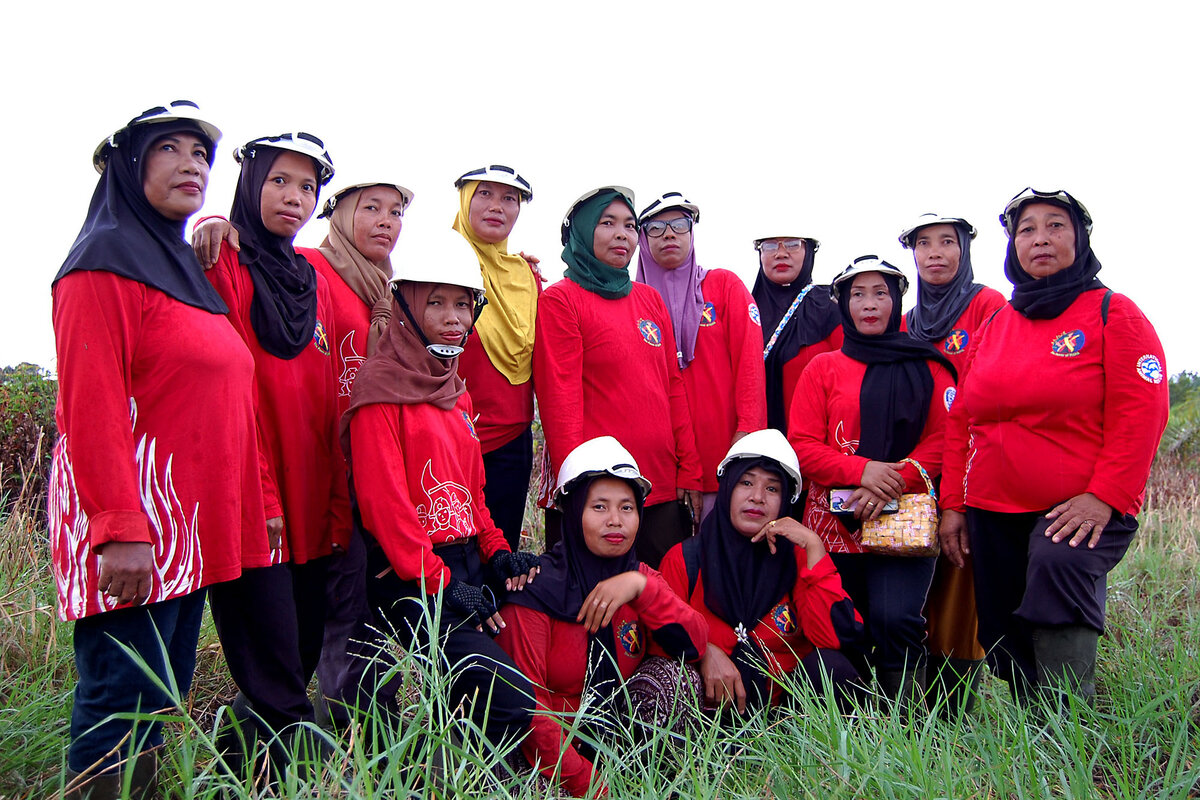
Photo: Lindsey McGinnis/The Christian Science Monitor.
Power of Mama patrollers, who routinely put out palm oil fires in Indonesia.
In Indonesia, women have answered the call to do something about wildfires. Because in Indonesia, careless and illegal palm-oil logging routinely causes fires, endangering orangutans. And not just orangutans.
Lindsey McGinnis and Sara Miller Llana report the story at the Christian Science Monitor.
“The women adjust hard hats over hijabs and pull on knee-high boots. Then they set off into what was once a dense forest of rubber and bamboo trees but is now a patchwork of small-scale palm oil fields. Everyone knows who they are. Their scarlet, elbow-patched uniforms with flames snaking up the torso, and the image of a firefighter emblazoned on the chest, give it away.
“This is the Power of Mama.
“Across Kalimantan, the Indonesian part of the island of Borneo, lush rainforest hosting carbon-rich peatland and one of the country’s most significant populations of orangutans meets illegal logging and palm oil farms. That adds up to wildfires.
“So Power of Mama members have started patrolling for fire risks, urging farmers to follow the rules about slash-and-burn clearing, and challenging stereotypes about women’s roles in rural Indonesian life along the way.
“Female forest rangers in Indonesia are rare, says Eulis Utami, director of a nongovernmental organization called Hutan Itu Indonesia, or Indonesia is Forest, which aims to educate Indonesians about their tropical rainforest, the world’s third-largest. But when women are given training and information, she says, ‘They protect the forest with their whole hearts.’
“In untouched forests of West Kalimantan, orangutans build their nests high up in trees. Hornbills soar through the vines with deep swoops of their wings. The chirps of songbirds mingle with the ‘o-ho!’ calls of gibbons.
“But this habitat is shrinking. West Kalimantan has lost more than a third of its tree cover since 2000.
“Indonesia is the world’s largest producer of palm oil, and nearly all of it comes from either Sumatra or Kalimantan. The farms have wreaked havoc on peatlands, one of the world’s most important carbon sinks. When the bogs are cleared, the water table sinks and soil becomes highly flammable.
“A new consciousness about the risks of fire spread rapidly to this community in 2019, when agricultural burning amid drought conditions sparked fires that raged for months. Millions of acres of peatlands and rainforest burned. And it kept many of the mothers who would eventually form the Power of Mama up at night, worried about the effects of smoke and haze on their children’s health.
“The Power of Mama was launched in 2022 by Yayasan International Animal Rescue Indonesia (YIARI), whose long-term goal is to save the critically endangered orangutan. …
“YIARI intentionally made women part of the solution. Male farmers have been impervious to NGOs trying to convince them to protect the forests, but they listen to their wives, says Anna Desliani from YIARI. ‘Women have influence in their families,’ she says.
“One of the newest branches is in the community of Sungai Putri, which counts 2,000 residents. Farmers here have long tended rice paddies but many switched to more lucrative oil palm trees in 2017.
“ ‘It’s sad because … before it was real forest,’ says Misnati, a patroller who, like many Indonesians, has just one name. She says she misses the sounds of gibbons and the cooler air the forest brought. She also felt more protected from fire and floods when the forest served as a buffer zone.
“The Power of Mama doesn’t aim to stamp out cultivation – in fact, most of its members’ husbands toil in palm oil now. But they have been educated on the risks of clearing land by burning, of overcultivating, and of smoking in a highly flammable field. And that knowledge gives them an authority that many had never known. …
“When it comes to forests, the discussion is always ‘heavy,’ explains Ms. Utami. It’s about deforestation, wildfire, conflict. That’s why Indonesia is Forest, which introduces young town dwellers to the rainforest, focuses on positive narratives that make people want to protect Indonesian biodiversity.
“The Power of Mama is, in its own way, cultivating a similar enthusiasm.
“On this rainy day, the women aren’t on high alert. They walk the land and talk with farmers. Passing a patch of blackened vegetation, Misnati recalls her proudest moment: when she figured out how to connect a hose to a water pump and put out a fire here last year. …
“Before the Power of Mama, ‘I’d never venture this far into the land alone,’ she says. ‘I’ve gotten to know the landscape even though I’ve lived here my whole life.’ …
“ ‘We need to be a role model, to set an example,’ says another patroller, Lita, sporting an upcycled crossbody purse made of plastic detergent sachets she collected from her neighbors. Other women are wearing them, too. ‘If we don’t do this, who will?’ ”
More at the Monitor, here. Nice pictures. No paywall.

 Suzanne's Mom's Blog