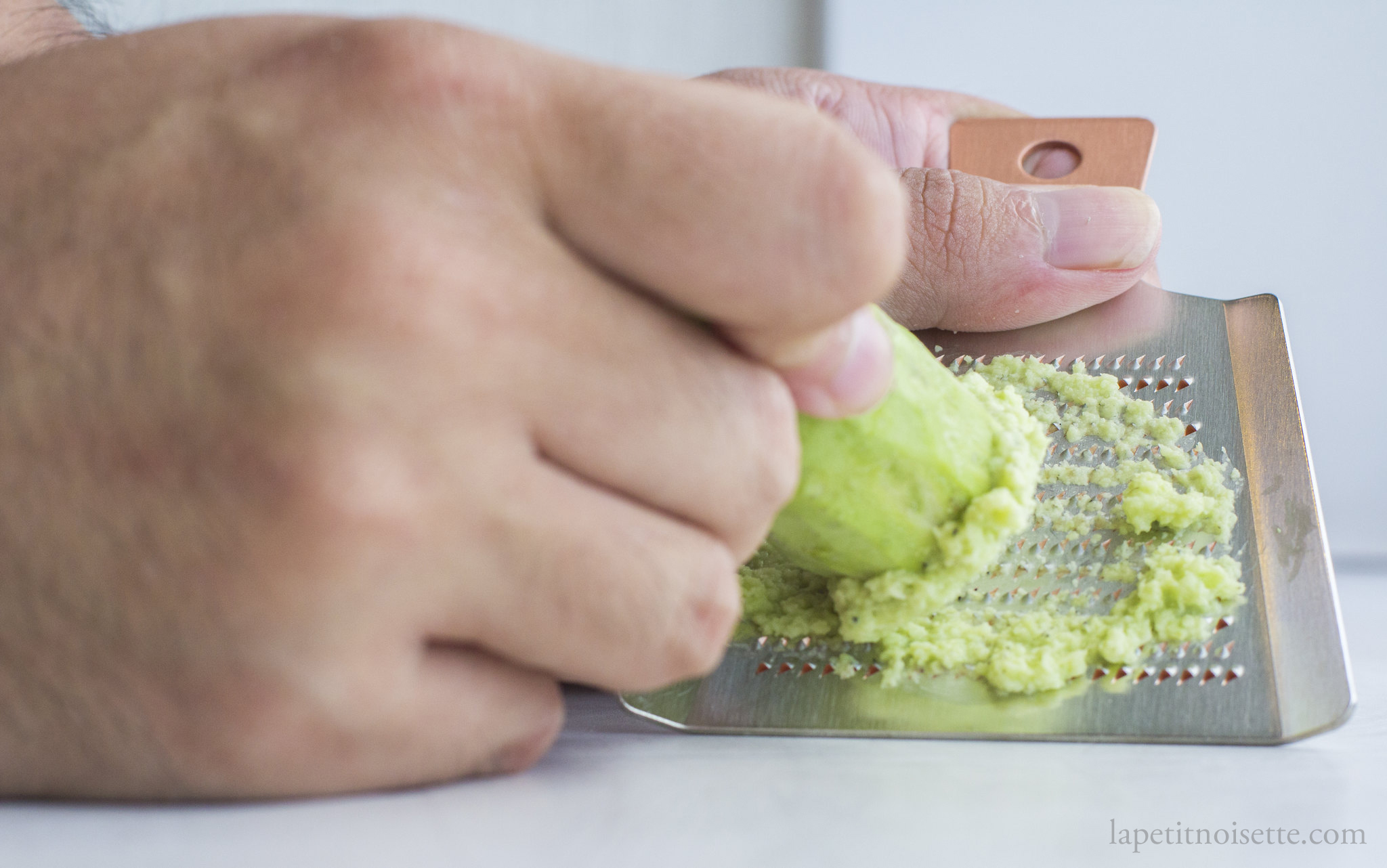
Photo: The Japanese Food Lab.
Grating a wasabi root. The fumes from this horseradish relative have been found to kill fungus on papyrus.
I love stories of great discoveries made by accident, but was the discovery in today’s post made by accident? I haven’t succeeded in finding out. Perhaps it was just a matter of understanding how chemicals work, as in the case of the Bryn Mawr professor who wrote that a pinch of salt improves a cup of tea. (Read about that tempest in a teapot here.)
Verity Babbs writes at Artnet, “A new study reveals that Japanese horseradish isn’t just good as a sinus-clearing part of a plate of sushi, but is also effective in art conservation.
“Wasabi vapors have been found to effectively treat fungal infections on both painted and unpainted samples of mock ancient Egyptian papyrus, and to do so without impacting the papyrus’ delicate chemicals or painted pigments.
“A study led by Hanadi Saada of the Conservation Center of the Grand Egyptian Museum and published in March’s volume of the Journal of Archaeological Science shares the results of treating fungally infected replicas of ancient papyri with wasabi.
“To create accurate replicas for the study, the team heated modern papyri (painted with accurately replicated ancient pigments) to 212°F for 120 days, mimicking a 1,000-year aging process. They then exposed the replicas to fungal species and treated them with vapors from wasabi left on nearby aluminum foil after three days.
“Exposure to the wasabi vapors was found to completely eradicate microbial growth and increase the sample papyri’s strength by 26 percent. The treatment only negligibly impacted the chemical makeup of the pigments used, and no noticeable change was observed in the color of both painted and unpainted samples of papyri.
“Papyrus — made from the stems of the plant Cyperus papyrus — was used in the ancient world for baskets, sails, and boat-making in addition to being a popular writing material. …
“Famous papyri include the Ebers Papyrus, which documents ancient Egyptian medical practices and is considered the world’s best-preserved and most extensive example. Dating to around 1550 B.C.E., it is kept at the Leipzig University Library in Germany. …
“Native to Japan as well as Korea and the far east of Russia, wasabi is a popular condiment, made from the plant Wasabia japonica, which is similar to the horseradish.
“This new conservation solution is a much greener and safer treatment than disinfectants previously used, which were known to harm the artifacts, possibly as badly as the fungus itself. Further research will be carried out to test the efficacy of wasabi for treating fungal infections on other organic, textile, and paper artifacts. The Grand Egyptian Museum in Giza plans to use the wasabi treatment for future preservation. The study concluded that ‘Wasabi can be considered a safety biocide for controlling biodegradation of archaeological painted papyri.’ ”
More at Artnet, here.

 Suzanne's Mom's Blog