Photo: Martin Nuñez-Bonilla.
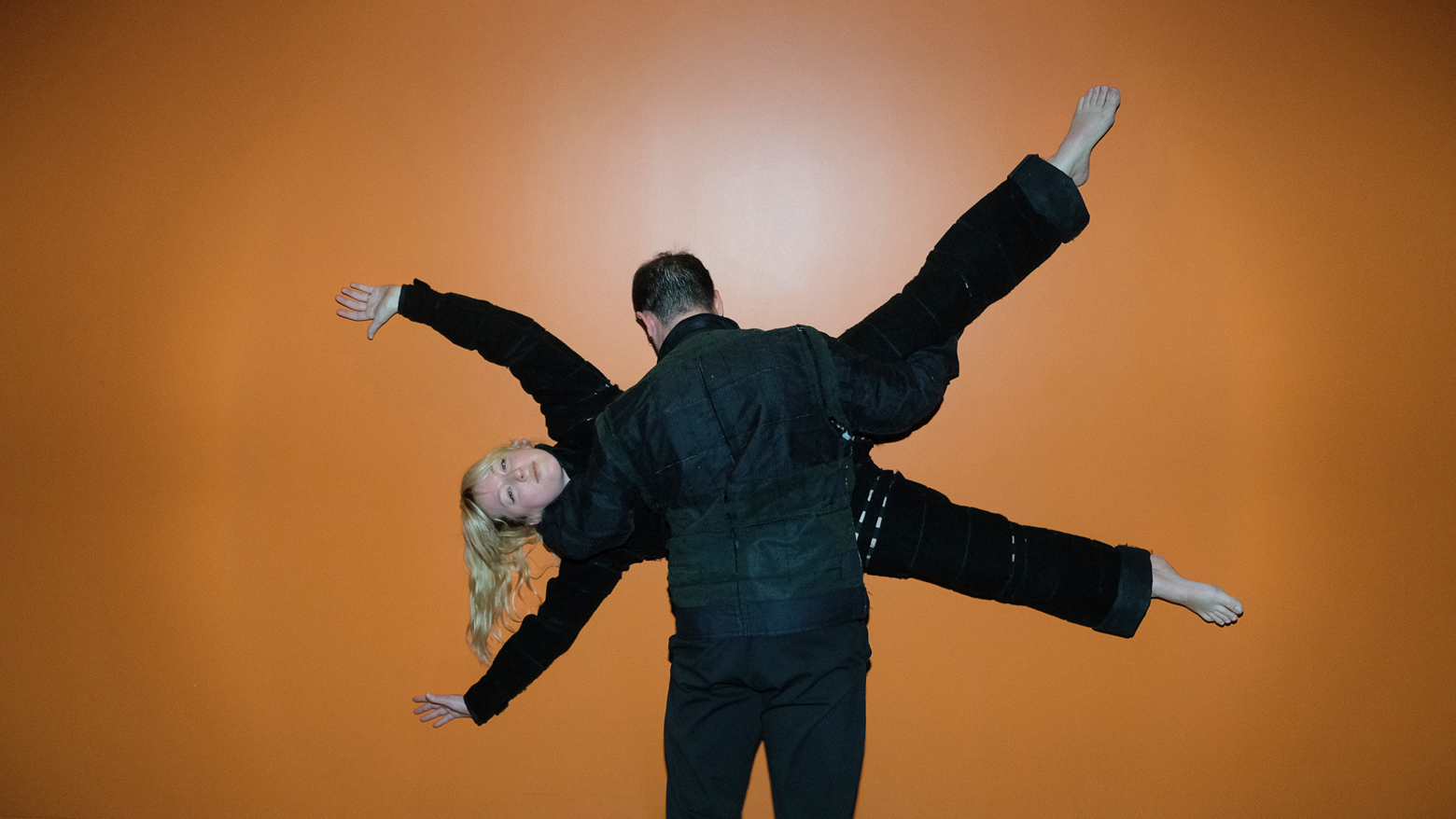
Sasha Peterson and Michael Figueroa in “Slapstuck” at the Conference for Research on Choreographic Interfaces last June.
Usually it’s people with science backgrounds who go into space. But artists are curious about everything, as we know, and some wonder what their own role in space travel might be. Some dance artists who have looked seriously into the possibilities of weightless choreography are now starting to rethink the ramifications.
Chava Pearl Lansky writes at Dance Magazine, “In a performance at the Conference for Research on Choreographic Interfaces [CRCI] this past June, Sasha Peterson leaned the side of her body onto Michael Figueroa’s shoulders, sharing weight in a traditional contact-improvisational lift. But rather than disembark back to the floor, Peterson rolled down Figueroa’s back — and stayed there, her body perpendicular to his, suspended in space.
“How? The answer in this case was Velcro-covered suits, lent by choreographer David Parker, who created ‘Slapstuck.’ … Velcro is just one form of technology that dancers are using to simulate the effects of weightlessness here on Earth. But for some, the end goal is to experience a true lack of gravity by bringing dance to space.
“ ‘Dance in zero gravity completely transforms how we think about choreography and performance,’ says Sydney Skybetter, the founder of CRCI and director of the Brown Arts Institute at Brown University. ‘When you remove the floor, which is the fundamental organizing principle of terrestrial dance, bodies become three-dimensional sculptures moving through space multi-axially.’ …
“There are a number of ways to simulate dance without gravity here on Earth, and dancemakers are experimenting with several of them. Last March, Peterson, Figueroa, and fellow dance artists Laila Franklin and Kate Gow came together for CRCI’s Movement in Microgravity residency, in which they created a base dance phrase and tested it in environments with varying gravitational relationships. In addition to working with Velcro suits, the group ventured to a trampoline park, an anti-gravity yoga class, float tanks, a pool, and a spatial-orientation laboratory. …
“Some dancers are interested not in bringing codified dance steps into space, but in taking the gravity out of a gravity-based practice. In 2022, dancer, geologist, and planetary scientist C. Adeene Denton wrote an essay in this magazine about her dream of dancing on the International Space Station. She’s spent a great deal of time both watching and speaking with astronauts and has enjoyed learning about the movements in microgravity that these experts already find fun.
” ‘What they like to do in their spare time is to try to crank up the momentum and shoot themselves through different passageways, or figure out different ways that they can spin,’ she says. Denton is also fascinated by effort. Astronauts living on the ISS, for example, learn how much energy they need to exert just to stay put. In order to stay still to work or eat, they grip a railing with just one or two toes.
“When she imagines what it would be like to dance on the ISS, Denton dreams about dueting with the space station itself. ‘Astronauts there are constantly drifting and following the motion of the space station as it orbits the Earth,’ she says. ‘So, I think it could be really interesting to try to do the microgravity equivalent of standing in one place.’
“[Multidisciplinary artist Sage Ni’Ja] Whitson is now beginning research in aerial performance techniques, with a goal of continuing their research via parabolic flight — the closest thing to space travel currently available on Earth — and, eventually, actual space travel. …
“[But now] the dancers are questioning the cost of parabolic flights, where dedicated research space can cost tens of thousands of dollars, and some artists have expressed concern over the privatization of space travel by billionaires like Elon Musk and Jeff Bezos. ‘Right now, space exploration is being shaped by people with some extremely problematic ideological stances,” says Skybetter.
“[Denton adds] ‘I would still love to dance in microgravity, but I think that is ultimately kind of a selfish dream that needs to be superseded by doing the kinds of good things on Earth that we can do.’ “
More at Dance Magazine, here.

 Suzanne's Mom's Blog