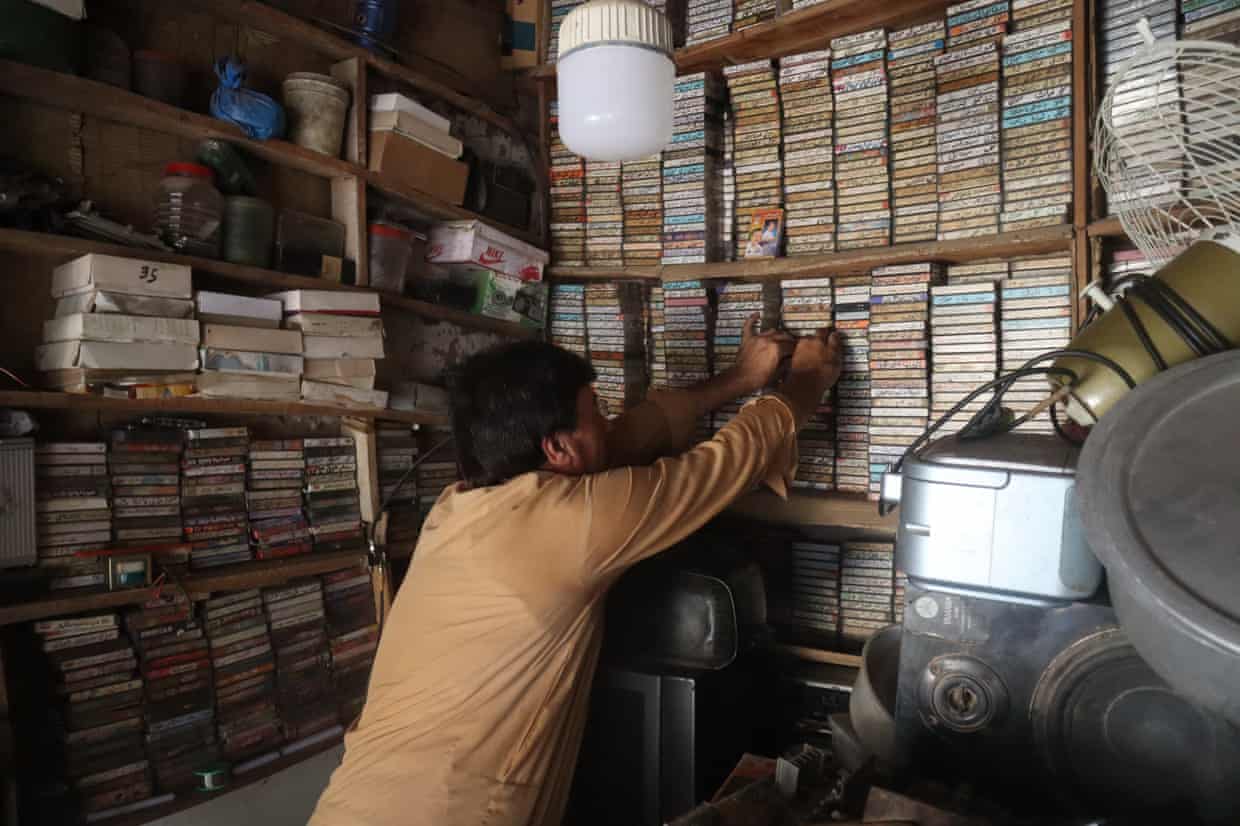
Photo: Shah Meer Baloch.
Afghan refugee Mohammed Hasan Zamri in his shop in Pakistan, where he keeps his collection of rare music cassettes from his homeland.
For the Afghan diaspora, you have to celebrate joy where you find it. In October, for example, Afghan friends lit up social media because of an unexpected triumph in cricket.
“I had a quick shower and was heading towards the office when I learned about Afghanistan’s phenomenal cricket victory against Pakistan, with the news dominating my socials,” Shadi Khan Saif exclaimed in the Guardian. …
“The team’s phenomenal performance has lifted up not just the devastated nation but millions in the Afghan diaspora, including in Australia. At Dandenong Park in Melbourne’s south-east, hundreds joined in on the traditional Attan dance to mark the victory. The scenes in Kabul and other cities in Afghanistan were equally charged with joy and celebration.
“Amid international isolation, Afghanistan’s cricket team has once again proved itself as the only source for the Afghans to connect with the outer world. Afghanistan’s tri-color flag – now replaced with the white Taliban flag – and the Republic-era anthem are still kept alive by the cricketers on the world stage.”
As unusual as was that moment of delight, it is clearly not the only way Afghans seek out joy. Some turn to a collector in Pakistan who is saving Afghan music for posterity.
Shah Meer Baloch reports for the Guardian, “Afghan music fans from Kabul and Jalalabad have crossed the border to the city of Peshawar in Pakistan to offer thousands of rupees to Mohammed Hasan Zamri’s workshop for just one cassette.
“Zamri, an Afghan refugee, refuses them all as he continues his quest to copy and, one day he hopes, digitize his collection of more than 1,000 rare and old Afghan music cassettes of various genres.
“It is his contribution to help preserve a musical culture that existed for centuries before the Taliban existed.
“Since retaking control of the country in 2021, the Taliban have imposed their rigid interpretation of Islam, restricting and even criminalising music and arts. In July, they publicised a bonfire of seized ‘illegal’ musical instruments, reminding Afghans that the sale of instruments was a punishable offense.
“ ‘The Taliban just use religion as an excuse to ban music and say it is haram, prohibited, in Islam. This is not true and it is part of our culture for centuries, but the Taliban have senselessly put a ban on it, says Zamri.
“Zamri fled Afghanistan during the Soviet invasion and went back for a few years after the war had ended and the Taliban had started to consolidate their power. He left again in 1996 and has been running a workshop fixing tape recorders and TVs ever since.
“Most of the space in his small workshop is taken up by stacks of cassettes, neatly arranged on a wall opposite the entrance. His collection includes tapes of renowned Afghan musicians including Munawar, Nashenas, Taj Mohammad and Haikal.
“ ‘I have done recordings of many singers myself who had fled Afghanistan in the 1990s or had come to Peshawar, which has been a thriving hub for Afghan refugees and musicians,’ he says.
“ ‘The love for music is there but the musicians, music and art is banned in the Taliban’s Afghanistan. Today, we have many singers but because of the ban, they cannot perform. They have fled Afghanistan.’
“Listening and copying his cassettes, Zamri reminisces of times when Afghan audiences could enjoy music and culture with freedom – the same freedom afforded to musicians and artists, men and women. … ‘The people who have heard these songs or lived through the era are the ones who come to buy cassettes. …
“ ‘Naseema, Kashan, Benazir and Zarghona were the best female singers who dominated Afghan music three to four decades ago. Now, if they do not allow men to sing or create music, how will they allow women?’
“Until [August], Zamri was unknown to many Pashto-speaking people until local media featured his attempts at saving Afghan music cassettes. He has since received both threats and messages of appreciation.
“ ‘I have been threatened on Facebook from people to stop my work and they would burn down my shop and that this is against Islam. But there were some positive and appreciative comments too. …
” ‘Some people are addicted to smoking, some people love pets and some are fond of many other things. I am addicted to Afghan music. It is my hobby and passion,’ he says.”
More at the Guardian, here.


 Suzanne's Mom's Blog