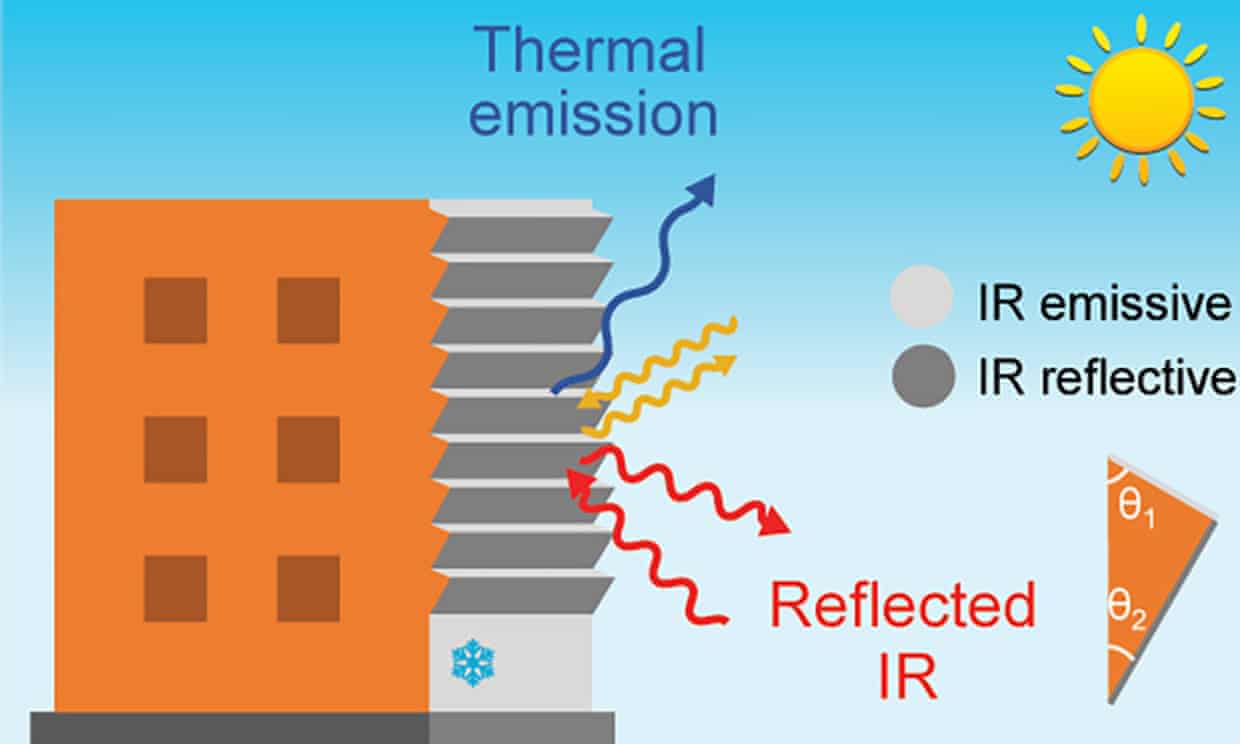
Diagram: Q Cheng/Nexus.
How a building’s zigzag wall could emit and reflect heat. IR refers to infrared energy.
In the department of “good ideas for a new year,” we learn about zigzag walls and how they might cool buildings without fossil fuels or even electricity. It’s kind of the opposite of “passive solar heat,” which you’ve heard of. This approach involves passive cooling.
Isabelle Rodney reports at the Guardian, “Incorporating zigzag patterns into building walls could help cool overheated buildings, research has found.
“Buildings are now responsible for approximately 40% of global energy consumption, contributing more than a third of global carbon dioxide emissions. A significant fraction of this energy comes from air conditioning usage. Scientists expect this figure to double by 2050 if left unchecked.
“As the planet continues to warm, the demand for cooling in buildings continues to rise. In response to this growing challenge, scientists have been exploring passive cooling solutions that do not rely on energy consumption.
“A research team led by Qilong Cheng at Columbia University in New York has developed a promising solution that could help reduce energy use, by redirecting the sun’s energy away from buildings.
“Cheng’s team has proposed a structural wall design featuring a zigzag pattern that can reduce a building’s surface temperature by up to 3C [37.4 degrees] compared with flat walls, without consuming any energy. …
“The design consists of walls with a series of protrusions that create a zigzag shape when viewed from the side. This configuration takes advantage of radiative cooling – a passive cooling strategy that reflects sunlight and emits long-wave infrared radiation through the Earth’s atmosphere into outer space. …
“Common strategies, such as painting rooftops white to reflect sunlight, have been effective for horizontal surfaces but are less ideal for vertical walls, which also absorb heat from the ground. The zigzag wall design addresses these challenges by creating surfaces that emit heat in the atmospheric transparency window and reflect infrared heat, rather than absorbing it.
“While this innovative cooling method shows promise for hotter climates, it could increase heating demands in colder regions during winter. To address this, Cheng and his colleagues have proposed an adaptive design featuring hinged ‘fins’ that can be raised in winter to increase heat absorption and lowered in summer to reduce it. More at the Guardian, here.
At LinkedIn, Cheng describes himself thus: “My overarching research goal is to contribute to the development of energy-efficient systems and high-performance devices, fostering a more environmentally sustainable and efficient society.
“At Columbia University, I developed thermal radiation regulated walls to reduce energy consumption in buildings. At UC Berkeley, I studied heat transfer in data storage devices and addressed related mechanics and tribology issues [tribology is the study of friction, lubrication, and wear in systems where surfaces are in relative motion]. I am currently continuing my academic journey at Purdue University.”
A chemistry PhD once told me emphatically that scientists did their most important work when they were young. Here’s hoping that this young researcher never loses his creativity.


 Suzanne's Mom's Blog