Feeds:
Posts
Comments

Posts Tagged ‘petition’

Photo: Steve Johnson.
Real books start with a human, a human with feelings.

Blogger Asakiyume is an activist against AI. And no wonder. She’s an author, and an especially creative one. Believe me, what her brain comes up with, no one else’s brain ever could! AI, however, just copies what has come before.

So right now, as other published authors are uniting against AI robot writers, she’s in good company.

Chloe Veltman reports at National Public Radio, “A group of more than 70 authors including Dennis Lehane, Gregory Maguire and Lauren Groff released an open letter on Friday about the use of AI on the literary website Lit Hub. It asked publishing houses to promise ‘they will never release books that were created by machines.’

“Addressed to the ‘big five’ U.S. publishers — Penguin, Random House, HarperCollins, Simon & Schuster, Hachette Book Group, and Macmillan — as well as ‘other publishers of America,’ the letter elicited more than 1,100 signatures on its accompanying petition in less than 24 hours. Among the well-known signatories after the letter’s release are Jodi Picoult, Olivie Blake and Paul Tremblay.

“The letter contains a list of direct requests to publishers concerning a wide array of ways in which AI may already — or could soon be — used in publishing. It asks them to refrain from publishing books written using AI tools built on copyrighted content without authors’ consent or compensation, to refrain from replacing publishing house employees wholly or partially with AI tools, and to only hire human audiobook narrators — among other requests. …

“The letter states, ‘AI is an enormously powerful tool, here to stay, with the capacity for real societal benefits — but the replacement of art and artists isn’t one of them.’

“Until now, authors have mostly expressed their displeasure with AI’s negative impacts on their work by launching lawsuits against AI companies rather than addressing publishing houses directly. Ta-Nehisi Coates, Michael Chabon, Junot Díaz and the comedian Sarah Silverman are among the biggest names involved in ongoing copyright infringement cases against AI players.

“Some of these cases are already starting to render rulings: Earlier this week, federal judges presiding over two such cases ruled in favor of defendants Anthropic AI and Meta, potentially giving AI companies the legal right under the fair use doctrine to train their large language models on copyrighted works — as long as they obtain copies of those works legally.

“Young adult fiction author Rioghnach Robinson, who goes by the pen name Riley Redgate … said, ‘Without publishers pledging not to generate internally competitive titles, nothing’s stopping publishing houses from AI-generating their authors out of existence. We’re hopeful that publishers will act to protect authors and industry workers from, specifically, the competitive and labor-related threats of AI.’

“The authors said the ‘existential threat’ of AI isn’t just about copyright infringement. Copycat books that appear to have been written by AI and are attached to real authors who didn’t write them have proliferated on Amazon and other platforms in recent years.

“The rise of AI audio production within publishing is another big threat addressed in the letter. Many authors make extra money narrating their own books. And the rise of machine narration and translation is an even greater concern for human voice actors and translators. For example, major audio books publisher Audible recently announced a partnership with publishers to expand AI narration and translation offerings. …

“Audible CEO Bob Carrigan said as part of the announcement, ‘We’ll be able to bring more stories to life — helping creators reach new audiences while ensuring listeners worldwide can access extraordinary books that might otherwise never reach their ears.’

“Robinson acknowledged the steps publishers have taken to help protect writers.

” ‘Many individual contracts now have AI opt-out clauses in an attempt to keep books out of AI training datasets, which is great,’ Robinson noted. But she said publishers should be doing much more to defend their writers against the onslaught of AI.”

More at NPR, here.
Read Full Post »

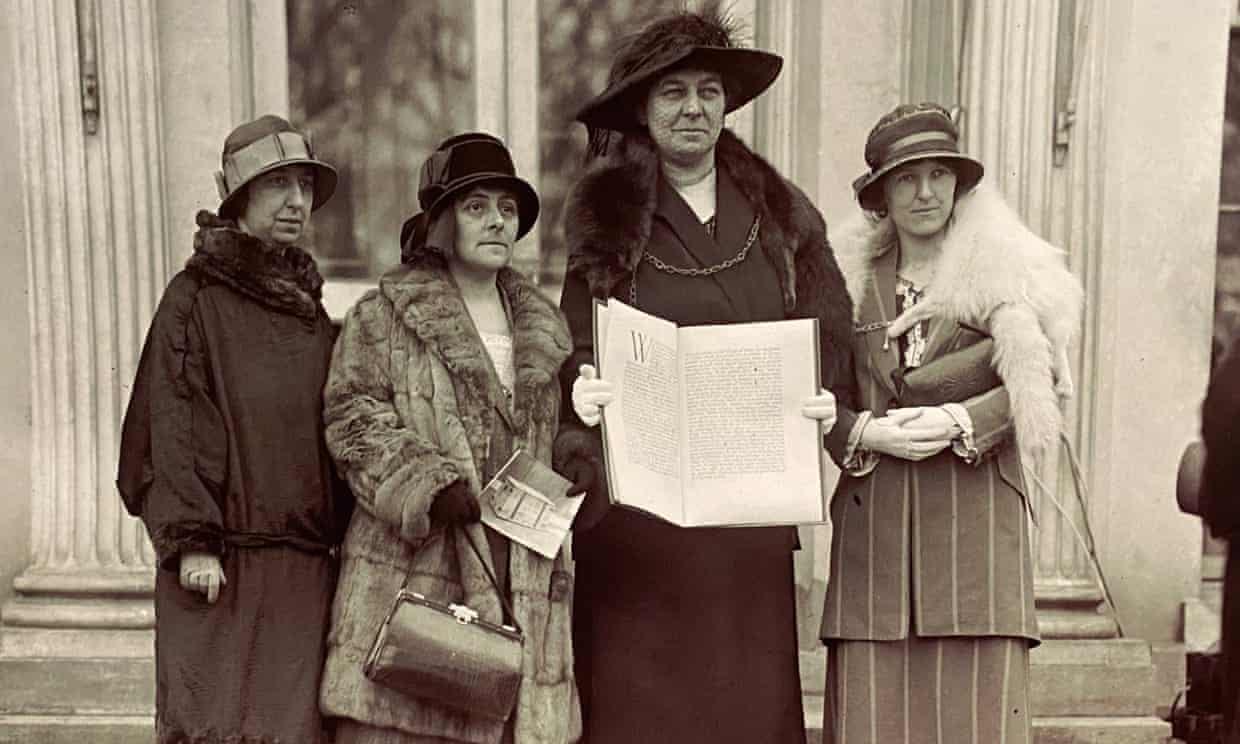
Photo: WCIA [Welsh Centre for International Affairs].
Annie Hughes-Griffiths holds the women’s peace appeal outside the White House in 1924 after a meeting with President Coolidge, with (from left) Gladys Thomas, Mary Ellis and Elined Prys. 

There are so many great initiatives by women that take years to get broad recognition because, at the time, they weren’t highly valued. That’s why I love sharing them now.

Steven Morris covered today’s example for the Guardian.

“There were tears of joy, speeches of hope and sighs of relief that all had gone smoothly after an extraordinary century-old document – reputedly seven miles long – completed its transatlantic trip back to Wales.

“The peace petition, signed by almost three-quarters of all Welsh women in the 1920s but forgotten until the last few years, arrived at the National Library of Wales [in April] after being gifted to the country by the National Museum of American History in Washington.

“Over the coming weeks and months, the reams of sheets will be taken carefully out of the hefty oak chest where they are stored, then digitized at the library in Aberystwyth, before a crowd-sourcing exercise takes place to transcribe all 390,296 signatures and addresses.

Prof Mererid Hopwood, the chair of the Peace Petition Partnership, said she was so excited she could hardly breathe and, though it was an overcast day in Wales, quoted the Welsh phrase mae’r haul yn gwenu – the sun smiles.

” ‘Actually, I think the sun’s practically chuckling with joy in Aberystwyth today. We are so very delighted,’ she said.

“In 1923, galvanized by the horrors of the first world war, a group of Welsh women decided to organize a campaign for world peace.

“During a Welsh League of Nations Union (WLNU) conference at Aberystwyth University, they agreed that the best way would be to appeal to the women of the US to work with them for a world without war. Two paid officers and 400 local organizers set about collecting names from every community in Wales.

“In 1924 the Welsh delegation, led by Annie Hughes-Griffiths, the chair of the WLNU, crossed the Atlantic with the petition and worked with American women such as the women’s rights campaigner Carrie Chapman Catt to disseminate their message.

“They received an enthusiastic welcome and travelled through the US addressing audiences. The US press claimed that if the signature sheets were laid end to end they would go on for 7 miles.

“However, over the years the petition was forgotten, until a mysterious plaque mentioning it was uncovered at the time of the centenary of the first world war in Cardiff’s Temple of Peace.

“ ‘It was a lost story, a hidden story,’ said Hopwood, a poet and the chair of Welsh and Celtic studies at Aberystwyth University. She said the idea of returning the petition to Wales was both to remind people of its amazing story and to inspire people today to campaign for peace.

“Hopwood pointed out that Wales has a history of its citizens working for peace, including … the women who marched from Wales to Greenham Common in Berkshire in 1981 to protest against nuclear weapons. …

“The Welsh deputy minister for arts and sport, Dawn Bowden, said it was an inspiring document: ‘I hope that the return of the petition to Wales will inspire and motivate a new generation of advocates for peace.’

“Dafydd Tudur, the head of digital services at the National Library of Wales, called it an ‘historic’ day.

“He said he hoped a pilot of the crowd-sourcing exercise would take place in the autumn, before fully beginning next year. An exhibition will be organized to present the chest and petition at three locations – Aberystwyth, St Fagans in south Wales, and Wrexham in the north.

“Tudur studied modern Welsh history but had not heard of the petition until the plaque was found. ‘It was forgotten. People are amazed when they hear about it,’ he said.” More at the Guardian, here. No firewall.

For more on the peace agenda, click here on an article co-authored by my friend Ann Tickner. The article examines “feminism in international relations from the emergence of women’s peace pragmatism during WW I to the development of the United Nations (UN) Women, Peace, and Security (WPS) agenda a century later. … We show how the principles articulated by women peace activists at the 1915 Hague Conference represent distinct contributions to the discipline.”

Read Full Post »