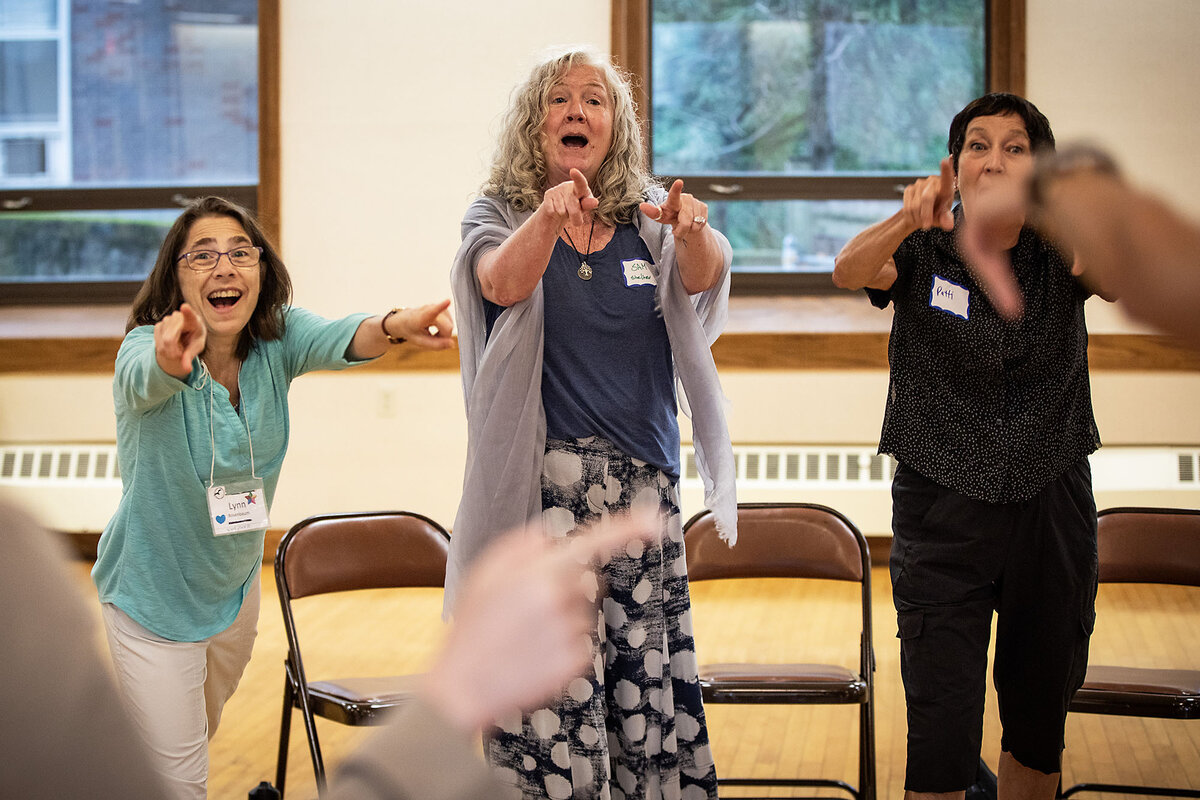
Photo: Melanie Stetson Freeman/CSM.
From left, Lynn Rosenbaum, Sam Whyte, and Patti Gurekian introduce themselves through song at a CircleSinging session at St. Mary Orthodox Church, Aug. 18, 2024, in Cambridge, Massachusetts.
Those of us worry a lot need to make a point of searching out joyful moments. Here’s one way that folks in Massachusetts fill their joy quotient: circle singing.
Oli Turner reports at the Christian Science Monitor, “The song coming from the St. Mary Orthodox Church meeting room in Cambridge, Massachusetts, has never been heard before. And it will never be heard again.
“Fourteen singers stand in a circle of metal folding chairs, improvising an organic cacophony of harmonious and discordant sounds. Some tap their feet, sway, or bob their heads to the rhythm – but no two people engage with the music in quite the same way.
“In CircleSinging, there’s no sheet music, no director, no pitch pipe. There’s an art to it, but not a pretentious one.
The singers have coalesced into an intergenerational network of friendship.
” ‘It’s really all about following. Following well,’ organizer Peter McLoughlin explains to the group between exercises. Mr. McLoughlin is not a teacher or a director. He gently sets the group in motion, and then blends into the circle as a participant.
“ ‘Everybody’s welcome, and we’re not as concerned with whether you’re an excellent singer or you are an excellent harmonizer,’ he says before the rest of the singers arrive.
“The Boston area’s CircleSinging community – tucked away in church meeting rooms in Cambridge, Arlington, Somerville, and the Jamaica Plain neighborhood – is part of an international network of CircleSingers who delight in the spontaneous art form.
“The improvisational singing technique was developed by jazz musician Bobby McFerrin, best known for his 1988 hit song ‘Don’t Worry, Be Happy,’ the first a cappella song to go No. 1 on the Billboard Hot 100 chart. Mr. McFerrin’s vocal jam sessions relied on a call-and-response model, in which a leader improvises one vocal part at a time and other singers repeat those ‘loops.’ Any singer can volunteer to lead a composition.
“Cambridge organizer Mr. McLoughlin started the first of the four Boston-area circles in 2015 on Meetup.com, inspired by Mr. McFerrin’s ‘magnificent’ rendition of Psalm 23. The looping choruses and complex harmonies reminded him of the music surrounding his own Catholic upbringing. He was hooked.
“Mr. McLoughlin learned the technique from Mr. McFerrin himself, attending his weeklong workshops once a year for seven years. Then CircleSinging Boston was born in Mr. McLoughlin’s living room.
“Each of the four Boston groups, run by different organizers, holds two-hour meetings that prioritize openness. One Boston CircleSinger, Maureen Root, says her favorite exercise starts by singing a random word – not for its meaning, but for its sounds.
“ ‘So it’s like these different vibrations and things come out,’ Ms. Root says. ‘It’s almost like you’re bypassing the mental circuitry. … It gets me out of my self-conscious mind.’
“Some CircleSingers have no prior musical or singing experience, like Ms. Root, a retired medical technologist and yoga and meditation instructor of more than 30 years. …
“Less-experienced singers like Ms. Root share a circle with vocal professionals like Boston Children’s Chorus conductor Destiny Cooper, who moved to Boston after college, ‘knowing not a soul.’ In experimental CircleSinging, a far cry from her familiar structured choirs, she found belonging.
“ ‘Most of the members are significantly older than me, but nonetheless, I think that community was really important to give me a sense of home,’ Ms. Cooper says. Since joining the group about five years ago, she never missed a circle until the pandemic. …
“Arlington CircleSinging organizer Lynn Rosenbaum leads her meetups with all singers in mind.
“ ‘I tend to think of the arc of where we start and where we end, and bringing people along, building their confidence and their skills,’ says Ms. Rosenbaum, a seasoned improv singer herself. ‘There’s usually a big difference between the beginning and the end, especially for new people – in their level of comfort and how much they’re willing to take risks.’ …
“ ‘Singing together and playing together – I say “playing” as in “playfulness” – it just creates a connection among people,’ Ms. Rosenbaum says. ‘It’s a common denominator that we can all connect to.’ …
“ ‘[CircleSinging is] just this opportunity to express our full range of emotions and letting it out through our voices and our bodies,’ Ms. Rosenbaum explains. ‘There’s not always a lot of opportunities in everyday life to do that, so this creates a safe space for people to be silly and explore and take risks and express joy.’ ”
More at the Monitor, here.

 Suzanne's Mom's Blog