Photo: Melanie Stetson Freeman/CSM.
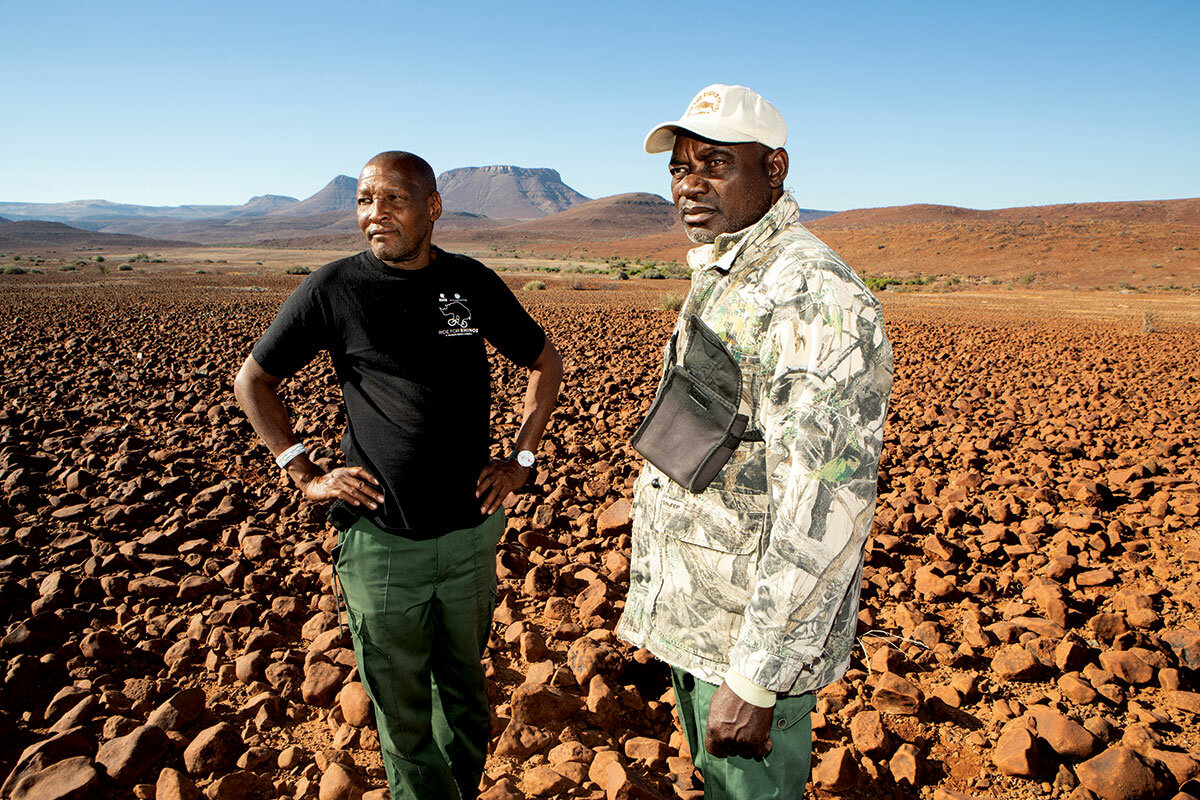
Ebson Mbunguha (right) and Sebulon Hoeb track endangered black rhinos in the Torra Conservancy near Palmwag, Namibia.
On Facebook and Instagram this past week, I’ve been following the adventures of an intrepid high school classmate who is in Africa for up-close and personal encounters with lions and elephants. I’m impressed at what a good traveler she is at our age, when I would be stressing over the time change, Covid exposure, what foods I can digest — every little thing. But, oh, the wonders she is seeing in Tanzania!
Today’s article is about one African wonder, the threatened black rhino. The people of Namibia truly love their rhinos and are doing all they can to protect them.
Sara Miller Llana writes at the Christian Science Monitor, “The rhino trackers trek a mile into the open desert plains of northwest Namibia. They stop 300 feet from a desert-adapted black rhinoceros grazing on the rocky hillside.
“Rhinos have poor eyesight, so the windy day works in the trackers’ favor, making it harder for the animals to locate them by sound or smell. Sebulon Hoeb, the principal field officer of Save the Rhino Trust Namibia, wants to get closer, but his partner today, Ebson Mbunguha, has his binoculars trained at the distance. He tells the group to back away. He has identified this rhino: Matty 2. She is 4 years old, which means her mother probably has a new baby and could appear on the open plain at any moment. There are no trees to climb if the crew is suddenly surrounded by creatures that can weigh as much as 3,000 pounds. Plus, they’ve identified her. Their job is now done.
“Every day and every night, trackers from Save the Rhino Trust, alongside rangers from the local community, patrol 25,000 square kilometers (just under 10,000 square miles) in Namibia’s northwest, the only place in the world where this desert-adapted subspecies of the black rhino is still truly wild. Even if these animals are spotted from a distance, the trackers know them so well that they can identify them from their behaviors, roaming patterns, and physical features like birthmarks. It’s all documented on small pieces of paper that pile up back at Save the Rhino Trust headquarters in the pinprick of a town, Palmwag.
“The trackers are not just building a living database of conservation or scientific study; patrolling is the best tool they have against rhino poaching. And the work is paying off.
“Rhino conservationists discourage publishing the price of horns on the black market, in order to deter criminal activity, but rhino horns are in high demand, especially in China and Vietnam. After years of successfully clamping down, Namibia saw rhino poaching increase by 93% last year over the year before, according to the Ministry of Environment, Forestry and Tourism. But here the community hasn’t logged a rhino poaching in three years. That’s because, within the structures of Namibia’s community conservation model, safeguarding the animals is more lucrative than selling them on the illegal market. …
“The desert-adapted rhino, one of the oldest mammals on Earth, has roamed this arid, red-earth region that glows at sunrise and sundown for millennia. Its presence is depicted in the ancient cave art found in nearby Twyfelfontein, a UNESCO World Heritage Site. But in the 20th century, European hunting all but eradicated its numbers. Between 1960 and 1995, black rhino numbers dropped by 98% to fewer than 2,500.
“Save the Rhino Trust was established in 1982, when only 50 black rhinos roamed this area. Forty years later, Namibia hosts almost 35% of the world’s remaining black rhino population, although the exact number is tightly guarded. ‘That’s a state secret,’ says Simson Uri-Khob, the CEO who has dedicated his career to saving the rhino.
“When Namibia gained its independence in 1990, it became the first country in Africa to protect the environment in its constitution. It also created community conservancies – lands with defined borders and governances outside the national park structure, where the communities themselves benefit from the resources, including animals, on their homelands. Today the government counts 86 communal conservancies covering more than 20% of the country’s territory. Many of these conservancies thrive by running lodges that draw tourists to see wildlife, in turn fueling local economies.
“Steve Galloway, chairman of the Community Conservation Fund of Namibia, says community conservation represents the best of both worlds. It puts large tracts of land under environmental protection – but not at the expense of people. ‘You bring in tourists, and you grow vegetables for those tourists and curios for those tourists. You do hiking trails, and you create a whole ecosystem,’ he says. …
“The rhino rangers start the day under a starry southern sky in the Namibian desert. … It’s no easy job. A 24/7 operation demands that the rangers live in tents for three weeks at a time, doing most of their tracking on foot. They get a bonus for how many kilometers they walk and how many sightings they log. It can be dangerous. ‘I’ve had to run for my life many times,’ says Mr. Hoeb.”
More at the Monitor, here. Good pictures. No firewall, but are subscriptions encouraged.

 Suzanne's Mom's Blog