Feeds:
Posts
Comments

Posts Tagged ‘poison’

Photo: University of St Andrews.
Books bound with potentially toxic green covers. 

With all the benighted book banning going on these days, you would think that the vigilantes had learned the written word would land people in the hospital. But reading is not lethal, and thinking about new ideas won’t kill anyone.

Having said that, I admit there is some reading material that may be dangerous to touch. Ella Creamer reports at the Guardian that “arsenic was historically mixed with copper to create a vivid green for book covers.”

“A new tool to quickly identify books that are poisonous to humans has been developed by the University of St Andrews,” Creamer writes. Historically, publishers used arsenic mixed with copper to achieve a vivid emerald green color for book covers. While the risk to the public is ‘low,’ handling arsenic-containing books regularly can lead to health issues including irritation of the eyes, nose and throat along with more serious side-effects. The toxic pigment in the book bindings can flake off, meaning small pieces can easily be inhaled.

“In recent years, many libraries have prevented access to all suspect green books as a precaution, as testing has until now been costly and time-consuming. … The new device can quickly and cheaply detect the presence of toxic pigment.

“ ‘A device used in the School of Earth Sciences to detect minerals in rocks was the starting point,’ said Pilar Gil, who led the research. ‘The Eureka moment was discovering the unique reflectance pattern from emerald green pigment in the visible spectrum. The idea was then to apply this discovery to an instrument which we could use and share with the sector.’

“Two scientists from the university’s astronomy and physics school, Graham Bruce and Morgan Facchin, developed a portable tool. ‘Our device shines different colors of light on to the book,’ said Facchin. ‘The amount of light reflected at each color is like a fingerprint of the pigment in the book.’ …

“The handheld device can screen books to test for the pigment in a fraction of a second. ‘Our team has been asked to look at thousands of books, of which more than 100 have been identified as containing emerald green pigment,’ said Bruce.

“At St Andrews, emerald green books are stored in Ziploc polythene bags. ‘When the books are used, we check first if there are any other copies available which are not bound in emerald green,’ reads the university’s website. ‘If not, the book is handled with special precautions such as the use of nitrile gloves.’ …

“ ‘The retention of green books from public view is not only a matter of safety, but it also restricts access to the information contained,’ said conservator Erica Kotze, who instigated the project. ‘This means that the books which have been tested and found not to contain the pigment can remain available to users.’

“A free exhibition exploring the project, Poisonous books – Dangers from the past, is running at the Wardlaw Museum in St Andrews until the end of July.”

More at the Guardian, here. No paywall, but please consider donating to support factual news.
Read Full Post »

Lead-Poisoned Eagles

Photo: Tri-State Brid Rescue & Research.
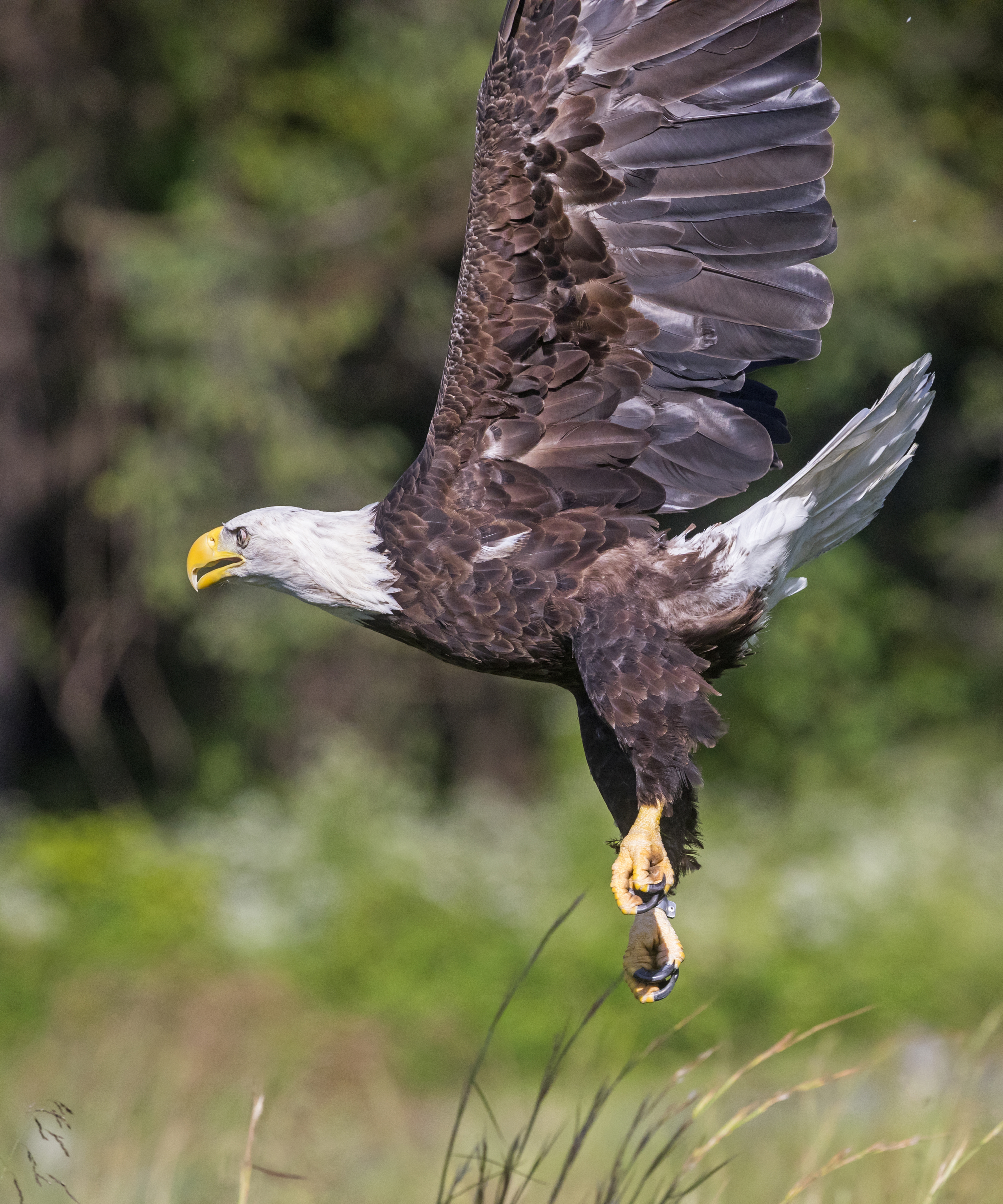
Study: Nearly half of bald eagles and golden eagles have chronic lead poisoning, probably from bullets lodged in their prey.

Eagles rebounded when humans stopped using DDT to kill mosquitos. But like most things in life, there’s always something else that comes along. Eternal vigilance is required. Today’s story looks into the reasons many of these eagles are now suffering from lead poisoning.

As Maria Cramer reported at the New York Times last month, “The bald eagle, whose resurgence is considered one of the great conservation success stories of the 21st century, is facing a serious threat: lead poisoning.

“Researchers who tested the feathers, bones, livers and blood of 1,200 bald eagles and golden eagles, another bird of prey in the Northern Hemisphere, found that nearly half of them had been exposed repeatedly to lead, which can lead to death and slow population growth.

“Scientists believe that the primary source of the lead is spent ammunition from hunters who shoot animals that eagles then scavenge, usually during the winter, according to the study, which was published on Thursday in the journal Science.

“Nearly a third of the birds tested also showed signs of acute poisoning, or short-term exposure to lead, according to the study, which was led by scientists from the United States Geological Survey, Conservation Science Global, Inc. and the U.S. Fish and Wildlife Service.

“The effects of lead poisoning are devastating, said Vincent A. Slabe, the lead author of the study and a research wildlife biologist for Conservation Science Global in Montana.

“Lead poisoning can prevent an eagle from digesting food properly, eventually leading to starvation, he said. It can cause loss of locomotion so severe that an eagle will lose the ability not only to fly, but also to move at all, he said. …

“The study, which examined bald eagles and golden eagles from 38 states, is the first to look at the effects of lead poisoning on the bird populations on such a large scale, said Todd E. Katzner, a research wildlife biologist at the U.S. Geological Survey.

” ‘The research also showed that poisoning slowed down population growth rates by about 4 percent for bald eagles and 1 percent for golden eagles. … These percentages seem small, but, over time, thousands and thousands of individual birds are being removed from the population’ because of lead poisoning, Dr. Katzner said. …

“Dr. Slabe said he hoped the report’s findings would help to educate hunters and encourage more of them to switch to lead-free ammunition.

“ ‘This is 100 percent human caused and totally preventable,’ said Laura Hale, president of the Badger Run Wildlife Rehab in Klamath Falls, Ore., whose organization has taken in bald eagles, golden eagles, and different species of hawks that were poisoned by lead.

“In 2018, the group tried to save an eagle that a hunter had found in the woods and was unable to fly and gasping for air.

When Ms. Hale told the hunter that the eagle most likely became sick from feeding on contaminated gut piles … ‘He was horrified. [He] wanted to stop hunting.’ [She] told him that he did not have to stop hunting; he needed only to stop using lead ammunition.

“Many hunters, concerned about effects not only on wildlife, but also on game meat consumed by humans, have been moving away from lead ammunition and have begun using copper bullets.

“Sporting Lead-Free, a hunters and anglers group based in Wyoming that seeks to raise awareness about the adverse effects of lead ammunition, posted a short film with testimonials from hunters who stopped using it.

“ ‘Hunters are conservationists,’ said Bryan Bedrosian, a co-founder of Sporting Lead-Free and a raptor biologist. ‘This does not need to be a polarizing issue.’

“Some hunters hesitate to switch ammunition because of tradition, a mistaken belief that copper bullets are less effective, or because they have a backlog of lead bullets, he said.

“ ‘Then there are still folks who just don’t know,’ said Mr. Bedrosian, who says he uses lead bullets at the range, where he knows the ammunition will not come into contact with wildlife.

“Hannah Leonard, the group’s outreach coordinator, said she hunted with lead bullets until four years ago, when she came upon an emaciated golden eagle hobbling on the ground while she was hunting in Anaconda, Mont.

“ ‘Her talons were really clenched, her wings were drooped,’ Ms. Leonard said. ‘You could tell she was in danger.’

“The eagle later died and Ms. Leonard said the animal rescue group she called to try and save the bird told her the cause of death was lead poisoning. ‘It was a no-brainer for me to switch’ types of ammunition, she said.

“In January 2017, the U.S. Fish and Wildlife Service issued a policy [later reversed] to phase out the use of lead ammunition and fishing tackle used on national wildlife refuges. … The service declined to say whether that policy would be reinstated as a result of the new study. …

“Dr. Slabe said that hunters, once they were educated, would voluntarily stop using lead ammunition. ‘Hunters are very receptive to this issue,’ he said.”

More at the Times, here.

Read Full Post »

What is going on with the oceans? Warming trends are bringing sea creatures further north and for longer periods.

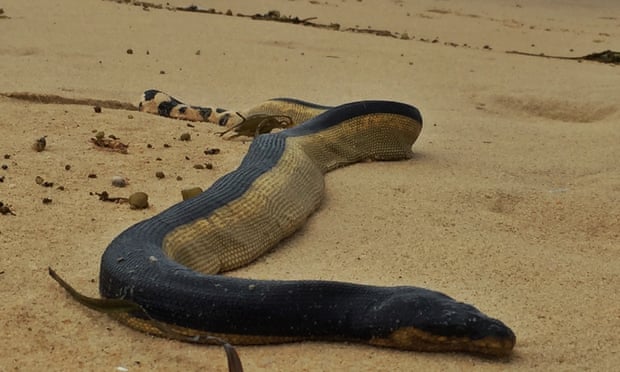
In January, Oliver Milman reported at the Guardian about a sea snake with a suggestive name (“Why you yellow-bellied sea snake, you …!”) that has suddenly shown up in California.

“California beachgoers have been urged to steer clear of a species of highly venomous sea snake following a third, and unprecedented, instance of an aquatic serpent washing up on to the state’s beaches.

“A 20-inch yellow-bellied sea snake was discovered on a beach near San Diego … The sighting was the third reported instance since October of the species, which prefers the tropical waters of the Pacific and Indian oceans, washing up on California’s beaches.

“The only previous verified sighting of a washed-up yellow-bellied sea snake was in 1972. Experts believe the snakes have ridden a warm current of water, fueled by the exceptionally strong El Niño climatic event, farther north than they have ever previously ventured. …

“ ‘It’s been an incredibly interesting year for southern California. We’ve seen tuna and marlin and tropical bird species such as red-footed boobies,’ said Greg Pauly, curator of herpetology at the Natural History Museum of Los Angeles County. …

“Yellow-bellied sea snakes are fully aquatic snakes capable of swimming vast distances. Although they are highly venomous, their targets are small fish and it’s thought they have yet to cause a recorded human death. However, Pauly said people should keep their distance if they encounter another washed-up snake.

“ ‘They are fairly docile and it’s unlikely for someone to be envenomated,’ he said. ‘It’s rare for them to bite people, it’s usually fishermen who are carelessly pulling up fishing nets.’ ”

More here.

Photo: Carolyn Larcombe/Wandiyali Images
Seen in California after el Niño, yellow-bellied sea snakes usually live in the deep waters of the Pacific and Indian oceans. 

Read Full Post »