Feeds:
Posts
Comments

Posts Tagged ‘polluting’

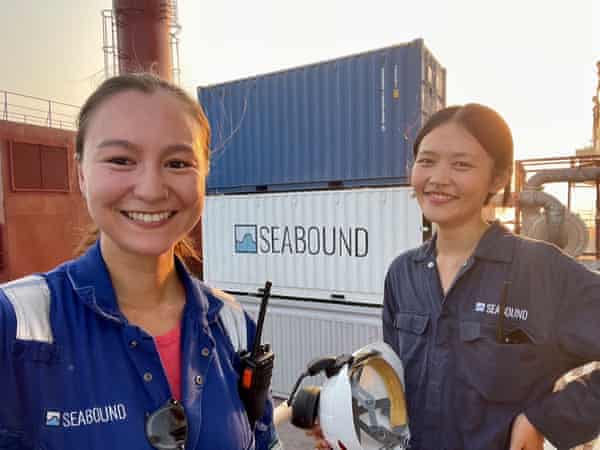
Photo: Seabound.
Seabound co-founders are chief executive Alisha Fredriksson (left) and chief technology officer Rojia Wen. Seabound’s carbon-capture prototype sailed for two months on a midsize container ship. 

Today’s story is about two women in the male-dominated shipping industry and their work on what might be a stepping stone to sustainability. The challenge is that the process to create their carbon-absorbing pellets also involves carbon release.

Emma Bryce writes at the Guardian, “An industrial park alongside the River Lea in the London suburb of Chingford might not be the most obvious place for a quiet revolution to be taking place. But there, a team of entrepreneurs is tinkering with a modest looking steel container that could hold a solution to one of the world’s dirtiest industries.

“Inside it are thousands of cherry-sized pellets made from quicklime. At one end, a diesel generator pipes fumes through the lime, which soaks up the carbon, triggering a chemical reaction that transforms it into limestone.

“With this invention, Seabound, the company behind it, hopes to capture large amounts of carbon directly from the decks of cargo ships, and help clean up this strikingly polluting industry. …

“Behind all this is Alisha Fredriksson, a young entrepreneur who once dreamed of being a doctor but reached a turning point in her career after reading a report from the Intergovernmental Panel on Climate Change that detailed the global implications of 2.7 F degrees versus 3.6 F degrees of warming.

“ ‘That’s when I realized that everyone around the world will be affected by the climate crisis, and so if I cared about large-scale social impact, the best thing I could do would be to help tackle it,’ says 30-year-old Fredriksson, chief executive of Seabound. …

“Trials have shown that her invention can scrub most of the carbon from the ship exhaust, filtered through its lime-pebbled interior. Ultimately, the goal is to have this device strapped to ships across the world’s oceans, she says. …

“She and her co-founder, Roujia Wen, hit on the idea of scaling down the existing quicklime-based carbon-capture technology typically employed at industrial plants. They then made a prototype, and attracted about $4m in funding from investors. Some of this came from shipping companies. ‘It all happened really quickly. Suddenly we had money, and we had to go build it,’ says Fredriksson. …

“Since then, successive prototypes of the Seabound container have taken her from the company’s test-bed in east London, to … a three-week voyage to test its efficiency. This showed that a Seabound unit can capture 78% of all the carbon from the exhaust that is pumped through it, and 90% of the sulphur, a toxic air pollutant.

“The latest prototype is being built to the dimensions of a standard 20ft shipping container, so that it can seamlessly slot in with cargoes on deck, Fredriksson says. … Once in port, the limestone-filled units can be substituted for containers of fresh quicklime. This product is made by heating limestone to high temperatures in kilns, an energy-intensive process that also releases CO2 from the limestone, making production extremely carbon-intensive.

“Companies are trying to make quicklime using kilns heated with renewable energy, or developing methods to capture the released CO2 so that it doesn’t enter the atmosphere. Seabound is working to source this ‘green’ quicklime, Fredriksson says. …

“Some critics are concerned that decarbonizing technologies could distract from solutions, such as zero-emission ammonia fuel or wind-powered innovations, that are essential to push the shipping industry to net zero.

“ ‘The potential for short-term use of carbon-capture retrofits on existing vessels should not become a justification to extend the lifespan of fossil fuels or delay the shift to truly sustainable alternatives,’ says Blánaid Sheeran, climate diplomacy policy officer at Opportunity Green, a nonprofit organization focused on gaps in global climate policy.

“But Fredriksson believes Seabound’s technology could support this transition. In April, at a meeting of the International Maritime Organization, UN member states agreed to a landmark deal that will start charging ships for every ton of emissions above a threshold. That threshold will gradually decrease to push the industry towards green fuels.

“Seabound slots into this new regulatory landscape, according to Fredriksson, by enabling ships to decarbonize their fuels, thereby lowering their emissions, and gradually adjust to the rules by adding more containers over time. …

“Fredriksson says [Seabound’s] offering is cost-effective and she has already had a commitment from one company to fit the first full-scale containers on to its ships this year.”

More at the Guardian, here. No firewall. Donations sought.
Read Full Post »

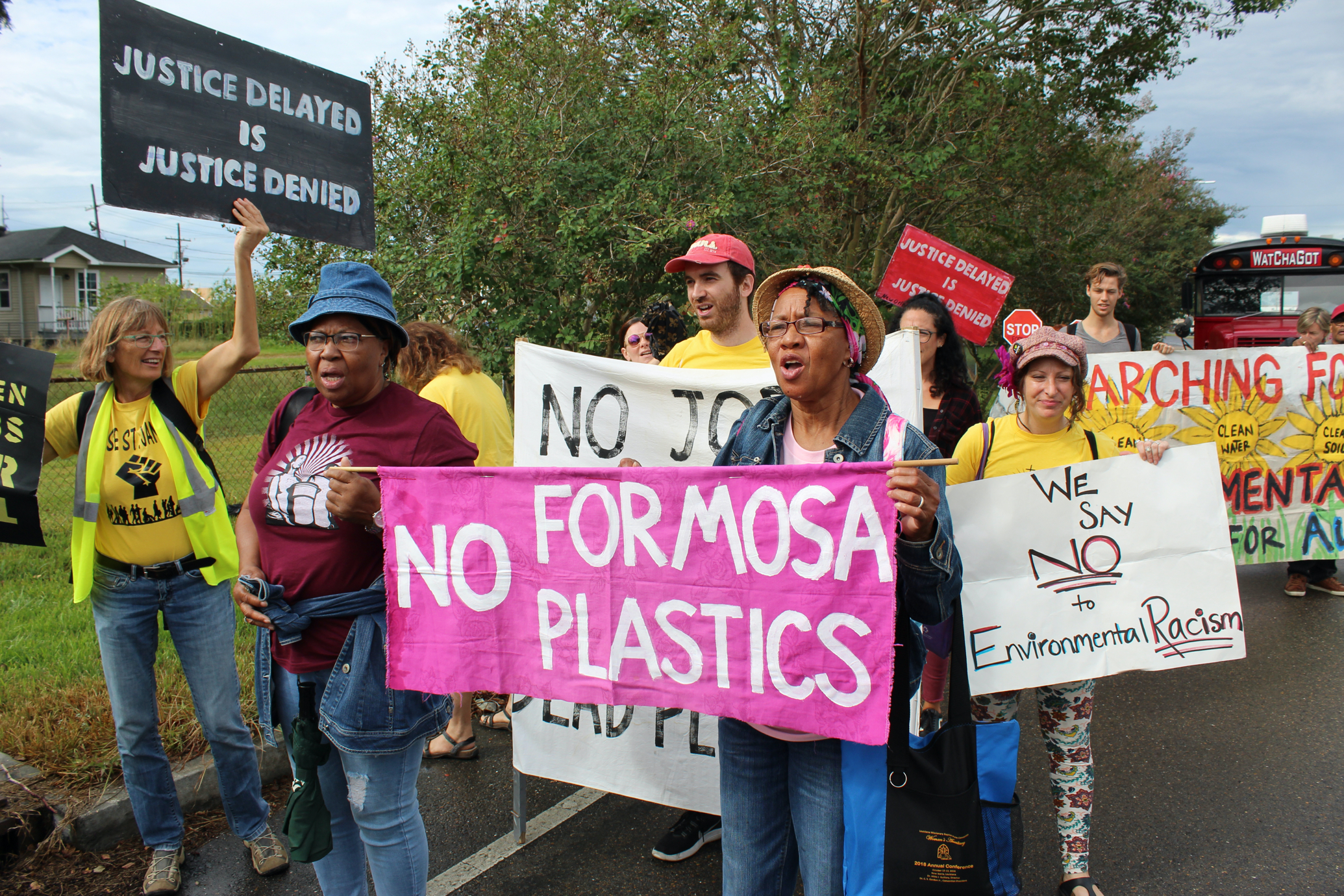
Photo: Louisiana Bucket Brigade.
One of the most effective grassroots groups fighting pollution in poor neighborhoods is the Louisiana Bucket Brigade, ordinary folks who got fed up with being endangered by Cancer Alley.

It’s no secret that some of the most polluting companies are located in poor or Black communities. I once had a boss who insisted that was not done on purpose, but still, decision makers often count on poor communities not fighting back.

I’m glad to say that’s changing. I’ve learned so much just from following the grassroots Louisiana Bucket Brigade, which has been fighting back effectively against Formosa Plastics.

In another example of fighting back, Michael Laris writes at the Washington Post about “how an outdoorsy engineer is working to cut transportation pollution around disadvantaged communities.”

Laris reports, “As a clean air and innovation manager at the Environmental Defense Fund, [Harold] Rickenbacker works with companies and communities to monitor and reduce pollution from transportation, which contributes to climate change and harms health, particularly in disadvantaged areas.

“While working on his engineering doctorate at the University of Pittsburgh several years ago, he worked with families hurt by the city’s air pollution, both outdoors and seeping into their homes. ‘My will to succeed when I wake up in the morning is impacted by … the air that I’m breathing,’ said Rickenbacker, who has taken up these issues in Maryland, Virginia, Delaware and other states. …

Q: The Environmental Defense Fund has developed a mapping tool to help understand how truck pollution near warehouses and fulfillment centers affects low-income communities and people of color. How does that work?

A: Medium- and heavy-duty trucks spew nitrogen oxides, black carbon, particulate matter, smog — you name it — which has had a clear impact on upper-respiratory health, things like asthma, lung cancer and even hypertension in some of the work we’ve done out in West Oakland. We use our GIS-based tool to calculate the population that lives within a half-mile radius of the predefined distribution centers and warehouses. It calculates the demographic and socioeconomic variables around those facilities. You can pinpoint X percentage of people of color that live near this facility and X amount of people with health issues who live near these facilities. Then you can prioritize things like green infrastructure, electric vehicles, workforce development, renewable energy. We’re using health- and equity-based tools to identify where the distribution of those infrastructure benefits should take place first.

Q: What has the Environmental Defense Fund found in Oakland through its air monitoring work?

A: Hyperlocal air pollution monitoring can occur every 30 to 60 meters, and every minute, every second, down to the hour or daily averages. Why is this significant? Well, conventional air pollution monitoring networks are spaced miles apart or away from cities.

We’ve had a partnership with Google Earth Outreach for many years, where we’re installing monitors on vehicles and getting a much more complete picture of air pollution at that neighborhood level.

“In West Oakland, the data really highlighted impact zones where residents lived among elevated levels of pollution. The highest concentrations of nitrogen dioxide in that community created a 40 percent greater risk of cardiovascular disease events among those who were 65 years of age or older. …

Q: Big trucks drive a lot and they pollute a lot, as they move so much of the economy. Yet electric trucks, which have no emissions, are still comparatively costly. How can that problem be tackled?

A: We have to lean on large corporations to move the needle. There are tons of different incentive programs out there, where there are opportunities to purchase commercial EVs and deploy them in communities. But that’s often not enough. For some of our corporate giants, if you have the bandwidth, you have the resources, you can really drive the demand and drive the market. If there’s a clear need for electric trucks, manufacturers will understand that and then you essentially have this revolving market where prices go down.

Q: Unlike with power plants and other big polluters causing climate change, transportation emissions stem from huge numbers of individuals making individual decisions. How do you address such a sprawling problem?

A: Part of it is really this idea of coalition-building. You have groups like EV100 that has dozens of corporations that have carbon-neutrality goals for 2030, or transportation-emission reduction goals. It’s not really an individual discussion or decision. It has to be more of a collective. [Justice40 initiative, which] means investments in climate, clean energy, clean transportation, you name it. Low-income communities that have been subjected to racial segregation — those same communities that have the health burdens — should see clean transportation and other environmental benefits in their communities first.

Q: But it’s still this vast swath of society that’s making decisions about what kind of cars to buy and how much to drive them — and creating those emissions.

A: Under the infrastructure funding and reconciliation packages, there are going to be tons of opportunities to beef up infrastructure, including public transit. Most of the communities that are impacted by transportation emissions are the same communities that are using public transit. More affluent communities can also understand you can lower your carbon footprint by riding a bus and not driving your vehicle. So at that point, it does turn into more of an individual decision.”

Alas, last-minute lobbying by the gas industry and a Pennsylvania Senator means the infrastructure bill actually has a huge fund for building more polluting buses. Man, you just cannot win! If you live in Pennsylvania, please give Sen. Patrick J. Toomey what-for!

More at the Post, here.

Read Full Post »