Feeds:
Posts
Comments

Posts Tagged ‘Pompeii’

Photo: Tony Jolliffe/ BBC.
Newly uncovered frescoes in Pompeii depict Paris (of Troy) and his surprisingly peaceful kidnapping of Helen (of Greece) — the act that triggered the Trojan War.

Art from the ancient world can make you think twice about what you know. When you picture the Greek myth in which Paris steals the most beautiful woman in the world from her husband Menelaus, do you ever imagine her going quietly? I don’t. But judging from newly uncovered frescoes, people in Pompeii did. It puts a whole different cast on the Trojan Wars.

Jonathan Amos, Rebecca Morelle, and Alison Francis report at the BBC, “Stunning artworks have been uncovered in a new excavation at Pompeii, the ancient Roman city buried in an eruption from Mount Vesuvius in AD79.

“Archaeologists say the frescos are among the finest to be found in the ruins of the ancient site. Mythical Greek figures such as Helen of Troy are depicted on the high black walls of a large banqueting hall. …

“A third of the lost city has still to be cleared of volcanic debris. The current dig, the biggest in a generation, is underlining Pompeii’s position as the world’s premier window on the people and culture of the Roman empire. …

“It was likely the walls’ stark color was chosen to hide the smoke deposits from lamps used during entertaining after sunset. ‘In the shimmering light, the paintings would have almost come to life,’ [Park director Dr Gabriel Zuchtriegel] said.

“Two set-piece frescos dominate. In one, the god Apollo is seen trying to seduce the priestess Cassandra. Her rejection of him, according to legend, resulted in her prophecies being ignored. The tragic consequence is told in the second painting, in which Prince Paris meets the beautiful Helen – a union Cassandra knows will doom them all in the resulting Trojan War.

“The black room is the latest treasure to emerge from the excavation, which started 12 months ago – an investigation [featured] in a documentary series from the BBC and Lion TV … in April. …

“Staff are having to move quickly to protect new finds, removing what they can to a storeroom. For the frescos that must stay in position, a plaster glue is injected to their rear to prevent them coming away from the walls. Masonry is being shored up with scaffolding and temporary roofing is going over the top. …

“Excavations in the late 19th Century uncovered a laundry in one corner. The latest work has now revealed a wholesale bakery next door, as well as the grand residence with its black room. The team is confident the three areas can be connected, physically via the plumbing and by particular passageways, but also in terms of their ownership. The identity of this individual is hinted at in numerous inscriptions with the initials ‘ARV.’ The letters appear on walls and even on the bakery’s millstones.

” ‘We know who ARV is: he’s Aulus Rustius Verus,’ explained park archaeologist Dr Sophie Hay. ‘We know him from other political propaganda in Pompeii. He’s a politician. He’s super-rich. We think he may be the one who owns the posh house behind the bakery and the laundry.’

“What’s clear, however, is that all the properties were undergoing renovation at the time of the eruption. Escaping workers left roof tiles neatly stacked; their pots of lime mortar are still filled, waiting to be used; their trowels and pickaxes remain, although the wooden handles have long since rotted away.

“Dr Lia Trapani catalogues everything from the dig. She reaches for one of the thousand or more boxes of artifacts in her storeroom and pulls out a squat, turquoise cone. ‘It’s the lead weight from a plumb line.’ Just like today’s builders, the Roman workers would have used it to align vertical surfaces.

“She holds the cone between her fingers: ‘If you look closely you can see a little piece of Roman string is still attached.’

“Dr Alessandro Russo has been the other co-lead archaeologist on the dig. He wants to show us a ceiling fresco recovered from one room. Smashed during the eruption, its recovered pieces have been laid out, jigsaw-style, on a large table.

“He’s sprayed the chunks of plaster with a mist of water, which makes the detail and vivid colours jump out. You can see landscapes with Egyptian characters; foods and flowers; and some imposing theatrical masks.

” ‘This is my favorite discovery in this excavation because it is complex and rare. It is high-quality for a high-status individual,’ he explained.”

At the BBC, here, read that there’s a dark side to what they’re finding. No paywall.

Read Full Post »

Photo: Archaeological Park of Pompeii.
A well-preserved fresco depicting the myth of Phrixus and Helle was recently uncovered at Pompeii, a city buried in 79 CE.

Have you ever felt curious about a Greek myth? Once you start digging in, you find there’s always another story behind the story. Consider the Golden Fleece of Jason and the Argonauts‘ quest. That’s a tale stirred up anew by a discovery at Pompeii.

As Rhea Nayyar reports at Hyperallergic, “Archaeologists in Italy recently uncovered a 2,000-year-old fresco in remarkable condition on the walls of the House of Leda, a Pompeii mansion under excavation since 2018 that’s recognized for its exquisite art. Painted as if it were a framed artwork on a yellow wall, the fresco depicts the Greek mythological tale of Phrixus and Helle with vibrant pigments and crisp dimensions that have been preserved beneath volcanic ash since 79 CE, after the eruption of Mount Vesuvius.

“According to the tale, Phrixus and Helle were twin children born to the Boeotian king Athamas and a nymph named Nephele. Athamas remarried to a mortal woman named Ino who hated her step-children and devised a plan to have Phrixus sacrificed by the order of an oracle so she could secure her own son’s right to the throne. Phrixus [the boy] and Helle [the girl] escaped from Boeotia with the help of the Golden Ram that flew them across the sea, but Helle sadly fell off of its back mid-flight and drowned in the ocean. Phrixus found safety with King Aeëtes of Colchis, and later married his daughter Chalciope. The fresco depicts the frequently referenced scene of Helle drowning while reaching out for her brother’s hand as the Golden Ram prepares to soar away.

“Gabriel Zuchtriegel, the director of the Pompeii Archaeological Park [says] ‘history has repeated itself’ … Phrixus and Helle were ‘two refugees at sea.’ …

“The discovery came along during the conclusion of the Great Pompeii Project that was spearheaded by the Italian government in 2012 to further excavate, stabilize, and restore structures across the ancient city amidst research efforts, climate emergencies, and increased tourism. Earlier this month, Zuchtriegel shared in an official statement that the next phase for Pompeii was to develop it from an urban planning standpoint that engages surrounding towns and cities and promotes further educational opportunities for history and culture.”

More at Hyperallergic, here. No paywall. Subscriptions welcomed.

More on the Greek myth from Greek: “Helle, for unknown reasons, fell off the ram and drowned in the strait between Europe and Asia, which was named after her the Hellespont, meaning the sea of Helle (now Dardanelles). Phrixus survived all the way to Colchis, where King Aeëtes, the son of the sun god Helios, took him in and treated him kindly, giving Phrixus his daughter, Chalciope, in marriage. In gratitude, Phrixus sacrificed the ram to Poseidon and gave the king the Golden Fleece of the ram, which Aeëtes hung in a tree in the holy grove of Ares in his kingdom, guarded by a dragon that never slept. Phrixus and Chalciope had four sons, who later joined forces with the Argonauts.”

See what I mean about the way each myth makes you want to research another myth? I’m quite intrigued by a “dragon that never slept.” Even Smaug sleeps, for goodness’ sake!

Read Full Post »

Photo: BBC.
“In the extreme northwest corner of the contiguous US,” reports the BBC, a 1970s storm uncovered a forgotten village.

If Lewis Carroll’s “boiling hot” sea becomes a reality, if the ocean doesn’t overflow from melted icebergs but instead dries out, will the lost Kingdom of Atlantis rise up?

Something like that already happened in 1970 on the west coast of Washington state.

Brendan Sainsbury wrote at the BBC, “In 1970, a violent storm uncovered a Makah village that was buried by a mudslide more than 300 years earlier. A newly re-opened museum tells the fascinating story of the ancient site.

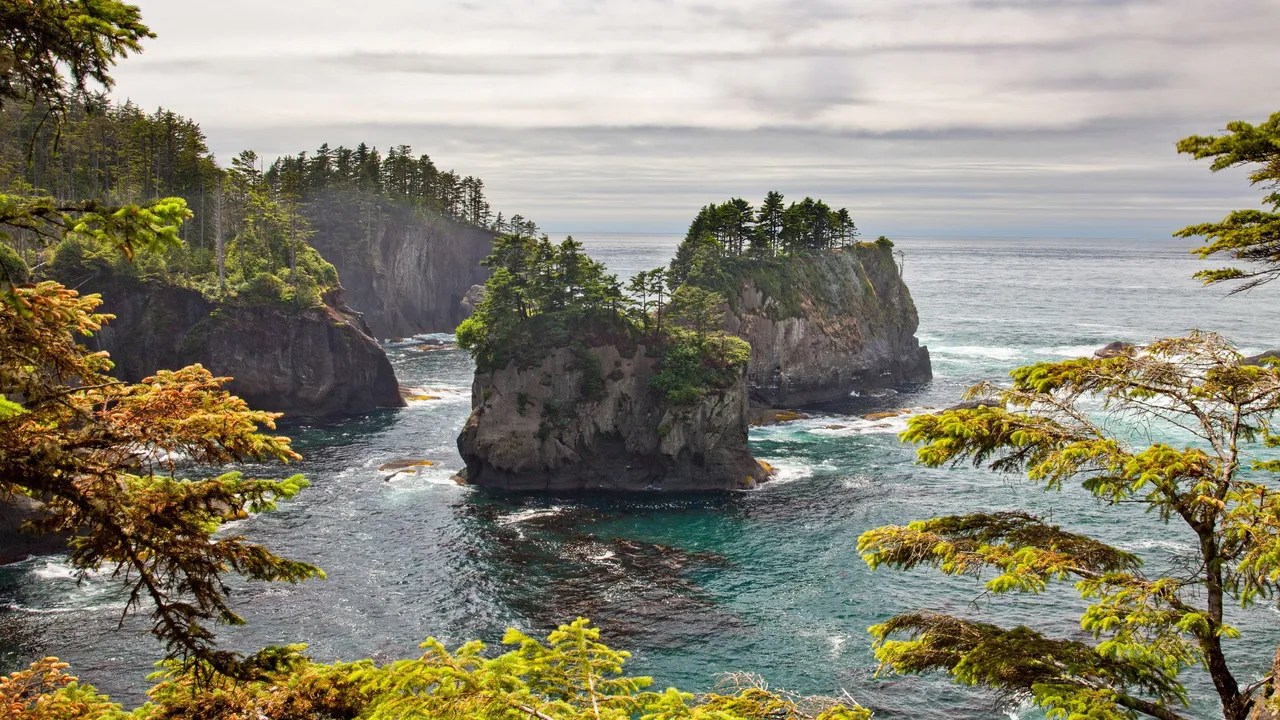
“Coming to the end of a short, winding trail, I found myself standing in the extreme north-west corner of the contiguous US, a wild, forested realm where white-capped waves slam against the isolated Washington coast with a savage ferocity. Buttressed by vertiginous cliffs battling with the corrosive power of the Pacific, Cape Flattery has an elemental, edge-of-continent feel. No town adorns this stormy promontory. The nearest settlement, Neah Bay, sits eight miles away by road, a diminutive coast-hugging community that is home to the Makah, an indigenous tribe who have fished and thrived in this region for centuries.

“The Makah are represented by the motif of a thunderbird perched atop a whale, and their story is closely linked to the sea.

” ‘The Makah is the only tribe with explicit treaty rights to whale hunting in the US,’ explained Rebekah Monette, a tribal member and historic preservation program manager. ‘Our expertise in whaling distinguished us from other tribes. It was very important culturally. In the stratification of Makah society, whaling was at the top of the hierarchy. Hunting had the capacity to supply food for a vast number of people and raw material for tools.’

“After reading recent news stories about the Makah’s whaling rights and the impact of climate change on their traditional waters, I had come to their 27,000-acre reservation on Washington’s Olympic Peninsula to learn more, by visiting a unique tribal museum that has just reopened after a two-year hiatus due to Covid-19.

“Due to a trick of fate, Makah history is exceptionally well-documented. In contrast to other North American civilizations, a snapshot of their past was captured and preserved by a single cataclysmic episode. In 1970, a brutal Pacific storm uncovered part of an abandoned coastal Makah village called Ozette located 15 miles south of Cape Flattery.

Part of the village had been buried by a mudslide that was possibly triggered by a dramatic seismic event around 1700, almost a century before the first European contact.

“Indeed, recent research argues that ancestors of the Makah – or related Wakashan speaking people – have been present in the area for at least 4,000 years, which, if proven, would change our understanding of prehistory in the Olympic Peninsula and Vancouver Island.

“Miraculously, the mud had protected embedded organic matter by sealing it off from the air. As a result, thousands of well-preserved artifacts that would normally have rotted – from intact woven cedar baskets to dog-hair blankets and wooden storage boxes – were able to be painstakingly unearthed during a pioneering archaeological dig. …

“The Washington Post called it ‘the most comprehensive collection of artifacts of a pre-European-contact Indian culture ever discovered in the United States.’

“Anxious the material might be engulfed by the sea and lost, the tribe called in Richard Daugherty, an influential archaeologist at Washington State University who’d been involved in fieldwork in the area since the 1940s. Having good connections with Congress, Daugherty helped secure federal funding for an exhaustive excavation.

” ‘Dr Daugherty was instrumental in the excavation work,’ recounted Monette. ‘He was very progressive and interested in working alongside the tribe.’ …

“The Makah, like many indigenous groups, have a strong oral tradition, with much of their history passed down through storytelling, song and dance. The evidence unearthed at Ozette affirmed these stories and added important details. …

“While much of the material dated from around 1700, some of it was significantly older. Indeed, archaeologists ultimately determined that multiple mudslides had hit Ozette over a number of centuries. Beneath one of the houses, another layer of well-preserved material dated back 800 years. The oldest finds so far have been radiocarbon-dated to 2,000 years and there are middens in the area that are at least 4,000 years old, according to [archaeologist Gary Wessen, a former field director at the site who later wrote a PhD dissertation on the topic].

“From the outset, the Ozette dig was different from other excavations. Tribal members worked alongside university students at the site, and, early on, it was decided that the unearthed material would stay on the reservation rather than be spirited off to distant universities or other non-indigenous institutions. In 1979, the tribe opened the Makah Cultural and Research Center in Neah Bay with a museum to house a ‘greatest hits’ of the collection. The 500 pieces currently on display represent less than 1% of the overall find.

” ‘The tribe was very assertive of their ownership and control of the collection,’ said Monette. ‘A lab was developed in Neah Bay. For the museum, we hired Jean Andre, the same exhibit designer as the Royal BC Museum in Victoria.’ “

More at the BBC, here. Doesn’t it sound like Pompeii, only with the preservative being mud instead of volcanic ash?

Read Full Post »

Photos: Ciro Fusco / Pompeii Parco Archeologico
Frescoes in Pompeii’s newly discovered “Enchanted Garden” room. The ashes of Mount Vesuvius left the ancient city remarkably intact after the volcano erupted in 79 AD.

When my younger grandson told me about a volcano in Guadalupe, where Suzanne’s family spent the holiday, he hastened to reassure me that it didn’t erupt. He’s six, and a stickler for fact.

Whether young or old, we are all fascinated by the extraordinary power of volcanoes and the way they change the world very suddenly, sometimes with no warning at all.

The complete destruction of Pompeii by the volcano Vesuvius in Italy is one of the reasons eruptions have such a hold over the collective imagination.

Interestingly, Pompeii continues to yield previously unseen beauty to archaeologists even after all these years.

As Sarah Cascone reported in October at ArtNetNews, “Pompeii is the city that keeps on giving. More than two hundred and fifty years after the ancient Roman town was discovered buried under a heap of volcanic ash, the archeological finds show no sign of abating. Now, archaeologists for the Great Pompei Project have uncovered yet another impressive discovery: an ancient shrine, or lararium, covered in gorgeously preserved frescoes, in a 16-by-12-foot room containing an altar, a garden, and a small pool.

“The Italian media has dubbed the new room, which would have been partially covered by a tile roof, ‘the Enchanted Garden.’ The figures in the paintings include two serpents, a wild boar fighting unidentified creatures against a blood-red backdrop, and a mysterious man with the head of a dog that may have been inspired by the Egyptian god Anubis. In front of a painted peacock, strolling through the plants, there would have been a planted flower bed, extending the illusionistic decorative design into the real world.

“ ‘It is the first time that such complex decoration has been found in a space dedicated to worship inside a house,’ Massimo Osanna, the director of the Parco Archeologico di Pompei, told the Wall Street Journal, praising the find as exceptional.

“ ‘Every house had a lararium of some kind,’ Ingrid Rowland, a professor at the University of Notre Dame and the author of From Pompeii: The Afterlife of a Roman Town, told the New York Times. But ‘only the wealthiest people could have afforded a lararium inside a special chamber with a raised pool and sumptuous decorations.’

“After clearing out the volcanic rock fragments, or lapili, that had buried the room for almost two millennia, archaeologists found an altar decorated with eggs, a symbol of fertility. There are burnt remains, which archaeologists believe may have contained food offerings, such as eggs, figs, or nuts, to fertility deities. The altar is flanked by paintings of the Roman gods of household rituals. …

“New excavations are much more careful than the original explorations of the site, which began in 1748. Without modern technology and techniques to aid their excavations, early archaeologists could be quite destructive. The new discovery helps provide a better understanding of what the early excavations would have looked like when first uncovered. …

“Since 2011, Italy has been carrying out much-needed preservation and restoration work to preserve the UNESCO World Heritage Site. The Great Pompeii Project, an initiative aimed at stemming the deterioration of the ancient structures, had an initial budget of €105 million ($140 million). … The discovery of the ‘Enchanted Garden’ represents perhaps the project’s greatest success thus far.”

More here.

In Pompeii, a recently uncovered household shrine, or lararium, features two serpents among its beautifully preserved frescoes.

Read Full Post »