Feeds:
Posts
Comments

Posts Tagged ‘potter’

Photo: Museum of Fine Arts, Boston.
Descendants of potter David Drake, seen at the Museum of Fine Arts with one of the artist’s works

If we are in a hurry for the many evils we see to be defeated, we’re likely be disappointed. But in time, even a foundering ship can right itself. The growth of initiatives to return artifacts stolen in the past is an example.

Jori Finkel writes at CNN that in a “likely precedent-setting agreement, the Museum of Fine Arts (MFA) Boston has agreed to return two works from 1857 by the Black potter David Drake, who made his ambitious jars while enslaved, to his present-day descendants.

“By the terms of the contract, one of those vessels will remain on loan to the museum for at least two years, according to the lawyer George Fatheree, who is representing Drake’s descendants. The other vessel — a masterpiece known as the ‘Poem Jar’ — has been purchased back by the museum from the heirs for an undisclosed sum. Now the work comes with ‘a certificate of ethical ownership.’

“ ‘In achieving this resolution, the MFA recognizes that Drake was deprived of his creations involuntarily and without compensation,’ a museum spokesperson said in a statement. ‘This marks the first time that the museum has resolved an ownership claim for works of art that were wrongfully taken under the conditions of slavery in the 19th-century US.’ …

‘Ethan Lasser, chair of the art of Americas at the MFA, said the museum has learned from its work restituting Nazi-looted art. ‘We’ve become very expert in Holocaust restitution. We’re dealing with (repatriation) issues in our African collections and Native American collections,’ he said over the phone. …

“He considers Drake’s work an example of ‘stolen property,’ too, ‘since the artist is always the first owner of his work and he never got to make the call about where it went or what he was paid for it.’

“Born enslaved around 1800 in Edgefield, South Carolina, a region known for its rich clay, Drake (who was also known as Dave the Potter) was one of relatively few African American potters to sign his work. He also dared — despite punitive anti-literacy laws for enslaved people in the state — to etch short sayings or poems on the jars, making them powerful acts of resistance. Some inscriptions boast of the jar’s intended contents or enormous capacity; others remark more poignantly on his own life or working conditions.

“The ‘Poem Jar,’ which the MFA originally bought in 1997 from a dealer in South Carolina, features a couplet that hints at Drake’s financial exploitation. The inscription reads: ‘I made this Jar = for cash/Though its called Lucre trash.’ Currently in a gallery for self-taught and outsider art at the museum, it will assume a more prominent spot at the entrance of the Art of Americas wing once renovated in June 2026. …

“Another jar made the same year, 1857, has a particularly wrenching inscription in light of Drake’s forced separation from a woman believed to be his wife and her two sons. That vessel, at the Greenville County Museum of Art in South Carolina, reads: ‘I wonder where is all my relation.’

“One of Drake’s great-great-great-great grandsons, the children’s book author and producer Yaba Baker, said he feels the restitution process offers one answer to that question. ‘It’s been exciting, overwhelming and feels full circle,’ he said in a video call. He praised the MFA for ‘showing integrity and leadership’ in ‘allowing us to connect to Dave’s legacy,’ noting that ‘to go from being slaves to having a family of engineers and doctors and people in executive positions is a testament to Dave’s legacy in a different way.’

‘These descendants began talking about getting involved in Drake’s legacy in 2022, upon the opening of ‘Hear Me Now: The Black Potters of Old Edgefield, South Carolina,’ an exhibition jointly organized by the MFA and the Metropolitan Museum of Art in New York. The family soon hired Fatheree, fresh from his win in the Bruce’s Beach land reparation case. Earlier this year they established the David Drake Legacy Trust, governed by five of the oldest heirs.

“So far there are about 15 family members involved, according to Fatheree, but they have created a website so that other descendants of Drake can be identified and join the efforts — what Fatheree calls ‘a big tent approach.’ …

“There are thought to be around 250 pots by Drake still in existence, and over the past five years the market for his work has exploded, driven mainly by American museums competing for pieces in the hopes of telling a more complex story about the history of slavery in the US. Several have paid six figures for his work, and in 2021 the Crystal Bridges Museum of American Art in Arkansas paid a record-setting $1.56 million for a 25-gallon stoneware jar at auction.

“Other museums that own Drake’s work include the Met, the Philadelphia Art Museum, the De Young Museum in San Francisco, the Art Institute of Chicago, Harvard Art Museums, the St Louis Art Museum and the Smithsonian American Art Museum in Washington, DC, as well as smaller venues in the American South.

“Fatheree confirmed he has begun to reach out to some of these other art institutions on behalf of the family. ‘Our approach has been one of collaboration and invitation. I am not a litigator; we did not go to the museum and file a lawsuit (or) threaten to sue them. But our hope and frankly our expectation is that other institutions’ — and private collectors of Drake’s work, he added — ‘will follow the Boston museum’s lead here.’ ”

More at CNN, here.
Read Full Post »

Photo: Lane Turner/Globe Staff.
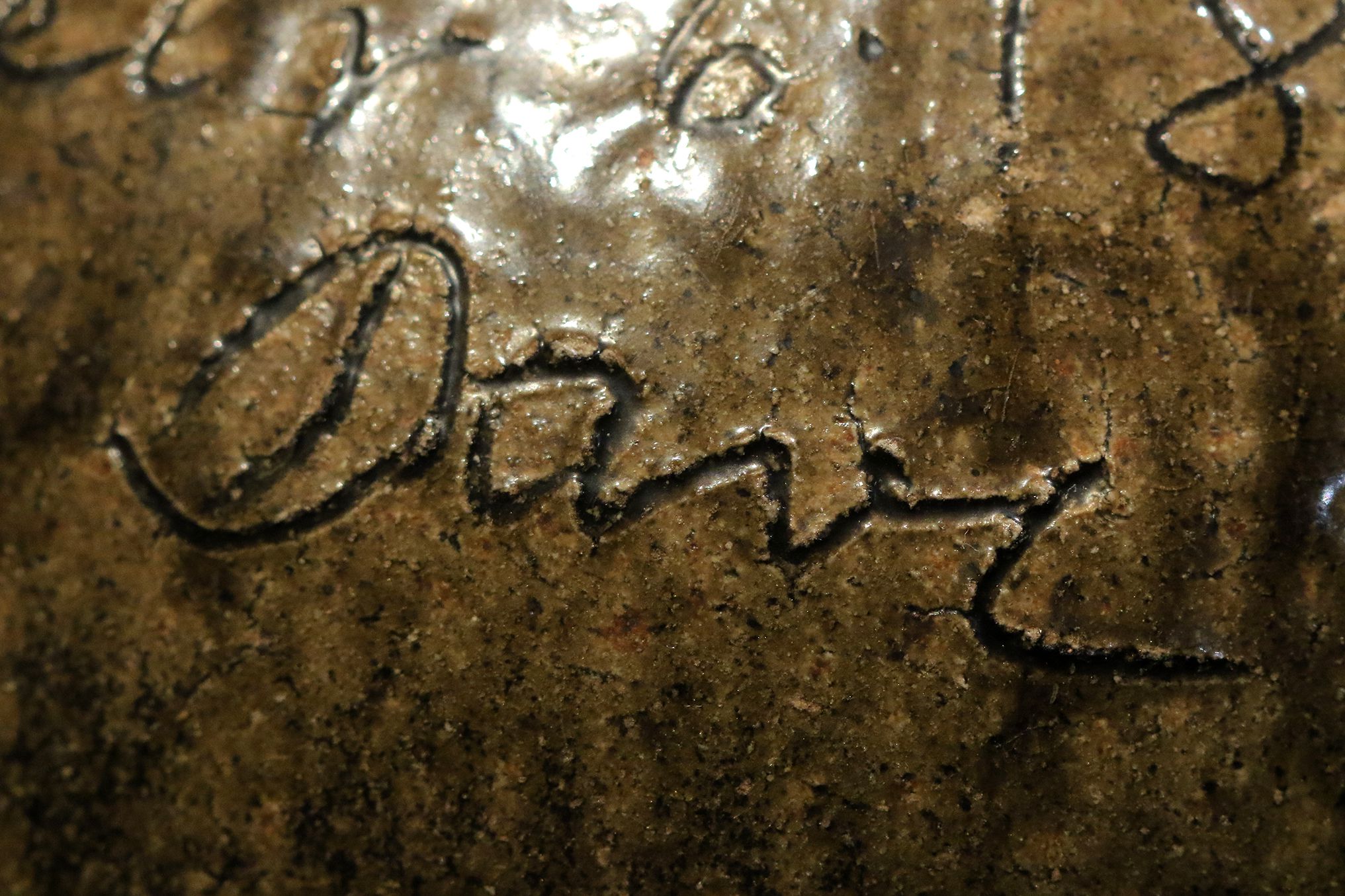
“Hear Me Now: The Black Potters of Old Edgefield, South Carolina,” an exhibition at Boston’s Museum of Fine Arts, presents 12 works by enslaved potter David Drake. Above, David Drake’s signature, “Dave,” on a storage jar from 1858. 

Today’s story is about an enslaved potter and the descendants who found him 150 years later. It is so painful to read about him being “bought.” You really have to wonder about the depths to which humanity sometimes descends.

Malcolm Gay reports at the Boston Globe, “In 1857, an enslaved potter in South Carolina’s Old Edgefield district carved a brief poem into a pot he’d turned in the mid-August heat.

“The potter had been bought and sold by a series of owners by then. He’d lost a leg, but his gifted hands won him local renown: His expert work with clay ensured he would be kept in the district known for its stoneware, even as his family was torn from him at auction.

“Using a sharpened tool, he etched into the jar’s shoulder: ‘I wonder where is all my relation/Friendship to all — and every nation.’ The potter then added his enslaver’s initials, the date, and, finally, his own name: ‘Dave.’

“In that simple act, the man, long known as Dave the Potter, and later David Drake, was not only wondering about his lost family: He was committing an extraordinary act of defiance in pre-Civil War South Carolina, indelibly asserting his existence in an age that sought to obliterate the humanity of Black people.

“Originally created to store meats and other foods, Drake’s 40 or so poem jars are today highly sought after by museums. His inscribed vessels routinely fetch six figures at auction, and his stoneware features prominently in ‘Hear Me Now: The Black Potters of Old Edgefield, South Carolina,’ an exhibition featuring enslaved potters [at Boston’s] Museum of Fine Arts.

“Perhaps most significantly: More than 150 years after Drake composed his mournful verse, researchers appear finally to have found his direct descendants.

“ ‘He was sending these messages,” said Daisy Whitner, 84, whom genealogists have identified as Drake’s great-great-great-granddaughter. ‘He wanted people to know: I’m a human being; treat me as such.’

“Now in their mid-70s and 80s, Whitner and her three siblings, Pauline Baker, John N. Williams, and Priscilla Ann Carolina, believed for most of their lives that their known family tree began in Aiken, S.C. They hadn’t known they’d had family in Edgefield. They’d certainly never heard of David Drake.

“But that changed in 2016, when April Hynes, an independent genealogist and researcher who’s been tracking down descendants of enslaved people from the area, cold-called Whitner. By pairing historical research with publicly available documents, Hynes had determined that Whitner and her siblings were the potter’s direct descendants. …

“ ‘I don’t have a word to describe him,’ said Baker, 75, seated on a sofa in her niece’s tidy home outside Washington, D.C., a replica Drake pot placed prominently on the dining room table. …

“Seated to her right, Whitner grew emotional as she described touching one of Drake’s pots during a trip to New York’s Metropolitan Museum of Art, which organized the exhibition with the MFA.

“ ‘It just tore me to pieces,’ she said. ‘I can’t stop reading and reading, trying to dig more and more.’

“The family has read nearly everything published about their ancestor, as they puzzle over his poems, searching for possible meanings and seeking clues about his life.

“Whitner is haunted by a particular jar Drake created and inscribed in 1836. It reads: ‘horses mules and hogs —/all our cows is in the bogs —/there they shall ever stay/till the buzzards take them away.’ ‘He’s using farm animals rather than to say slave,’ she said. …

“The [family] had mixed emotions when Hynes first called them with the news about Drake, but soon they were traveling down to Edgefield with around 30 family members to take part in celebrations to honor the potter.

“ ‘It’s a joyous feeling,’ said John N. Williams, 81. ‘But then there was a sadness about it, because you thought about the atrocities that happened.’

“They appreciate how rare it is, as the descendants of slaves, to be able to read their ancestor’s thoughts — particularly while he was still in bondage. But discovering a forebear who spent most of his life enslaved has also personalized their perception of the era, wrestling as they do with the scant details, and many unknowns, of Drake’s life.

“Whitner said she’d previously avoided looking at movies about slavery because ‘my heart couldn’t take it.’

“ ‘It hurt me to my core,’ she said. ‘And I will look now.’ ”

More at the Globe, here.

Read Full Post »

Photo: YouTube
The late Mastanamma shot to fame at the age of 105, after her cooking videos were uploaded to YouTube.

Not long ago I read two interesting obituaries on the same day — one of a 107-year-old YouTube star, the other of a 97-year-old keeper of Cherokee pottery traditions. I thought that seeing them together could teach us all something about human possibility.

At the New York Times, Kai Schulz wrote the obit for the talented chef in India.

“Mastanamma got her big break at age 105.

“After she prepared an especially delicious eggplant curry, her great-grandson suggested that he film her cooking and then post the videos on YouTube.

“No matter that she was more than 100 years old, suffered from cataracts, wore dentures, cooked outside on an open fire, and sometimes roasted chicken inside a steaming watermelon. That was all part of the charm.

” ‘She knew she was famous,’ said Srinath Reddy, who helped start the channel. ‘She loved that.’ … She died at age 107.

“Born in a rural village in the southern Indian state of Andhra Pradesh, Karre Mastanamma married at 11 years old. By the time she was 22, her husband was dead. With no education, she was left to care for their five children. …

“To support her children, Mastanamma worked as a laborer, earning a few dollars a day carrying 200-pound rice sacks on her back. Over the years, she would lose four of her children to disease. For much of her life, she lived in a small hut made of palm leaves in the village of Gudiwada. …

“In 2016, her great-grandson, Karre Laxman, and Reddy, a friend, started filming the videos of her cooking and posting them on Country Foods. Her popularity soared: The channel surpassed 200 million views. Hordes of fans from around the world watched Mastanamma’s pared-down cooking tips on making spicy shrimp powder and ‘delicious cabbage.’ Mastanamma peeled ginger with her thumbs, stored bird eggs in her sari and [barked] out orders to subordinates from a squatted position over simmering pots. …

“Mastanamma claimed to be the world’s oldest YouTuber.  Fans loved her salt-of-the-earth sense of humor. In interviews, she joked about breaking her dentures, having given her husband a 15-cent dowry, and the time a pair of brothers teased her when she was a young woman. After one of the brothers touched her hand and long curly hair, she threw him in a river. …

“Wearing off-kilter aviator sunglasses, Mastanamma waves at the camera from a leather-cushioned car in one clip on Country Foods. ‘Hi, kids!’ she says, before blurting out observations. ‘I lost my teeth, naturally. Before, I was so beautiful. My age is above 100 years! It’s in government records.’ ” More about the 107-year-old YouTube star here.

Back in the USA, Ana Fota writes for the New York Times about a revered Cherokee potter. “Amanda Sequoyah Swimmer was born in North Carolina at a time when Native American children were forced to attend boarding schools, as part of a national effort to assimilate them into mainstream culture.

“But as a child in fourth grade she grew tired of being punished for speaking her native Cherokee and forced to use English, and one day she jumped her school’s courtyard fence and ran away. She never returned.

“Instead she fashioned a life devoted to the preservation of Cherokee culture, keeping its language and pottery traditions alive. She was revered in the mountainous tribal lands of western North Carolina — honored there as a ‘Beloved Woman’ — and renowned as one of her people’s most skilled potters.

“Ms. Swimmer’s work has been shown at the Smithsonian in Washington, the North Carolina State Museum, and at local museums across North Carolina, Georgia, and Tennessee. It was also featured in the 2011 book ‘Cherokee Pottery: From the Hands of Our Elders,’ by M. Anna Fariello. And Ms. Swimmer herself was profiled in a 2000 documentary film, ‘Women of These Hills — Three Cultures of Appalachia.’

“In 2005, as an octogenarian, she was awarded an honorary doctor of humane letters degree by the University of North Carolina, Asheville, for her work in preserving Cherokee heritage and her role in founding the Cherokee Potters’ Guild. …

“Ms. Swimmer died Nov. 24 at her home in the Big Cove community in the federal land trust known as the Qualla Boundary of the Eastern Band of the Cherokee. She was 97 and was one of the last fluent speakers of Cherokee. …

“ ‘She was known for her pottery, but she was also known for caring,’ said Richard French, a Big Cove Tribal Council representative. ‘She voted in every tribal election.’ …

“ ‘She had an impact on the whole tribal nation,’ her eldest grandson, Eddie Swimmer, said. ‘Everybody called her grandmother.’ ” More on Amanda Swimmer here.

Photo: Museum of the Cherokee Indian via the New York Times
Ms. Swimmer, a potter, was revered in the tribal lands of western North Carolina.

Read Full Post »