Feeds:
Posts
Comments

Posts Tagged ‘power’

Photo: Hiro Yamagata, Flickr, CC BY-SA 2.0
From Living on Earth: “VPPs are networks of small energy-producing and storage devices, such as solar panels and batteries, that are pooled together to serve the electricity grid.

What to do about an old electrical grid that is having trouble keeping up with energy innovation? Steve Curwood, host of the environmental radio program Living on Earth, talks to the Brattle Group’s Ryan Hledik about using “virtual power plants.”

Steve Curwood: Electric vehicles aren’t just useful for getting you and me from Point A to Point B. With smart policies they could also help decarbonize the grid. That’s because renewables like wind and solar don’t produce electricity around the clock. So there’s often a mismatch between when the power is being generated and when it’s being used. And until it’s needed, the big batteries in electric cars and trucks can help store some of that precious power.

“That’s part of the strategy called virtual power plants. A recent report by the consulting firm The Brattle Group estimates that virtual power plants could save utilities and their customers as much as $35 billion over the next decade. Ryan Hledik is a principal at the Brattle Group and joins us now. … So what exactly is a virtual power plant? Please explain how they would operate.

Ryan Hledik: So a virtual power plant is basically a collection of customers [who] have been recruited into a program and are participating in that program and being provided incentives to participate in order to provide some of these services to the grid. It’s basically this idea where customers have a lot of flexibility in their demand for electricity. Customers who are buying electric vehicles have the ability to change when they’re charging that car to a degree, customers with smart thermostats can manage the thermostat in a way that changes when they’re cooling their home.

“So one example of this could be if you’re a customer who had made an investment in a battery at your home because you wanted to use that battery as a form of backup power during an outage, you could be paid by your local utility or another company to actually allow them to control that battery on a limited number of days per year, limited number of hours per day, to provide services to the grid from the battery. By doing this, the really interesting opportunity that we’re seeing here is, first of all, it’s a way to directly pay customers to participate in the decarbonization transition. And then in addition to that, instead of going out and building a [gas] plant that might only be used 100 hours per year, we’re able to tap into an investment that’s already been made for other reasons … and get more use out of that. …

“By encouraging customers to shift their charging to those off-peak hours in the middle of the night, when demand is low, or even in the middle of the day, when maybe there’s solar power that’s being curtailed, because you have more than you need, you can shift the charging load of the EVS into those hours to provide benefits that you otherwise wouldn’t have if the customers were to just simply drive home from work and plug their electric vehicle into the wall when they got home.

Curwood: But what if somebody wants to get in that car right now and then wants to drive the 200 miles to Aunt Thelma’s because she called saying she has an issue?

Hledik: That’s right and one of the important characteristics of virtual power plant programs is they are designed with constraints on how they’ll be used to make sure that customer comfort and convenience is maintained. So in the case of an electric vehicle, virtual power plant, you could have a program designed such that customers are always ensured that even if their utility is going to manage how that vehicle is charging overnight, that they will be starting the next day at 6 am with a full state of charge in their EV. …

Curwood: What kind of money could we save in this country if we use virtual power plants rather than trying to just expand the traditional grid infrastructure?

Hledik: We looked into the answer to that question in our study and what we found was if we reached a pretty significant but achievable level of virtual power plant deployment by 2030, we could save $15 billion to $35 billion over the ensuing decade, relative to if we were to make investments in those more conventional gas peakers and utility-scale batteries. …

“And we estimated that over that same 10 year period, at the level of deployment that I described, there can be an additional $20 billion of benefits associated with improved health and avoiding other detrimental effects that are associated with carbon emissions. …

Curwood: What are some of the other ways that we could take advantage of that baseload that right now goes to waste? …

Hledik: Providing customers with an incentive to shift their electric vehicle charging load into [off-peak] hours is one opportunity. But another example would be if customers were to pre cool their homes during that midday period, so that they didn’t need to run their air conditioners as much during the evening period. That’s one way to shift some of their electricity consumption to the middle of the day.”

More at Living on Earth, here. No firewall.
Read Full Post »

still15_wide-2fba47733060b3e54c428cdbf3de87a8331aaae1-s700-c85

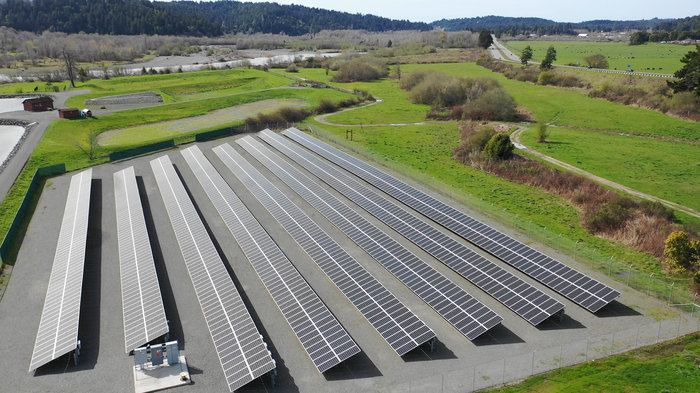
Photo: Blue Lake Rancheria
The Blue Lake Rancheria microgrid powers a number of buildings on the reservation and helped provide energy when California’s Pacific Gas and Electric shut off power during wildfires.

In the following story, disempowered people lacking reliable services not only took action to help themselves but were generous to more-privileged neighbors who suddenly learned what it’s like not to have services.

This is a story about two kinds of power.

Erik Neumann reports at National Public Radio (NPR), “California’s largest electric utility took the unprecedented step of shutting off power to millions of customers beginning last October. The decision was meant to prevent power equipment from sparking catastrophic wildfires.

“Now a renewable energy microgrid on a tiny California Native American reservation is proving to be one solution to this ongoing problem. The Blue Lake Rancheria is located just north of Eureka, Calif. On the 100-acre campus, just behind the casino and hotel, Jana Ganion opens a chain-link fence. …

“Inside, in an area half the size of a football field, are more than 1,500 solar panels, slanted toward the noonday sun. Ganion is the sustainability director with the Blue Lake Rancheria, which includes about 50 members.

[Ganion] helped build this solar microgrid as part of the tribe’s goal to develop climate-resilient infrastructure and to be ready for earthquakes and tsunamis. But then beginning in October, it became useful in a whole new way. …

“As one of the only gas stations in the county with power, the reservation provided diesel to United Indian Health Services to refrigerate their medications and to the Mad River Fish Hatchery to keep their fish alive. The local newspaper used a hotel conference room to put out the next day’s paper. Area residents stopped by to charge their cell phones.

“Ganion estimates that on that day more than 10,000 nearby residents came to the reservation for gas and supplies.

“County officials had been warned about the utility shutoffs, but they didn’t know they were happening until that day, says Ryan Derby, emergency services manager for Humboldt County, where Blue Lake Rancheria is located.

” ‘Our entire planning model for the last 18 months got thrown out the window,’ Derby says. … ‘Humboldt County prides itself on being resilient,’ Derby says, ‘But I think in light of these public safety power shutoffs we realized how dependent we really are on electricity.’

“The county focused on residents who relied on medical devices like respirators or oxygen tanks. At the Blue Lake Rancheria, Anita Huff was directing emergency services for people with critical medical needs.

” ‘We had eight people here who could not have lived without electricity,’ Huff says. ‘So, we saved eight lives.’ …

” ‘Microgrids are very complex. In some ways they’re kind of like snowflakes where no two of them are the same because it depends on where you are on the grid and what your facility is,’ says Dave Carter, the managing research engineer at the Schatz Energy Research Center and the lead technical engineer on the [Blue Lake] project.

“Microgrids keep the electricity flowing to customers even after disconnecting from the overall power grid. During an outage, the Blue Lake microgrid goes into ‘island mode’ and a large Tesla battery system stores extra power and balances the energy supply and demand.

“By comparison, Carter says, conventional solar arrays have to automatically shut down during outages for safety so they don’t electrocute powerline maintenance workers or people who could come in contact with a downed line.

“Microgrids do come at a price. The Blue Lake installation cost $6.3 million. Five million dollars came from a California Energy Commission grant, and the tribe helped raise the rest. …

“Carter’s lab at the Schatz Energy Research Center is looking for ways to lower the cost of microgrids. In spite of the upfront price, he says, communities should consider what it’s worth to stay in control during a natural disaster. …

“Jana Ganion, with the Blue Lake Rancheria, says with future electricity shutoffs, rural communities, and Native American reservations in particular, need to be especially resilient.

” ‘Many, many tribal nations are located at the end of the line in terms of the electricity grid,’ Ganion says. ‘They may have no power. They may have poor quality power. Microgrids are just a way to do an end-run around all of that.’ ”

More at NPR, here.

Read Full Post »

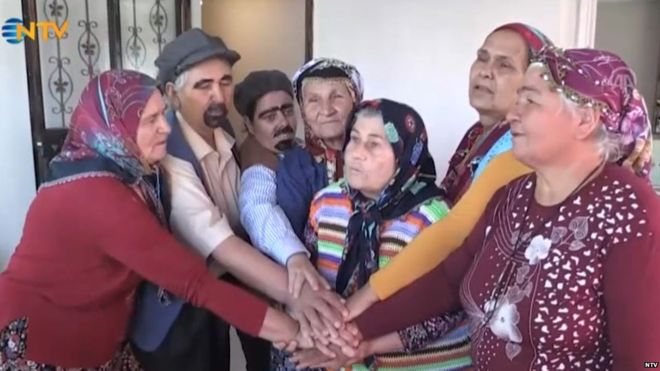
108525880_grannies5

Photo: NTV
Led by a grandmother, an amateur theater group in Turkey is raising awareness about climate change and the lives of rural women.

Wherever you live, whatever age you are, you have the power to do something valuable for the world. A grandmother in rural Turkey understood that from an early age and is making her voice heard.

The BBC garnered this story from NTV, the Turkish television news channel.

Dilay Yalcin and Krassi Twigg reported, “A 62-year-old grandmother from rural Turkey who rose to national fame with her all-women village theatre group is now set to stage a play raising awareness about climate change.

“Ummiye Kocak from the village of Arslankoy in the Mediterranean province of Mersin recently began rehearsals for her new play ‘Mother, the Sky is Pierced!’

“She told Anadolu news agency that she wanted ‘people to realise just how serious it is.’

The climate crisis is ‘not only our problem, it is the world’s problem,’ she says. ‘I am shouting as loud as I can — this world is ours, we need to take good care of it!’

“Ummiye Kocak has written plays for many years, always aiming to change perceptions. Her previous works have tackled issues from poverty and domestic violence to Alzheimer’s Disease. … In 2013 she won an award at a New York festival with a film focusing on the difficulties of women’s lives in a Turkish village. …

“Ummiye Kocak grew up in a conservative rural area, and only got primary education ‘by chance — as each family was required to send one girl to school.

“But she says her father was open-minded enough to take all his children to the cinema at a time when no other dad in the village would, sparking her love of drama.

“She says that when she first arrived in the village of Arslankoy as a young bride, she noticed that women there had to do all the work — in the fields as well as in the house. She thought that wasn’t right and told herself: ‘Ummiye, you have to make the voices of these women heard!’

“Her village doesn’t have a stage, so she gathers her performers under a walnut tree in her garden for rehearsals while they do their domestic chores. …

“People in other parts of the country want a piece of the action, issuing invitations on social media for the group to perform locally.

“One woman in Istanbul wrote: ‘I’m proud and honoured on behalf of all women every time I see you, Aunt Ummiye. … I hope all women lead their lives knowing they have this power like you do.’ ”

More at the BBC, here.

Read Full Post »

Photo: Alfredo Sosa
The newest solar farm of Florida Power & Light Company [FPL] is equipped to generate 74.5 megawatts of power, enough for approximately 15,000 Florida homes.

Large numbers of Americans are not as concerned as I am about fossil fuels and how they hurt the planet and until recently have not supported sustainable energy. But as the cost of renewable power comes down, many of them are giving wind and solar a new, pragmatic look.

Eva Botkin-Kowacki writes at the Christian Science Monitor, “There’s a new crop sprouting in southern Florida. Amid fields of sweet corn, squash, and okra dotting the landscape outside Miami, rows and rows of solar panels now soak up the Florida sunshine. …

“Despite being the Sunshine State, Florida has long lagged when it comes to tapping into the abundant rays overhead. But now that is changing as utility companies in the state have begun to recognize solar power as a vital component of a diverse energy future. …

“As solar has become more economically viable, the state’s utility companies now see opportunity more than competition in the technology Florida utilities’ newfound embrace for solar power echoes trends seen across the country, as the renewable energy source has shifted from a fringe indulgence for wealthy environmentalists to becoming a conventional part of power production. …

“With abundant sunshine, Florida ranks ninth in the United States for solar potential. But as recently as 2015, just one-tenth of a percent of the state’s power came from the sun. …

“Solar is still a bit player in Florida. At the end of 2018, solar power made up just 1.07 percent of the state’s energy portfolio, according to the [Solar Energy Industries Association] reports. But the rapid acceleration reflects a broader shift happening nationally. …

“Some of the ways Florida stands out among states make it a particularly good indicator of the renewable energy’s newfound status as mainstream. Many leading solar energy states, such as Massachusetts, Vermont, and California, have installed solar as part of a legislative push to diversify the energy sector in pursuit of emissions reductions. Policymakers in Florida, however, have not set specific renewable energy requirements or even aspirational goals. …

“The utilities want to maintain their control over the market, says Professor Fenton of the University of Central Florida. In 2016, they fought to amend a law that required them to purchase the electricity generated by customers’ rooftop panels at the net retail rate. … The recent foray into solar is a testament to the increasing economic viability of solar power. …

“ ‘[In 2016], the price point was just becoming right for us to be able to have it make economic sense for our customers for us to go and begin building large solar energy centers,’ FPL spokeswoman Alys Daly says.” More here.

One thought: As my friend Jean, of the environmental-education nonprofit Meadowscaping for Biodiversity, reminds me, it’s important not to cut down trees for solar arrays. Trees help the environment even more than solar energy. We need to keep the big picture in mind.

Read Full Post »

Did you read the Ancient Greek tragedy Antigone, by Sophocles, in school? I was actually in a college production — performed in Greek. It was much too hard for me, even with my bit part.

But in high school, the play really captured my imagination with its young heroine insisting that the higher laws required her to give her rebel brother a proper burial and the king determined to make an example of rebels.

Anyway, that’s how I remember dinner discussions — my aunt and uncle arguing for the power of the state and me arguing for rebels.

So you may imagine how intrigued I was when I saw that a theater troop was enlisting big stars to bring Antigone (in English) to Ferguson, Missouri, to generate a community dialogue. Ferguson was where the majority of Americans first became aware of the issues that have led to the Black Lives Matter movement.

National Public Radio alerted listeners to the event, here.

“WILLIS RYDER ARNOLD (REPORTER): Bryan Doerries is a director who puts on ancient Greek plays. He says his productions aren’t boring classroom exercises.

“BRYAN DOERRIES: These are readings on steroids, and spit is flying and tears are projectile crying off the stage, and sounds are coming up out of the actors that they’ve never heard themselves make before.

“ARNOLD: After the performance, Doerries asks the audience to react. He leads a conversation that can take as long as the actual play. For him, the performance is a chance to ask some deeper questions.

“DOERRIES: How many different ways can we give you, as the audience, permission to have a conversation that wouldn’t otherwise be possible, to speak your personal truths, to be acknowledged and heard?

“ARNOLD: A local resident urged Doerries to bring his project to Ferguson. Doerries will present ‘Antigone.’ ”

The plan for “Antigone in Ferguson,” developed by Outside the Wire and the PopTech Institute, and co-presented by the Onassis Foundation USA, was as follows:

“Screening of selected segments from the documentary Antigone in Ferguson, followed by a dramatic reading of scenes from Antigone with Reg E. Cathey (House of Cards, The Wire), Gloria Reuben (ER), Glenn Davis (24, The Unit), and Samira Wiley (Orange Is the New Black).

“The reading will be followed by a town hall discussion, framed by remarks from community panelists — including members of law enforcement, activists, and concerned citizens — facilitated by Bryan Doerries, with the goal of generating powerful dialogue and fostering compassion, understanding, and positive action.”

I managed to find twitter reactions the day after the Sept. 17 performance:

Sep 18 Amazing! brought the community together through art and our own human experiences!
Sep 18 All of tonight’s was incredible. Thank you . Wow.
Sep 17 I wish everyone I know could have been at the reading of Antigone in Ferguson by . Church choir as Greek chorus? Amen

Read Full Post »

Well, here’s a new concept in energy production: braking regeneration.

Diane Cardwell writes at the NY Times, “Along Philadelphia’s busy Market-Frankford subway line, the trains behave like those of any transit system, slowing to halt at the platforms and picking up passengers.

“But more is happening than meets the eye. In an experimental system that is soon to be more widely adopted, every time the trains pull into certain stations, they recover the kinetic energy as they brake and channel it as electricity to battery banks at one of two substations.

“The batteries, managed by software, can then use that power to push the trains back out or to help modulate electricity flows on the grid.

“The system is unusual because the batteries are being used for more than just powering the trains, said Gary Fromer, senior vice president for distributed energy at Constellation, the power provider that will own and operate the system for the transportation authority.

“The electricity savings alone do not justify the battery costs, he said, so it was important to find another source of revenue, which comes from selling energy services to the grid. …

” ‘We don’t have to front the money and we’re reaping both savings and actually money coming back our way,’ said Jeffrey D. Knueppel, general manager of the transportation authority. The base technology of the system, known as regenerative braking, was one of the breakthroughs that allowed for the development of hybrid and electric cars like the Prius.” More here.

This reminds me of my 2012 post on inmates in Brazil who bike to create electricity — and reduce their sentences. And this post from 2013 about lighting schools by playing soccer. All hail to human ingenuity!

Photo: Jessica Kourkounis for The New York Times
The Market-Frankford subway line in Philadelphia is part of a regenerative braking experiment.

Read Full Post »