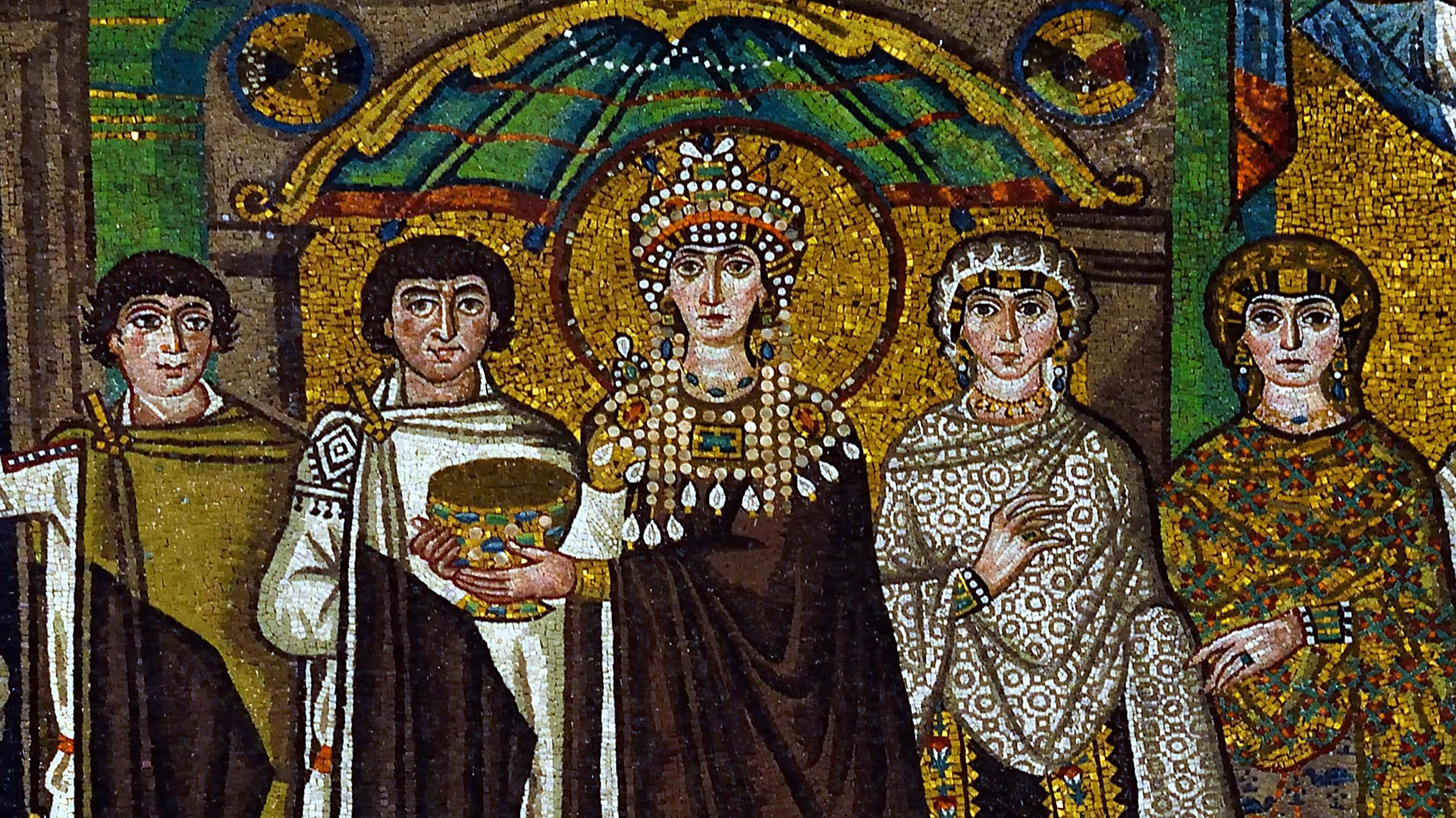
Photo: Alamy.
A mosaic of the Byzantine empress Theodora from 547 AD. The purple color was once considered more precious than gold. (It seems a bit brown in photos.)
Today’s story about a valuable pigment that comes from mollusks made me think of “wampum,” the jewelry/currency made from quahog shells by indigenous people in North America. The difference is that to get this royal purple, it was the insides of snails that were used.
Zaria Gorvett reports at the BBC, “For millennia, Tyrian purple was the most valuable color on the planet. Then the recipe to make it was lost. By piecing together ancient clues, could one man bring it back?
“At first, they just looked like stains. It was 2002 at the site of Qatna – a ruined palace at the edge of the Syrian desert, on the shores of a long-vanished lake. Over three millennia after it was abandoned, a team of archaeologists had been granted permission to investigate – and they were on the hunt for the royal tomb.
“After navigating through large hallways and narrow corridors, down crumbling steps, they came across a deep shaft. On one side were two identical statues guarding a sealed door: they had found it. Inside was a hoard of ancient wonders – 2,000 objects, including jewelery and a large golden hand. But there were also some intriguing dark patches on the ground. They sent a sample for testing – eventually separating out a vivid purple layer from the dust and muck.
“The researchers had uncovered one of the most legendary commodities in the ancient world. This precious product forged empires, felled kings, and cemented the power of generations of global rulers. The Egyptian Queen Cleopatra was so obsessed with it, she even used it for the sails of her boat, while some Roman emperors decreed that anyone caught wearing it – other than them – would be sentenced to death.
“That invention was Tyrian purple, otherwise known as shellfish purple.
But though this noble pigment was the most expensive product in antiquity – worth more than three times its weight in gold, according to a Roman edict issued in 301 AD – no one living today knows how to make it.
“By the 15th Century, the elaborate recipes to extract and process the dye had been lost. But why did this alluring color disappear? And can it be resurrected?
“In a small garden hut in north-eastern Tunisia, just a short distance from what was once the Phoenician city of Carthage, one man has spent most of the last 16 years smashing up sea snails – attempting to coax their entrails into something resembling Tyrian purple. …
“Ancient authors are particular about the precise hue that was worthy of the name: a deep reddish-purple, like that of coagulated blood, tinged with black. Pliny the Elder described it as having a ‘shining appearance when held up to the light.’ …
“It was so central to the success of the Phoenicians it was named after their city-state Tyre, and they became known as the ‘purple people.’ … In 40 AD, the king of Mauretania was killed in a surprise assassination in Rome, ordered by the emperor. Despite being a friend to the Romans, the unfortunate royal had caused grave offense when he strode into an amphitheatre to watch a gladiatorial match wearing a purple robe. The jealous, insatiable lust that the color ignited was sometimes compared to a kind of madness. …
“Tyrian purple could be produced from the secretions of three species of sea snail, each of which made a different color: Hexaplex trunculus (bluish purple), Bolinus brandaris (reddish purple), and Stramonita haemastoma (red). …
“Accounts of how colorless snail slime was transformed into the dye of legends are vague, contradictory and sometimes obviously mistaken – Aristotle said the mucous glands came from the throat of a ‘purple fish.’ To complicate matters further, the dyeing industry was highly secretive – each manufacturer had their own recipe, and these complex, multi-step formulas were closely guarded. …
“The most detailed record comes from Pliny, who explained the process in the 1st Century AD. It went something like this: after isolating the mucous glands, they were salted and left to ferment for three days. Next came the cooking, which was done in tin or possibly lead pots on a ‘moderate’ heat. This continued until the whole mixture had been boiled down to a fraction of its original volume. On the tenth day, the dye was tested by dipping in some fabric – if it emerged stained with the desired shade, it was ready.
“Given that each snail only contained the tiniest amount of mucous, it could take some 10,000 to make just a single gram of dye. Mounds of billions of discarded sea snail shells have been reported in areas where it was once manufactured. In fact, the production of Tyrian purple has been described as the first chemical industry – and this not only applies to the scale of the operations, but their exacting nature.”
More at the BBC, here.

 Suzanne's Mom's Blog