Feeds:
Posts
Comments

Posts Tagged ‘printing’

Illustration: Theodore Low De Vinne (1828-1914) via Wikimedia Commons.
Illustration of a punch (left) and matrix (right) used in type-founding, ca. 1876.

I’ve always loved the way steel-cut letters make a formal invitation look, the way they press into high-quality paper, drawing my attention to the hands of whoever did the typesetting. It’s a dying art to make the letters and even to print with them, and that inspired a filmmaker to look into the masters of the craft.

Carey Dunne writes at Hyperallergic, “In a smoky atelier in Torino, Italy, Giuseppe Branchino works as one of the world’s last punch cutters. Cutting punches, the first step in traditional typesetting, is the meticulous craft of carving letterforms into small steel billets.

“Branchino was the former head of the engraving department of type foundry and printing press manufacturer Nebiolo, founded in Turin in 1852. Along with a few others scattered across the globe, he carries on a centuries-old practice that’s becoming obsolete in the age of digital type.

“In the meditative short film The Last Punchcutter, by Giorgio Affanni and Gabriele Chiapparini, we watch Branchino create a punch. Drinking espresso and smoking a cigarette, he works silently and slowly, carving the letter ‘G’ into a thin block of steel with awls and chisels, peering through a magnifying glass to inspect his handiwork. He spends nearly seven minutes on a single letter.

“The film was created as part of Griffo, the Great Gala of Letters, a multidisciplinary project focusing on the life of Francesco Griffo, a 15th-century Venetian punch cutter and type designer. Born circa 1450 near Bologna, the son of the goldsmith and engraver Cesare Griffo, he went on to work for the house of Aldus Manutius of Venice, the most important publisher of the day. In 1501, for an edition of Virgil (the Aldine Virgil), he created what’s regarded as the first italic typeface. 

“Though his typefaces are still widely used and inspire most contemporary type designers, details of his biography are murky and, as Joseph Blumenthal put it in The Art of the Printed Book 1455–1955, ‘Griffo has never received adequate recognition for his enormous contribution to type design.’ Through videos, texts, and an upcoming exhibition, the Great Gala of Letters project aims to bring Griffo some long overdue recognition on the the 500th anniversary of his death.”

That book is out of print, but nothing stops GoodReaders from reading out-of-print books. Marc Joseph gave Blumenthal book five stars, saying, “Joseph Blumenthal was a fine printer for years at his Spiral Press. One of the great printers of the mid-twentieth century. He was also a typographer, educator, author in all things fine printing and a historian in the history of the printed word.

“Here he brings all of that acumen to bear on the history of the printed book, from 1455 to 1955. … There are multiple plates showing examples of the printing mentioned in the text, so the reader not only reads the facts, but sees them as well.

“This book forms a foundational basis for understanding the history of print. A note must also be made on the production values of this book. It is printed letterpress by the Stinehour Press (which for the size of the book and length is crazy). The tactile feel of the letterpress is amazing and shows the reader what fine press work is all about.

“The plates were printed by the Meridian Gravure Company, another fine printer, particularly of plates, either black and white or in color (black and white here). This hardbound volume was released in 1973 by the co-publishers, the Pierpont Morgan Library and David R. Godine. At the time of writing this review [December 2023], this particular edition can be had for $22.00 in ‘as new’ condition.”
Read Full Post »

Photo: Melanie Stetson Freeman/CSM staff.
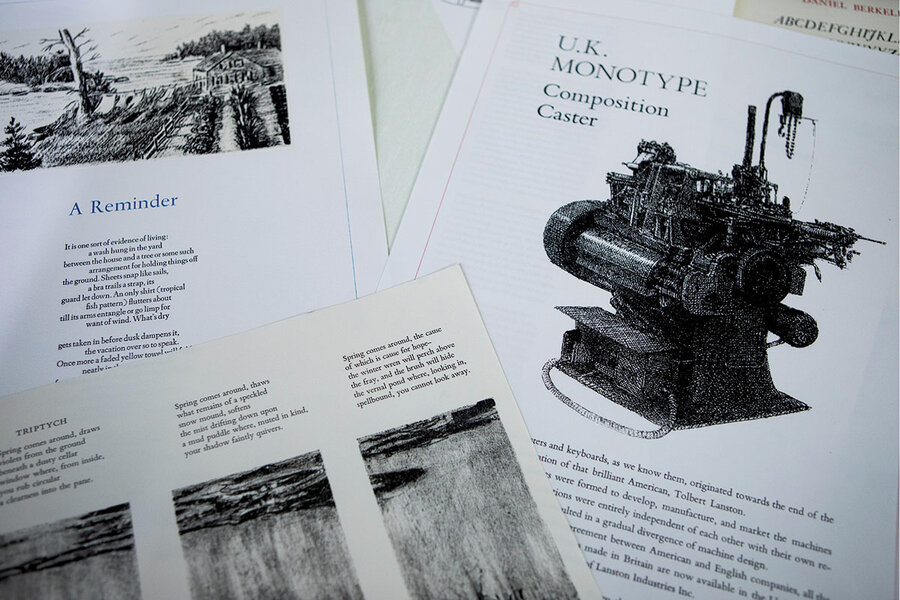
In his Maine shop, master printmaker David Wolfe uses machines from bygone eras to create.

Don’t you love the look of old-time lead type printing? I once ordered sweet business cards from a New Shoreham letterpress, no longer operating, and Suzanne has often used Jacque’s Offset in Providence. Today’s story is about a letterpress in Maine that got some attention in the movies.

Jennifer Wolcott reports at the Christian Science Monitor, “Visitors to David Wolfe’s printing shop in Portland, Maine, can’t miss the statuesque Civil War-era Tufts hand-press machine that stands tall near the front door. It exited that same door several years ago, headed for a movie set. 

“For its cameo in the 2019 film, his ‘Little Women machine,’ as he calls it, was hauled down to Massachusetts. Mr. Wolfe accompanied it, dressed in 1860s costume for his role as the printer of Jo March’s book. Yet as he recalls, laughing, ‘Only my hands made the cut.’ 

“Wolfe Editions is a place buzzing with activity. The master printmaker and fine artist treasures his many letterpress machines not only for their place in history, but also for their ability to help him craft exquisitely beautiful books, prints, posters, and more. They are essential tools for daily production, ones that stand out in an ever more high-tech world.

“Rather than using bits and bytes, Mr. Wolfe prints just as Johannes Gutenberg did when he developed the process of letterpress printing in the 15th century to make his famous Bible: Letters are cast in lead, then locked together, inked, and pressed into paper. 

“ ‘The computer didn’t kill my business. It made it stronger,’ he says, noting that he’s also benefited from recent interest in the lost art of letterpress printing. ‘The product I make is high end, and computers took over all the other stuff.’ …

“On a recent afternoon, he has just paused production of an edition of John Steinbeck’s Of Mice and Men while waiting for a shipment of handmade paper. He’s using the time instead to create designs for one son’s new canned cocktails company (his other son is a printer). He’s also teaming up with artist and friend Charlie Hewitt to design a poster commemorating the anniversary of Muhammad Ali’s fight in Lewiston, Maine.

“Mr. Hewitt has known Mr. Wolfe for 20 years, has collaborated with him on multiple projects, and happens to have a studio right next door. He says it’s important to the printmaker to pass down the old techniques to a new generation. ‘He is always training and teaching others. He is incredibly generous, remarkably skilled, and brings so much to every medium,’ Mr. Hewitt adds. …

“Mr. Wolfe’s letterpress and hot-metal casting machines, about 10 in all, fill his spacious shop – a former bakery. Despite their age and frequent use, the devices appear impeccably cared for. …

“Not only is he passionate about his work, but it suits him. ‘Letterpress printing couldn’t be more tedious,’ he says. ‘But I like tedium.’ … Lately he’s been mentoring an apprentice, a student from nearby Maine College of Art & Design, who shares his taste in music and also for tedium. ‘I’ll ask Claire to put away the type,’ he says, ‘and she’ll respond, “Oh, I love putting away type!” ‘ …

“Mr. Wolfe has taught at schools in Maine including Bowdoin College, Haystack Mountain School of Crafts, and Gould Academy. He’s also shared his expertise further afield, at Dartmouth College in New Hampshire and Penland School of Craft in North Carolina.

“He most enjoys the workshop format, for its small size and short duration. ‘It’s more intense when you have to cover a lot in a short amount of time, and students in workshops are typically motivated and excited about learning.’ …

“Mr. Hewitt recalls a project he and Mr. Wolfe worked on together: the illuminated neon ‘Hopeful’ sign mounted in 2019 on the roof of Speedwell Projects, a nonprofit gallery in Portland. ‘I wanted to use the word “Hopeful,” and I scribbled it on paper for David,’ he explains. ‘I needed a master printer to facilitate the process and create the font.’ 

“Mr. Hewitt says he was elated with the design – inspired by the building’s history as an auto dealership, typeface from the badge of a 1940s Packard, and his own love for 1960s counterculture. …

“For his part, Mr. Wolfe relishes collaborations like that one: the process of give and take, the creative energy, the mutual admiration. Or as he puts it, ‘I enjoy helping people realize their ideas. It broadens my scope, and artists are pushing the mediums beyond what they were using before.’ “

More at the Monitor, here. No paywall.

Read Full Post »