Feeds:
Posts
Comments

Posts Tagged ‘private equity’

Photo: NiemanLab.
A late private equity bid to disrupt the sale of the Dallas Morning News to Hearst was foiled by a fourth-generation newspaper owner turning down more money.

Some days journalism and free speech seem threatened on every hand. Whether its officials trying to control what is said or hedge funds buying up newspapers to wring them dry, a girl could get depressed.

Today’s story is about how one newspaper escaped disaster at the eleventh hour.

Joshua Benton at NiemanLab gives his views on what happened. As a former employee of the paper he’s writing about, he gets pretty worked up, but his take is interesting. It reminds me that not all shareholders are greedy. It also reminds that usually they are.

“By now, it’s a familiar move to watchers of Alden Global Capital, the ravenous hedge fund with the unusual hobby of sucking the lifeblood out of newspapers.

“See, Alden likes to wait until a newspaper merger or acquisition is juuuuust about consummated. Then, right before the final papers get signed, it swoops in with a late bid that promises the seller a bigger payday. Respectable newspaper owners don’t love the idea of selling to Alden, whose relish for laying off journalists is well known. They’ve sometimes built entire strategies around selling to anyone but Alden. But in the tense final hours of a deal, it can be difficult to explain to shareholders why, exactly, they should turn down a few extra million.

“It’s smart: wait until some other buyer has kicked the tires and run the numbers to come up with a valuation. If Random Newspaper Company thinks it can profitably run a paper at the price of $𝑥 million, surely Alden can run it profitably at $(𝑥 × 1.2) million. All it’ll take is 20% more cuts — and that’s Alden’s specialty.

“Sometimes it works. In 2018, just before a bankruptcy auction for the Boston Herald, Alden announced its intentions to bid, offering more than double the stalking horse bid made by rival GateHouse. Alden got what it wanted. …

“After a few comparatively quiet years, Alden opened up its playbook again six days ago when it announced a bid for the Dallas Morning News, offering $88 million. This came 12 days after the Morning News had taken itself off the market by announcing it would be acquired by Hearst for $75 million. …

“This time Alden won’t get the prize — because of one particular shareholder. This morning, the DallasNews Corporation (formerly A.H. Belo) announced that its board had “reviewed and rejected” Alden’s offer. …

” ‘DallasNews Corporation controlling shareholder Robert W. Decherd, a great-grandson of co-founder George Bannerman Dealey, sent a letter Friday to his former company’s board emphatically stating his complete commitment to the Hearst merger.’ …

“The Morning News was objectively one of the most appealing solo newspapers left for a chain to snare. For one thing, North Texas continues to boom in population. The Metroplex’s population has grown by 2.9 million people since I started there 25 years ago. (For context, that’s equivalent to adding the entire Denver metro area to a place that already had 5.2 million people.)

“But the DMN is also appealing because it hasn’t been gutted as much as most other metro newspapers in its weight class. To be clear: It’s been cut — a lot. When I started there, the newsroom had more than 600 people and bureaus around the world. Today, newsroom headcount is at 157 people. That’s not 600, of course. But 157 is significantly larger than Alden’s (roughly) 70 at the Orange County Register50 at the Denver Post, or 50 at the Orlando Sentinel.

“For a chain thinking for the long term — like still family–controlled Hearst — that relative strength makes the Morning News an asset worth investing in. But it also makes the DMN appealing to a raider like Alden, for a very different reason: Taking over a bigger newsroom means more opportunities for cuts. …

“It’s easy to over-romanticize the days of family ownership of newspapers. The Dealey–Decherd family has been running the Dallas Morning News, in one way or another, since 1885. Over that century-plus, there’s plenty to complain about. … But there’s a simple grace to how that era of stewardship is ending. Robert Decherd turned down several million dollars to keep his family’s newspaper out of Alden’s hands. I’m not sure how many newspaper owners would do that today — but I’m glad the number is at least one.”

More at NiemanLab, here.
Read Full Post »

Photo: benedek/Getty Images.
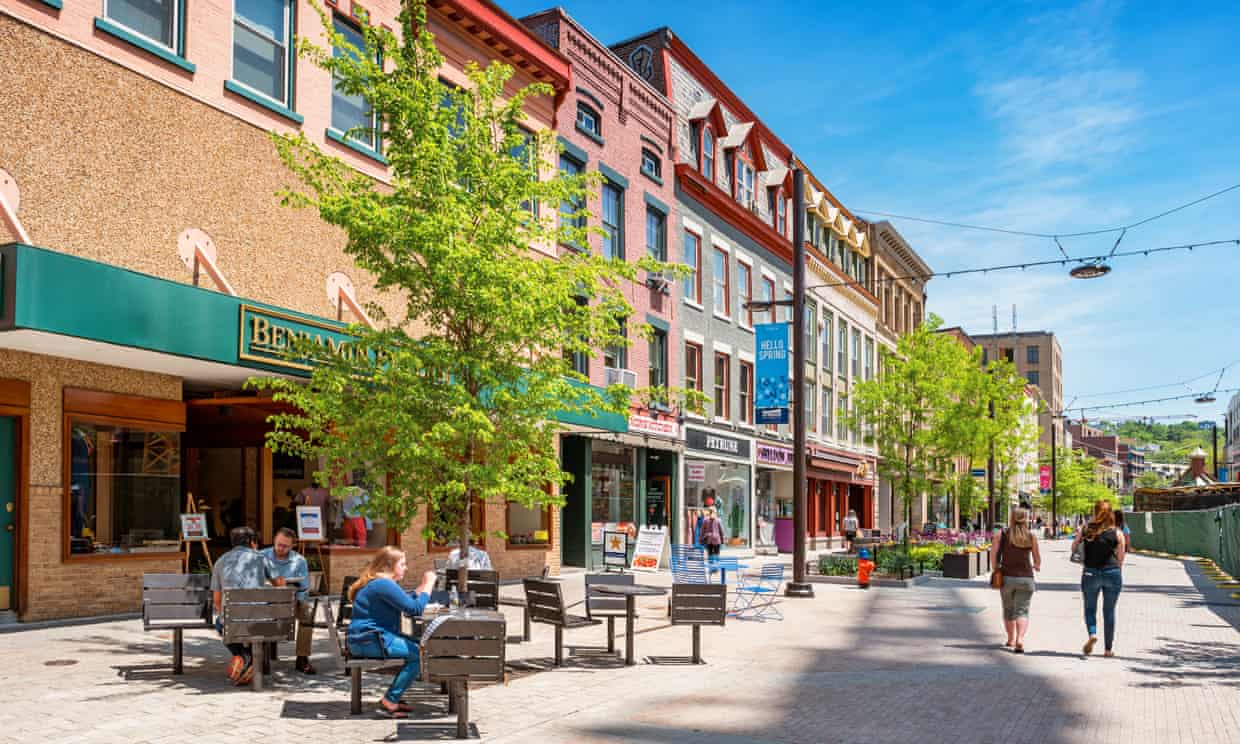
Downtown Ithaca, New York. The city has a plan to lower the climate footprint of thousands of buildings across the city.

My family is trying to disentangle itself from fossil fuels. Too slowly, I fear. I have a hybrid car, and my husband has been working with an electrician to change out the gas stove for an electric one. Suzanne and Erik are looking into electric for cooking, too. John has an all-electric car and solar panels on the roof.

The thing is, I’m sure I would have started this process much sooner if I had realized earlier that gas was bad. I’ve been in my current home nearly 40 years, and I assure you that 40 years ago, I hadn’t a clue.

In Ithaca, New York, there are people who had a clue long before I did, as Mike De Socio reported at the Guardian in August.

“When Fred Schoeps bought a 150-year-old building in downtown Ithaca, New York, a decade ago, he was one of only a handful of building owners dedicated to ending their reliance on fossil fuels and reducing their carbon footprint.

“His three-year renovation of the building, comprising three apartments above a skate store, included installing energy-efficient windows and insulation, plus fully electric appliances, heating and cooling systems.

“But while that was an achievement on its own, said Schoeps, Ithaca cannot address climate change one building at a time. ‘In order to move the needle, you’ve got to think in terms of a thousand [buildings],’ he said.

“Luis Aguirre-Torres, Ithaca’s new director of sustainability, is trying to do exactly that. The upstate New York city of 30,000, home to Cornell University and Ithaca College, adopted a Green New Deal in 2019, a big part of which involves decarbonizing thousands of privately owned commercial and residential buildings across the city.

“Ithaca’s main climate objective is to eliminate or offset all of its carbon emissions ​​by 2030. The focus on retrofitting buildings – installing electric heating systems, solar panels and battery storage as well as reducing energy use and greening the electric grid – promises to tackle an often-overlooked but significant contributor to climate change:

buildings make up nearly 40% of US carbon emissions. …

“Ithaca is exploring a new solution to fund and motivate building owners to decarbonize: private equity.

“Aguirre-Torres has helped Ithaca – which has a total budget of less than $80m – raise $100m by offering investors entry to a large-scale program he pitched as low risk with the potential for lots of cashflow. The goal is to create a lending program providing low- or no-interest loans and quick implementation of sustainable technology. …

“For most homeowners, the program would help them swap out a gas furnace for an electric heat pump, or a gas stove for an electric one – changes that would otherwise involve high upfront costs. Aguirre-Torres says the program will also train a new green workforce in Ithaca. …

“The plan aims to create 1,000 new jobs by 2030, and the city has promised to redirect 50% of the financial benefits of its Green New Deal plan to low-income residents, although there are few specifics on how this will work.

“Conversations with investors started earlier this year. Covid-19 had already battered Ithaca’s finances, said Aguirre-Torres, and it was clear the city would never be able to fund this energy transformation alone.

“These discussions quickly revealed a problem: how do you keep a lending program affordable? ‘What we needed to do was bring down the cost of capital even further,’ Aguirre-Torres said.

“The city is addressing this by trying to reduce risk. It aims to create an economy of scale by sizing the program for 1,000 commercial and residential buildings in the first 1,000 days, which will mean more consistent work for contractors and lower material costs. Ithaca plans to use a $10m loan loss reserve, backed by New York state, that would act as a guarantee for lenders in case any borrower defaults. It will also secure insurance to protect against catastrophic losses,’ such as a massive default due to another pandemic, Aguirre-Torres said. …

“Ithaca’s reliance on private equity may be new, but the cash incentives and on-bill repayment programs have precedent in states around the country, such as New York and California.

” ‘We’ve seen this work,’ said Ethan Elkind, the director of the climate program at UC Berkeley’s Center for Law, Energy & the Environment. Utilities and municipalities have long been offering upfront dollars to ratepayers to encourage them to upgrade lightbulbs or home insulation.

“However, these types of improvements may be an easier sell than swapping out a gas range or fireplace. Consumer preference for natural gas appliances is one of the biggest barriers to home electrification. Cost is another. ‘If you have the money to do something to your house, putting in a new bathroom or kitchen is much more appealing to people than an invisible efficiency upgrade that pays for itself over eight years,’ Elkind said.

“Anne Rhodes has a different view, however. The 76-year-old Ithaca homeowner, who earns about $20,000 a year, is using an existing state incentive program to insulate her home and replace her oil heating system with electric heat pumps. In addition to the climate impact, she said the upgrades will make her home more comfortable to live in.”

More at the Guardian, here.

Read Full Post »