Feeds:
Posts
Comments

Posts Tagged ‘public broadcasting’

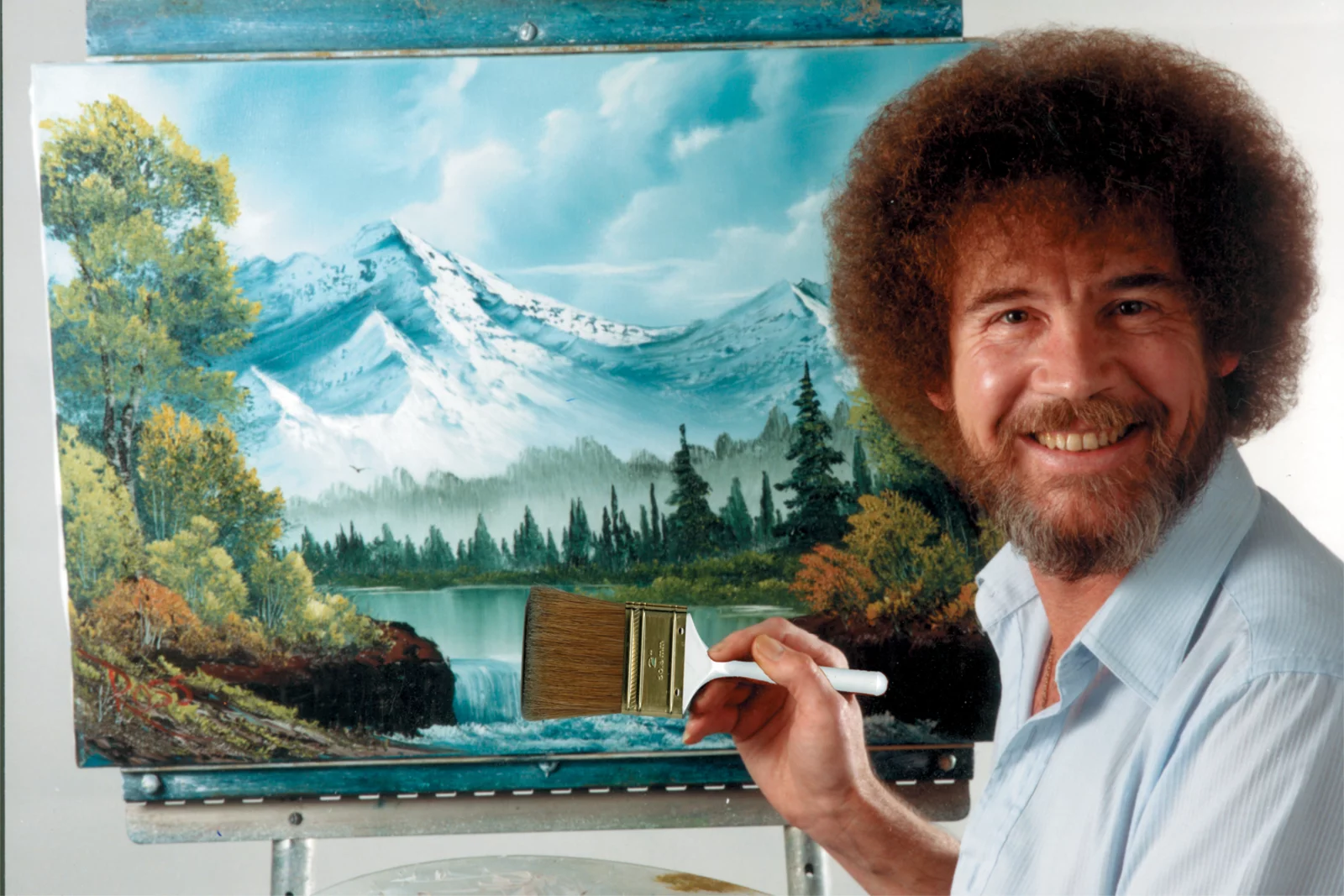
Photo: Bob Ross Inc./AP.
The late Bob Ross encouraged millions of Americans to make and appreciate art through his show The Joy of Painting, which has aired on PBS stations since 1983.

I once got an art kit from public broadcasting painter Bob Ross for my older granddaughter, a big fan. She was happy with the kit, but she did admit later that Ross made everything look easier on television than it really was.

Now we know that many other people not only liked Ross’s art, but want to support the medium where it was presented.

Rachel Treisman writes at National Public Radio (NPR), “The first of 30 Bob Ross paintings — many of them created live on the PBS series that made him a household name — have been auctioned off to support public television.

“Ross, with his distinctive afro, soothing voice and sunny outlook, empowered millions of viewers to make and appreciate art through his show The Joy of Painting. More than 400 half-hour episodes aired on PBS (and eventually the Canadian Broadcasting Corporation) from 1983 to 1994, the year before Ross died of cancer at age 52. …

“His show still airs on PBS and streams on platforms like Hulu and Twitch. It has surged in popularity in recent years, particularly as viewers searched for comfort during COVID-19 lockdowns. … But his artwork rarely goes up for sale — until recently.

“In October, the nonprofit syndicator American Public Television (APT) announced it would auction off 30 of Ross’ paintings to raise money for public broadcasters hit by federal funding cuts. It pledged to direct 100% of its net sales proceeds to APT and PBS stations nationwide. Auction house Bonhams is calling it the ‘largest single offering of Bob Ross original works ever brought to market.’ …

“The first three paintings sold in Los Angeles on Nov. 11. for a record-shattering $662,000. Bonhams says the works attracted hundreds of registrations, more than twice the usual number for that type of sale. …

“Said Robin Starr, the general manager of Bonhams Skinner, the auction house’s Massachusetts branch, ‘These successes provide a solid foundation as we look ahead to 2026 and prepare to present the next group of Bob Ross works.’

“The next trio of paintings will be auctioned in Massachusetts in late January. The rest will be sold throughout 2026 at Bonham’s salesrooms in Los Angeles, New York and Boston. …

“Congress voted in July to claw back $1.1 billion in previously allocated funding for the Corporation for Public Broadcasting (CPB), leaving the country’s roughly 330 PBS and 244 NPR stations in a precarious position.

“CPB began shutting down at the end of September … and several local TV and radio stations have also announced layoffs and closures.

” ‘I think he would be very disappointed’ about the CPB cuts, [Joan Kowalski, president of Bob Ross, Inc.] said of Ross. … I think this would have probably been his idea.” Kowalski, whose parents founded Bob Ross Inc. together with the painter in 1985, said Ross favored positive activism over destructive or empty rhetoric. …

“The Ross auction aims to help stations pay their licensing fees to the national TV channel Create, which in turn allows them to air popular public television programs. … Bonhams says the auction proceeds will help stations — particularly smaller and rural ones — defray the cost burden of licensing fees, making Create available to more of them. …

“The 30 paintings going up for sale span Ross’ career … include vibrant landscapes, with the serene mountains, lake views and ‘happy trees’ that became his trademark.

“Ross started painting during his 20-year career in the Air Force, much of which was spent in Alaska. That experience shaped his penchant for landscapes and ability to work quickly — and, he later said, his desire not to raise his voice once out of the service.

“Once on the airwaves, Ross’ soft-spoken guidance and gentle demeanor won over millions of viewers. His advice applied to art as well as life: Mistakes are just ‘happy accidents, talent is a ‘pursued interest,’ and it’s important to ‘take a step back and look.’ …

“In August [before any talk of a public television fundraiser] Bonhams sold two of Ross’ early 1990s mountain and lake scenes as part of an online auction of American art. They fetched $114,800 and $95,750, surpassing expectations and setting a new auction world record for Ross at the time. Kowalski says that’s when her gears started turning.

” ‘And it just got me to thinking, that’s a substantial amount of money,’ she recalled. ‘And what if, what if, what if?’ “

More at NPR, here. A few days ago funder CPB announced it was shutting down. But, by hook or by crook, public tv will carry on.

Read Full Post »

Photo: Andrea Tinker/Alabama Reflector.
A public tv fan holds up a sign during the Alabama Educational Television Commission’s meeting on Nov. 18, 2025, in Birmingham, Alabama. The AETC ultimately voted to maintain PBS programming through the end of the contract.

PBS is safe in Alabama. At least until June. And if viewers have anything to say about it, it won’t end there.

Andrea Tinker wrote at the Alabama Reflector in November, “The governing body of Alabama Public Television (APT) Tuesday voted to continue its contract with the Public Broadcasting Service (PBS), rejecting a proposal to end its agreement with the broadcaster.

“The commission voted 5-1 to continue the contract after a presentation from APT staff and in front of 50 people, many of whom spoke about the importance of public broadcasting in their lives. …

“Diana Isom, who attended the meeting, told the commission that PBS Kids programming had been invaluable for her son.  

“ ‘PBS is the reason my son is at a kindergarten level at three years old,’ Isom told the commission. ‘My son goes to an autism clinic; all of those kids watch PBS.’ …

“Two commissioners at October’s meeting suggested dropping PBS programming, citing the [administration] slashing the budget for the Corporation for Public Broadcasting (CPB) this summer and what one member of the commission characterized as ideological objections. 

“But the proposal drew sharp criticism from around the state, including over 1,400 emails to APT. …

“ ‘I think it’s important to stand up for quality education, quality programs for our children, especially in economic times such as these, not everyone can afford cable,’ … Julie Reese, one of the protesters, said.

In a letter sent Monday, Gov. Kay Ivey asked the commission to survey the public to see if disaffiliation with PBS had support, and then develop a plan to do so. Pete Conroy, a member of the AETC, passed a motion at the meeting to create a commission to study the issue, consisting of journalists and broadcasters. …

“APT Executive Director Wayne Reid said during the meeting if the station dropped programming it would be replaced by American Public Television, a non-profit syndicator that he said produces ‘complementary programming’ to PBS. But Reid told commissioners that if PBS programming stopped altogether, it could result in a drop in annual membership contributions of $2.4 to $2.7 million, hurting APT operations. …

“Reid said Tuesday the station received emails and phone calls and tags on social media expressing concerns about stopping PBS programs.

“ ‘I’ve been a fan of PBS since my children were little, and they’re now in their 50s. … Carol Binder, a Hoover resident who attended the meeting, said. ‘Now, I love everything on PBS. I have [PBS] Passport, and there’s hundreds and hundreds of programs, and it’s just not right for one, two or three people who don’t like the program to cut it off for everybody in the state.’ …

“Reese said she heard from other protesters that they wouldn’t continue to donate if programming was cut. ‘I just spoke to a gentleman down the corner. … He will not continue donating to APT if PBS folds, which is going to severely impact Alabama public television,’ she said.

“Following Reid’s presentation, Commissioner Bebe Williams made a motion to continue to pay the PBS contract and maintain programming which passed with only one commissioner, Les Barnett, voting no.

“Sens. Linda Coleman-Madison, D-Birmingham, and Rodger Smitherman, D-Birmingham, also spoke to the commission. …

“ ‘You may not be able to travel around the world. I have the opportunity now, but I’ve already been there with public television,’ Coleman-Madison said. ‘And the good thing about it, when I do go, I know where they’re telling me the truth or they’re giving me a snow job. It is trust. We trust public television because we know that the information we get in particular on PBS is going to be true, is going to be factual.’ …

“ ‘I think today really was a huge victory for the state of Alabama, victory for PBS and APT, although it needs constant attention and this is the beginning of a campaign and not the end,’ Conroy said after the meeting. 

“Reid said continuing the contract, which expires next June, gives APT a clear picture of what direction to go next. ‘I’m a business guy. … I don’t like to go back on contracts that we’ve signed.’ “

More at the Alabama Reflector, here. Where do you stand on public television?

Read Full Post »

Suzanne’s friend Sara, from Pomona College days, has a nice report on KUMN, the public broadcasting station in Albuquerque. It’s about Health Care for the Homeless — a program serving 7,500 people in the Albuquerque area — and in particular, it’s about a successful art therapy program. The story tends to confirm my observations earlier this week on the “Waste Land” documentary — namely, that art can open up the world for even the most disadvantaged.

Comments may be sent to suzannesmom@lunaandstella.com. I will post them.

Asakiyume comments: I, too, felt the resonance with the entry you had posted earlier about Wasteland. On the one hand, when someone tells me in passing about various unusual services for the homeless–like this one–I sometimes roll my eyes and get all practical minded (art? art? how about a PLACE TO LIVE and a JOB).  And yet, on the other hand, the chance to make art, to be “allowed” (as it were) to be a person who creates, and not merely someone desperate to survive, restores dignity and personhood and also, I’m thinking, a kind of autonomy. So yes: ART!

Read Full Post »