
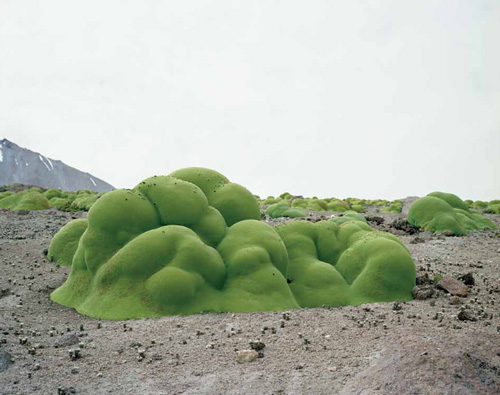
Photo: Rachel Sussman
Rachel Sussman’s “Study for Sidewalk Kintsukuroi #02 (MASS MoCA),” photograph with enamel paint and metallic dust.
What a lovely art idea! Mending cracks with gold resonates with me on so many different levels. You start with sidewalks and then …
Allison Meier writes at Hyperallergic, “Artist Rachel Sussman had traveled for years photographing the most ancient organisms on Earth when a photograph on social media of a shattered bowl reassembled with gold introduced her to the tradition of kintsukuroi, also called kintsugi. In this Japanese practice, broken pottery is repaired with gold dust and glue. …
“This sense of time and its visibly healed scars, and the beauty of imperfections, helped inspire her current Sidewalk Kintsukuroi series, of which the newest edition is in ‘Alchemy: Transformations in Gold,’ currently at the Des Moines Art Center in Iowa. As part of the exhibition, which considers the cultural and historical connotations of gold, Sussman repaired a fissure in the museum’s marble floor, an embedded installation now in their permanent collection.
“ ‘We’re not talking the millions of years it took for the Grand Canyon to form, but by noticing the crack in the marble floor of the Des Moines Art Center that formed over the course of several decades, it serves as a reminder that natural processes are happening all around us, but at a pace that is far too slow for us to observe with the naked eye,’ Sussman explained.
“The Alchemy exhibition includes images of her Sidewalk Kintsukuroi gold dust alterations on photographs of cracks on the streets of Soho and Williamsburg in New York City. Each patching, whether a physical surface or photograph, can take weeks of physically straining work. …
“ ‘Over time, even the repairs will be destroyed,’ Sussman stated. … “Such is the transient nature of everything in the universe. All the more reason to value the time we have.”
” ‘Alchemy: Transformations in Gold’ continues at the Des Moines Art Center (4700 Grand Avenue, Des Moines, Iowa) through May 5.”
Love this concept! Let’s mend everything in ways that go beyond the need.
More at Hyperallergic, here.
Hat tip: Gwarlingo on twitter.

 Suzanne's Mom's Blog