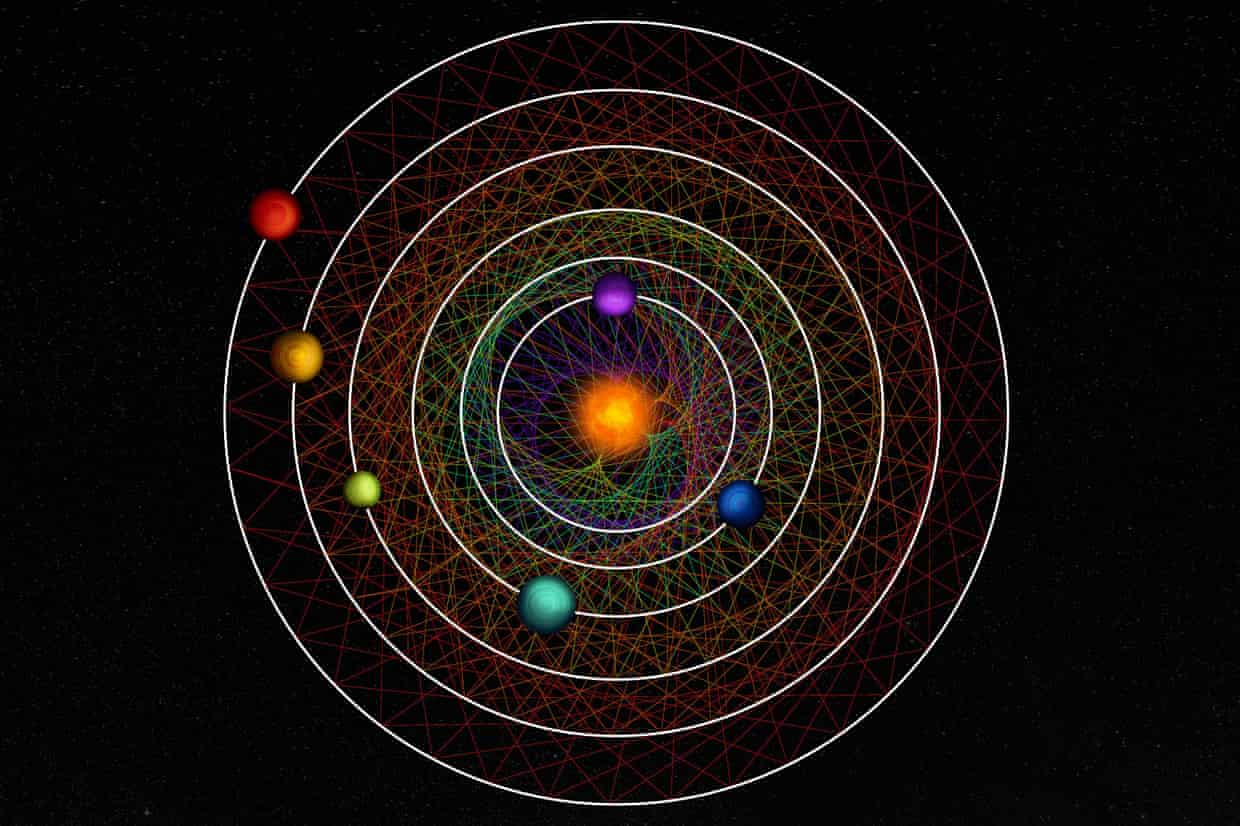
Photo: Thibaut Roger/NCCR PlanetS/PA.
The planets surrounding the HD110076 star orbit it in neat ratios depending on their closeness to it.
Where I went to high school, we memorized Bible verses every week. I always liked the words from this time of year: “The star, which they saw in the east, went before them till it came and stood over where the young child was.” So I’m going to say that today’s post on stars is a seasonal post.
At the Guardian, Nicola Davis delves into new star research from the journal Nature.
“Six planets that orbit their star in a coordinated dance have been discovered by scientists, who say the finding could help shed light on why planets in our own solar system move to their own beat.
“The newly discovered planets orbit a star that sits about 100 light years away in the constellation Coma Berenices, with a mass about 20% smaller than our Sun.
“Not only is their makeup different from planets within our solar system, but their movements appear to be tied together: the team said the time it takes one planet to travel around the star was related to that of the next planet by a neat ratio.
“ ‘This system has this very delicate resonant configuration,’ [said] Dr Rafael Luque, co-author of the research from the University of Chicago. The team said such ‘resonance’ should be common within planetary systems, arising from gravitational interactions between planets that begin as they form.
Astronomer Hugh Osborn, a co-author from the University of Bern, converted the resonance among these planets’ orbits into music.
“However, in reality only about 1% of observed planetary systems show resonance – and even fewer involve as many as six planets moving in a coordinated fashion. …
“The team added that the newly discovered planets sit close to their star, with temperatures of 170-650C, and have diameters two to three times that of Earth but smaller than Neptune, making them ‘sub-Neptunes.’ The masses of the planets and their densities were elucidated using ground-based measurements. …
“ ‘Even though we have found so many planets like these ones outside of the solar system, we do not know much about them,’ said Luque.
“Luque added that with six sub-Neptunes of varying sizes, temperatures and masses around the same, bright star, astronomers now had a way to explore how and why such planets differed. …
“Data from [Nasa’s Transiting Exoplanet Survey Satellite] has revealed that one planet had a nine-day orbit while another took 13 days to orbit the star. Subsequent data from the European Space Agency’s Characterizing Exoplanet Satellite (Cheops), suggested yet another planet took 20.5 days to orbit the star.
“The team realized these orbits formed neat ratios: the first planet from the star makes three orbits in the time it takes the second planet to make two orbits, and the second planet makes three orbits in the time it takes the third planet to make two orbits.
“The discovery led the team to propose that the orbits of the other three planets in the system also would be related by simple ratios. Further observations confirmed they were right.”
More at the Guardian, here. You should know that Dr Hugh Osborn, a co-author from the University of Bern, converted the resonance among these planets’ orbits into music. Listen to that music in an audio clip of about 2-1/2 minutes at Public Radio International’s The World, here. Very special.

 Suzanne's Mom's Blog