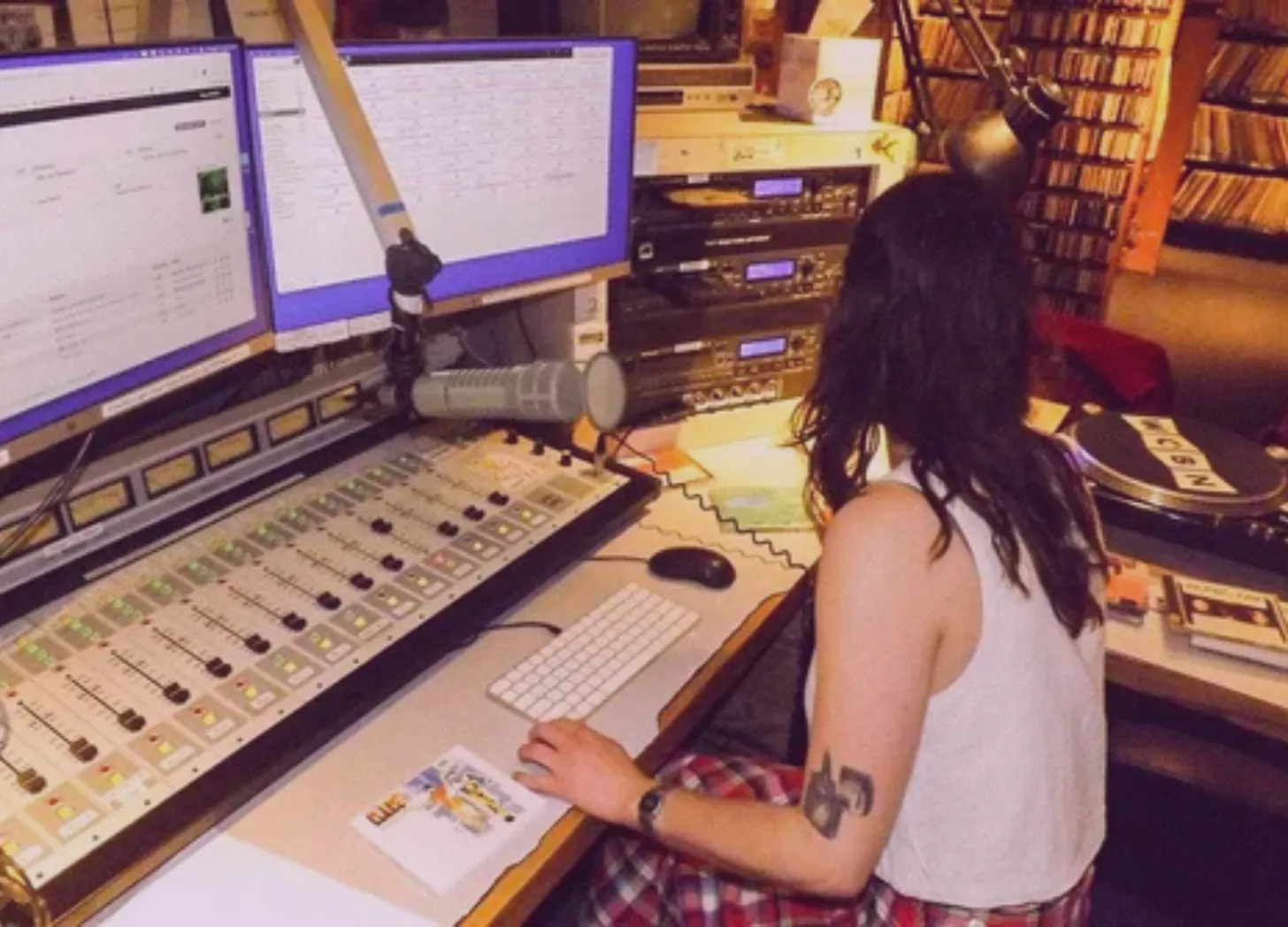
Photo: Olivia Glinski.
DJ Maya, WCBN (University of Michigan).
Whenever radio seems to be dead, something happens to revive it. And it’s never just one individual thing, but many individual things that roll up into a wave. Take a look at today’s college radio and why young people are gravitating toward it.
Emily White writes at her Substack, emwhitenoise, “It’s been a weird summer for the music industry. The fewest new hits in U.S. history. No song of the summer. An AI artist just signed a $3M record deal. The biggest band on the charts? HUNTR/X, a fictional K-pop girl group from a Netflix movie. …
“In September, a bombshell report from MIDiA Research crystallized the mood: ‘music discovery is at a generational crossroads,’ it argues: ‘Music discovery is traditionally associated with youth, but today’s 16-24-year-olds are less likely than 25-34-year-olds to have discovered an artist they love in the last year.’ …
“Even when they do discover artists, they are less likely to stream that artist’s music, according to the report. If you stopped reading here, you might conclude young people just don’t care about music anymore. However, one unexpected source of music discovery is quietly booming among Gen Z listeners: college radio. …
“I spoke to seven student general managers and surveyed 80+ DJs at stations across America: ACRN (Ohio University), WCBN (University of Michigan), WEGL (Auburn University), WHRW (Binghamton University), WRFL (University of Kentucky), WVBR (Cornell University), and WZBC (Boston College).
“They told me student interest in college radio has dramatically increased in recent years. Stations that once struggled to fill airtime are now turning people away, shortening shows, alternating time slots, and running training programs just to keep up with the demand from aspiring student DJs.
“For decades, college radio championed underground artists before they hit the mainstream. Against all odds — COVID shutdowns, FCC regulations, and the long decline of FM radio — college radio is thriving again. …Ten years ago, WCBN (Michigan) was struggling to fill three-hour programming blocks, says GM Anja Sheppard. Today, it’s the ‘fullest schedule we’ve had in recent memory,’ with shows reduced to one-hour due to ‘such demand from students to be on air.’
“At WRFL (Kentucky), ‘we’ve had some of the most exponential growth this station has seen in its 37 year history,’ says GM Aidan Greenwell. ‘We’ve gotten to the point where we simply don’t have enough time to allow everybody on the show schedule.’ …
“Demand for on-air slots is out-pacing ‘hours in the day’ at WEGL (Auburn), GM Rae Nawrocki says. The station has grown from roughly 30 members four years ago to 120 students and 60 on-air shows today.
“Some stations have so many aspiring student DJs, they have internships and apprenticeship programs for those waiting for their chance to go on-air: WHRW (Binghamton) has 150–200 active DJs and another 80 apprentices, WZBC (Boston College) counts 70 interns for its online stream in addition to 90 FM DJs.
“When Anna Loy, the president of the student media guild at WVBR (Cornell), first got involved with the radio station there were about 15 student DJs. ‘I’d sit around with my friends and kind of joke, “should we try to save the radio station?” ‘ she says. But now the station is thriving. …
“Students consistently described radio as an authentic, community-driven refuge from the passive, isolated, algorithm-driven digital experiences that have defined their adolescence. ‘You can’t scroll on reels and run a radio station at the same time,’ says Greenwell (WRFL) ‘You have to be in the present.’
“In our survey of 80+ DJs, students under 25 years old named ‘friends/word of mouth’ as their favorite way to discover music (69%), with TikTok (21%), YouTube (10%) or other social media (16%) relatively low-ranked.
“When asked ‘Who is your favorite artist you discovered recently, and how did you discover them?’ open-ended responses were split almost evenly between friends/word of mouth (27%) and algorithmic/streaming discovery (26%). …
” ‘I’m 21. I grew up in the age of algorithms. The way music is right now scares me because of the rise of AI. Not even AI made music (I hate it) but even just “Daily Mix, 1 and 2 and 3 and 4 and 5.” It’s not made by someone. It’s made by an algorithm. I wish more of that stuff was person curated.’ — Mari McLaughlin, WHRW (Binghamton)
“ ‘What attracts a lot of people to college radio is the idea of putting somebody on. Showing them a new song they haven’t seen before, outside of the algorithmic nature of streaming.’ — Aidan Greenwell, WRFL (Kentucky)
“ ‘I’ve started learning a lot more about music from other people’s recommendations than I ever had before. These experiences are shaping me more than algorithms or Spotify.’ — Anna Loy, WVBR (Cornell).
“ ‘Diehard music lovers are shifting away from Spotify. The trend I am seeing is people want ownership and community instead of this vague green app.’ — Rae Nawrocki (WEGL)
More at emwhitenoise, here. Do you listen to any college stations? I like WERS, especially for its weekend Broadway show. What’s funny about Emily White’s article is that young people are rebelling against Spotify algorithms that choose music for them when I’m so retro I haven’t even gotten to the algorithm stage. I think I’ll skip it.

 Suzanne's Mom's Blog