Feeds:
Posts
Comments

Posts Tagged ‘rediscovered’

Photo: Robles Casas & Campos.
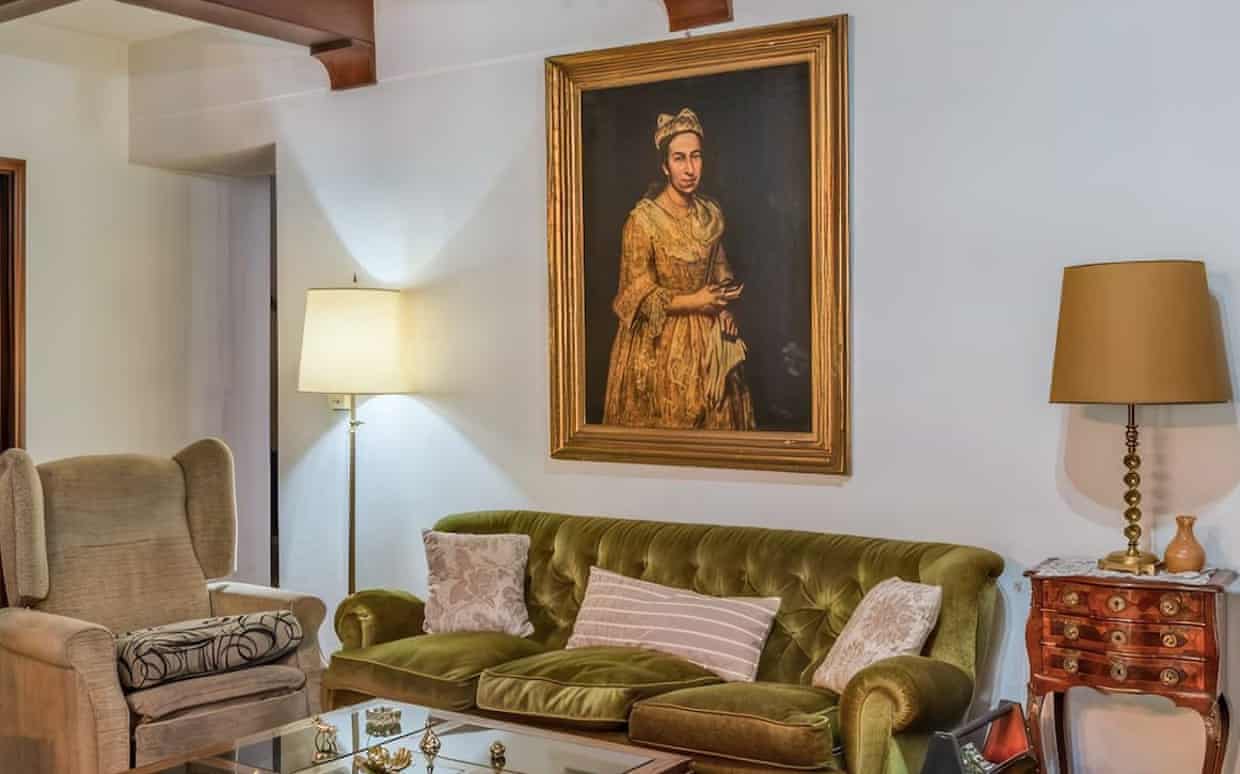
The painting by Italian artist Giuseppe Ghislandi in a living room in Mar del Plata. The 18th-century painting ‘Portrait of a Lady’ (Contessa Colleoni) was stolen by an SS officer and rediscovered this year in Argentina.

Guilty secrets don’t stay hidden forever. It may take a long time, as in today’s story about Nazi loot, but more often than not, truth eventually surfaces.

Facundo Iglesia  and Jon Henley write at the Guardian, “There was nothing very remarkable about the middle-aged couple who lived in the low, stone-clad villa on calle Padre Cardiel, a quiet residential street in the leafy Parque Luro district of Argentina’s best-known seaside town, Mar del Plata.

“Patricia Kadgien, 59, was born in Buenos Aires, five hours to the north. Her social media described her as a yoga teacher and practitioner of biodecoding, an obscure alternative therapy that claims to cure illness by resolving past traumas.

“Her husband, Juan Carlos Cortegoso, 61, built and raced go-karts. Like many in this neighborhood, the couple were comfortably off, and discreet. …

“Then, last month, they put their house up for sale. A photographer from a local estate agent, Robles Casas y Campos, came round to shoot the spacious, elegantly furnished interiors. The pictures went up. And their quiet existence came crashing down.

“The fifth photograph on the agency’s listing showed a general view of the villa’s living room. Hanging on the wall, above a buttoned sofa in plush green velvet and next to a polished antique commode, was a highly distinctive oil painting of a woman.

“More than [6,000 miles] away, the Dutch news outlet AD had, for several years, been quietly investigating the fate of old master paintings looted by the Nazis and still listed by the Dutch culture ministry as ‘unreturned‘ after the second world war.

“Journalists had made several attempts to speak to Patricia Kadgien, the owner of the property, and to her elder sister, Alicia, the daughters of a high-ranking Nazi official Friedrich Kadgien, who was known to have settled in Argentina after the war.

“Their calls and messages had consistently gone unanswered, or been rebuffed. But then a Dutch reporter based in Buenos Aires, Peter Schouten, went knocking on the door of the villa – and spotted a ‘for sale’ sign.

“What followed, after Schouten and his colleagues in Rotterdam clicked on the link to the property and instantly recognized the work, made headlines around the world as the story unfolded of the unlikely recovery of an 18th-century portrait missing for 80 years. …

“After the media reports of the work’s likely location, and before a police search, the couple had tried to obstruct the investigation, the prosecutor argued, by taking down the online property listing and for sale sign and replacing the portrait with a tapestry.

“Despite knowing they were under investigation, it was alleged that the defendants had also attempted a civil action claiming the painting was rightfully theirs, turning it over only after they were placed under house arrest and facing further police raids.

“Through their lawyer, Kadgien and Cortegoso have denied concealment, saying they had always been willing to hand over the painting, and obstruction, arguing that their civil action was aimed at establishing ownership and not at hiding the artwork. …

” ‘Portrait of a Lady’ belonged to Jacques Goudstikker, a Jewish-Dutch art dealer who fled Amsterdam in mid-May 1940 to escape the Nazis, but died after falling through an open hatch into the hold of the SS Bodegraven, the ship carrying him to the UK.

“Goudstikker carried with him a notebook detailing his collection of more than 1,100 artworks, including pieces by Rubens, Giotto, Titian, Rembrandt and Van Gogh, all of which were snapped up for a fraction of their value by Nazi officials.

“Some were later recovered and displayed as part of the Dutch national collection in the Rijksmuseum, before 202 works were restored to the dealer’s sole heir, his daughter-in-law, Marei von Saher, in 2006. ‘Portrait of a Lady’ was not among them. …

“Born in 1907, Kadgien joined the Nazi party in 1932 and the SS in 1935. By 1938, he was a special representative working for Göring on the four-year economic plan drawn up by Adolf Hitler to rearm Germany and prepare it for self-sufficiency by 1940. …

“Kadgien ‘confiscated a large amount of property from Jewish merchants, including jewelry and diamonds in Amsterdam, and oversaw the sale of expropriated shares and securities through banks and front companies in Switzerland’ [federal prosecutor Carlos Martínez] said.

“He fled to Zurich early in 1945, then to nearby Baden, where in 1948 he set up a successful finance and trading firm, Imhauka. With pressure growing after questioning by Swiss and US investigators, Kadgien left for South America in 1949. …

“Kadgien resurfaced in Rio de Janeiro in 1951, settling in the Santa Teresa district and establishing a Brazilian branch of Imhauka. … Imhauka secured valuable contracts with Juan Perón’s government, including acting as an intermediary for major German engineering firms such as Siemens. …

“The fate of ‘Portrait of a Lady,’ which will be registered with Argentina’s supreme court, is now uncertain. Prosecutors have requested it be held, but not displayed, at the Holocaust Museum in Buenos Aires while its ultimate ownership is determined. This week von Saher, Goudstikker’s heir, lodged a legal claim to the work with the FBI in New York.”

More at the Guardian, here. No firewall.
Read Full Post »

Photo: Elisabeth von Boch/Stanford.
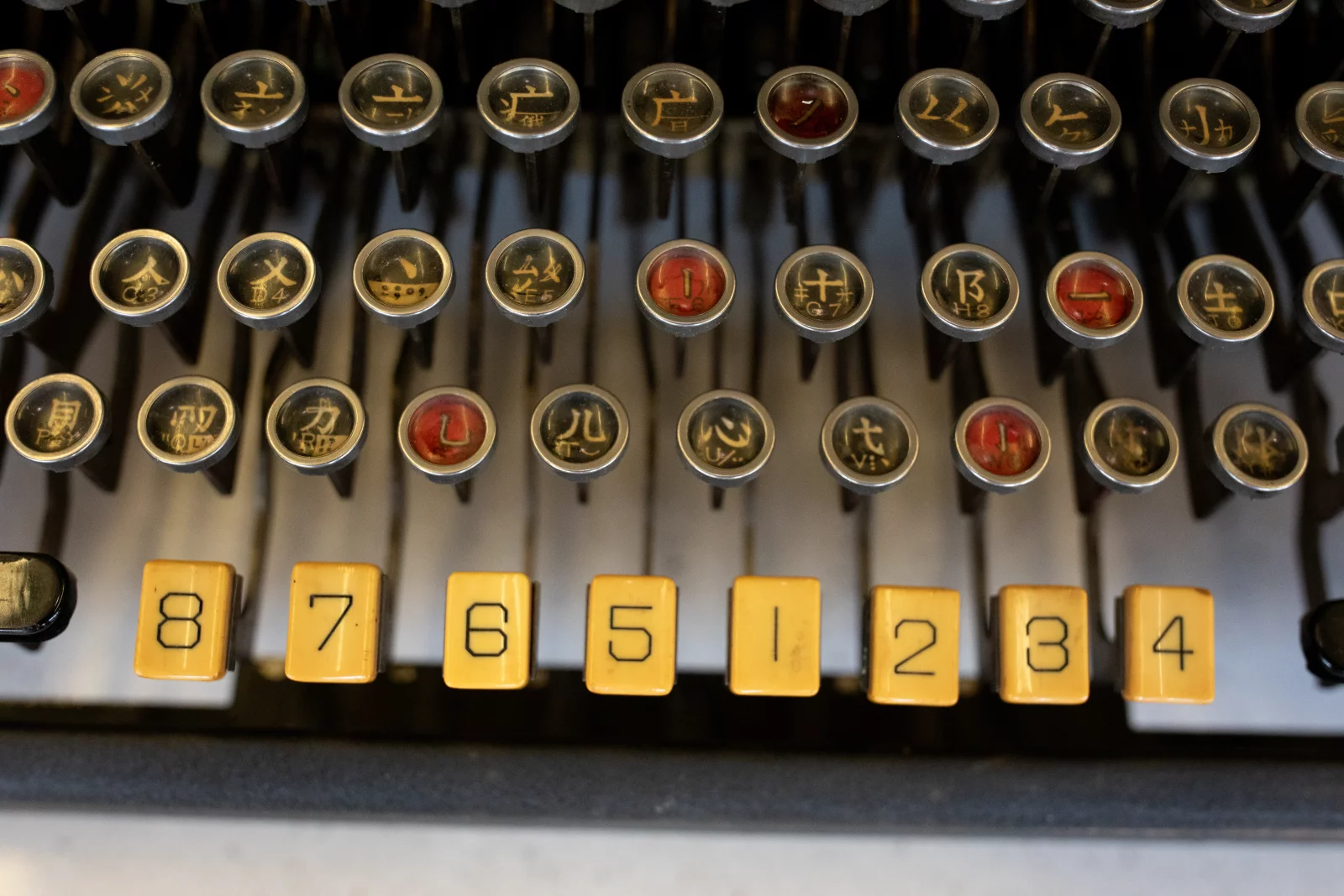
The MingKwai typewriter, crucial to the development of modern Chinese computing, has resurfaced. Its keys enable the typist to find and retrieve Chinese characters.

I love stories about finding long-lost treasures. The story of this old typewriter, the only one of its kind ever made, fits that category.

Emily Feng writes at National Public Radio (NPR), “Scholars in the U.S., Taiwan and China are buzzing about the discovery of an old typewriter, because the long-lost machine is part of the origin story of modern Chinese computing — and central to ongoing questions about the politics of language.

“China’s entry into modern computing was critical in allowing the country to become the technological powerhouse it is today. But before this, some of the brightest Chinese minds of the 20th century had to figure out a way to harness the complex pictographs that make up written Chinese into a typewriter, and later, a computer.

“One man succeeded more than any other before him. His name was Lin Yutang, a noted linguist and writer from southern China. He made just one prototype of his Chinese typewriter, which he dubbed the MingKwai. …

“Detailed U.S. patent records and diagrams of the typewriter from the 1940s are public, but the physical prototype went missing. Scholars assumed it was lost to history.

” ‘I had really, truly thought it was gone,’ says Thomas Mullaney, a history professor at Stanford University who has studied Chinese computing for two decades and is the author of The Chinese Typewriter.

Mullaney was at a conference last year when he got a message that someone in upstate New York had found a strange machine in their basement and posted a picture of it on Facebook.

” ‘It was a sleepless night.’ …

“Eventually, the owner reached out to him. They had acquired the typewriter from a relative who had worked at Mergenthaler Linotype, once of the most prominent U.S. makers of typesetting machines. The company helped craft the only known prototype of the MingKwai typewriter. …

” ‘It’s like a family member showing up at your doorstep and you had just assumed you would never see them,’ Mullaney says.

“The story of why such a typewriter even exists runs parallel to the political upheaval and conflict over Chinese identity and politics in the 20th century.

“Lin, its inventor, was born in 1895 in southern China during the tail end of a failing Qing dynasty. Student activists and radical thinkers were desperate to reform and strengthen China. Some proposed dismantling traditional Chinese culture in favor of Western science and technology, even eliminating Chinese characters altogether in favor of a Roman alphabet.

” ‘Lin Yutang charted a path right down the middle,’ says Chia-Fang Tsai, the director of the Lin Yutang House, a foundation set up in Taiwan to commemorate the linguist’s work. …

“Typing Chinese was a monumental challenge. Chinese has no alphabet. Instead, it uses tens of thousands of pictographs. When Lin started his work in the early 20th century, there was no standardized version of Mandarin Chinese. Instead, people spoke hundreds of dialects and languages, meaning there was no singular phonetic spelling of the sound of each word.

“Lin had financial backing from the American writer Pearl S. Buck to create the typewriter, but he also sunk much of his own savings into the project as costs ballooned.

” ‘He’d spent a lot of money. A lot,’ says Jill Lai Miller, Lin’s granddaughter. …

“The typewriter’s ingenuity comes from the way Lin decided to break down Chinese pictographs: by their shapes, not sounds. The typist can search for certain combinations of shapes by pressing down on the ergonomic keyboard. Then, a small screen above the keyboard (Lin called it his ‘magic eye’) offers the typist up to eight possible characters that might match. In this way, the typewriter boasts the ability to retrieve up to 90,000 characters. …

“Encoded in the machine’s engineering was an ambitious globalism. Lin’s way of breaking down languages by the shape of their words rather than their sounds or alphabets meant his machine theoretically can type English, Russian and Japanese as well, according to the typewriter’s manual.

” ‘One thing that was very interesting … in Li Yutang’s thinking about Chinese-ness and Chinese culture is that it must not be insular. It must have this porous border, it must be capacious and be able to communicate and talk with other cultures,’ says Yangyang Cheng, who first wrote about the typewriter’s discovery. …

“Mullaney is now researching the typewriter full-time, trying to understand how its mechanical innards work, with the far-off dream of one day replicating it. He recently found the typewriter’s ink spool was still fully intact inside.

” ‘You would need the sort of technology that they used on, like, discoveries of the Dead Sea Scroll and stuff like that, but you’ll notice that the ink spool is still there,’ he points out, using a dental mirror to peer inside the machine.

“The ink spool could contain traces of the last words Lin or his daughter typed on the machine — meaning perhaps the inventor’s own words are in his magical machine too.”

More at NPR, here. The New York Times also has a story on the typewriter. Read it here.

Read Full Post »

Photo: Hansons Auctioneers.
Ten rediscovered Salvador Dalí prints were scheduled to be auctioned off in September. 

Have you ever bought something and stored it away, only to forget about it for years? I have. Mystery objects turned up when I was downsizing, but nothing of great value. I remember a folk art candle holder of brown painted pottery, for example. It was sweet, but I have no idea why or when I bought it.

Lianne Kolirin at CNN wrote about a different kind of discovery.

“Ten signed Salvador Dalí lithographs have been discovered in a garage in London, where they have been stashed for half a century. The artworks, which were discovered by an auctioneer during a routine valuation, are now expected to fetch several thousand dollars at auction.

“The colorful prints were uncovered when the expert was called to a property in Mayfair, central London, to give the customer an assessment of some antiques at the property. But the visit took a turn when the pair went out to the garage of the client, who has not been identified.

“Chris Kirkham, associate director of London’s Hansons Richmond auction house, recalled … ‘It was an amazing find. … I was invited to assess some antiques at a client’s home. During the visit the vendor took me to his garage and, lo and behold, out came this treasure trove of surrealist lithographs – all 15 of them.’

“Together with the 10 Dalí lithographs, which are a mixture of mostly mythological and allegorical scenes, were another five by Theo Tobiasse, a French painter, engraver, illustrator and sculptor.

“ ‘They’d been tucked away and forgotten about for around 50 years. It felt quite surreal. You never know what you’re going to uncover on a routine home visit,’ said Kirkham. … ‘The prints ended up in his garage. They were rediscovered because the seller has been having a clear out. He’s looking to retire and move abroad, so now his lithographs will finally see the light of day at auction. …

“Dalí, a leading member of the Surrealist group, was born in Figueres in Catalonia in 1904 and died there in 1989. A prolific artist, he was renowned for his bizarre images which famously included melting clocks.”

According to Artnet News, the seller, who “paid just $655 for the lot in the 1970s,” sold them in September for $26,200. (Click here.)

More at CNN, here. I once read that it’s advisable to do downsizing regularly — maybe every year. That way you find out what you’ve got that would be better to move elsewhere. Maybe it would help if every time we acquired something new, we promised ourselves to give away something else.

Read Full Post »