Feeds:
Posts
Comments

Posts Tagged ‘regime’

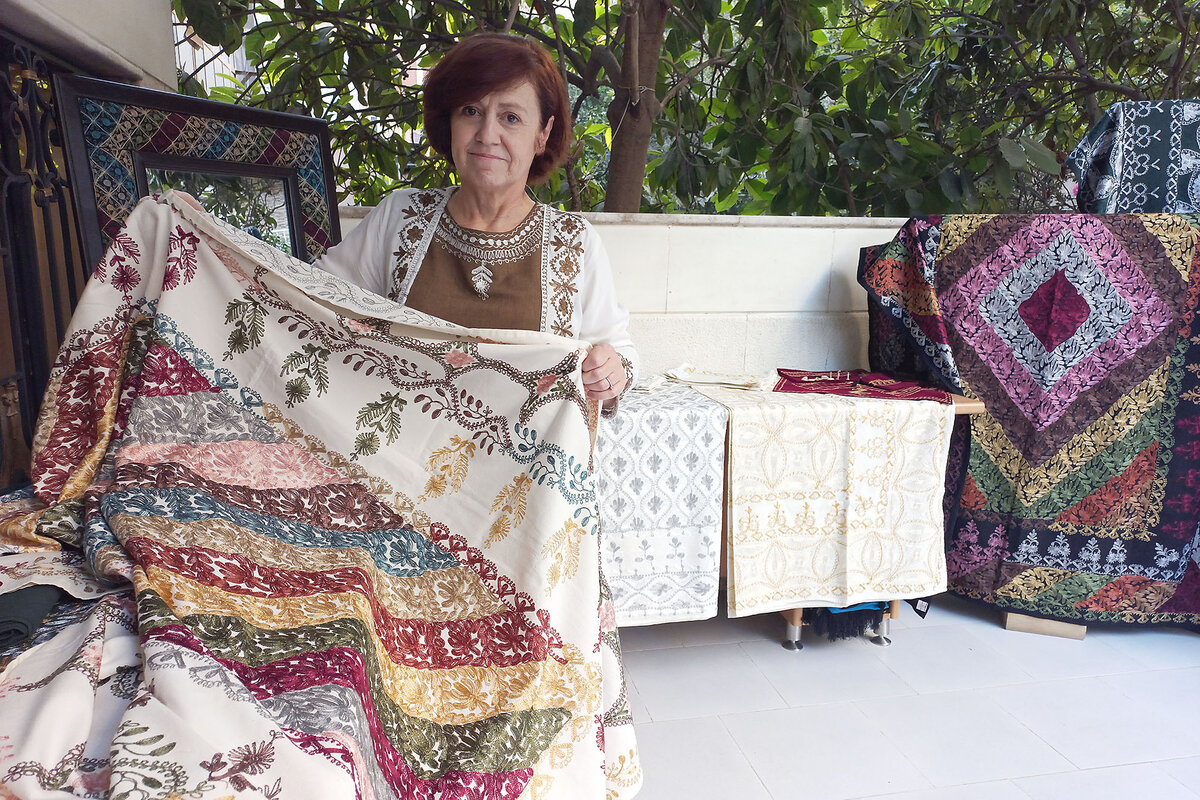
Photo: Walaa Buaidani.
Mona Araghili showcases aghabani embroidery at the Threads of Hope exhibition in Damascus, Syria. Post-Assad, she sees an opportunity for serious investment in traditional crafts.

“Threads of Hope” is a phrase that seems to cover a lot of what is going on in the world. Hopes may be hanging by threads, but every day they can strengthen. In today’s article from the Christian Science Monitor, the words are applied to the reemergence of traditional Syrian embroidery after the fall of the Assad regime.

Dominique Soguel writes, “By the time Ameera al-Hammouri was 10, her hands were dancing across the taut fabric beneath her grandmother’s aghabani embroidery machine. She was too short to sit, so she stood, working the foot pedal to coax floral patterns from metallic thread and her own memory.

“Decades later, in a rundown apartment building on the outskirts of Damascus, her machine now runs on an erratic supply of electricity. The building’s elevator no longer works and many of its windows are broken, but inside the sanctity of Ms. Hammouri’s spotless home, the artistry lives on. ‘Working on the embroidery machine for me is like drawing on paper,’ she says. … ‘Whatever I imagine, I bring to life with my hands.’

“Aghabani embroidery originated in Damascus more than 150 years ago, blending Ottoman, Arabic, and Persian design influences. Traditionally, patterns were hand-printed in Damascus onto fabrics that were then sent to Douma, about 8 miles from the capital, where women embroidered them at home. Their work, displayed on tablecloths and other household items, became a hallmark of Syrian hospitality.

“Today, the survival – indeed, the revival – of this craft tradition rests in the hands of women from Douma, a city synonymous with both resistance and ruin. The women behind these works are not only artisans. They are mothers, widows, and survivors of siege, displacement, and economic collapse.

“Ms. Hammouri herself endured all of it. Her husband and eldest son were arrested in 2012 and never returned. Douma was subjected to a five-year siege, when government forces surrounded the city, cutting it off from food, medicine, and fuel. Ms. Hammouri’s house was destroyed. As the bombs fell, she moved her children from house to house, basement to basement.

“The siege ended in 2018. With no income and no husband, Ms. Hammouri turned to the one thing that had always grounded her: her original aghabani machine, bought in 1988 with money she scraped together by selling her wedding gold and other treasures. It still stands in a corner of her bedroom, alongside a newer model.

“ ‘I talk to this machine,’ confides Ms. Hammouri, who is known in the community as Umm Meriee. ‘It holds my secrets. I’ve cried over it.’

“At first, she worked quietly from home, taking orders from traders who remembered her family’s reputation and bought pieces for export. Over time, she began training other women.

“If Syria’s current political opening brings more trade and tourism, she says, crafts like aghabani could once again become a source of stable income rather than just a means of survival.

“Now, twice a week, her apartment fills with the chatter and laughter of industrious women. … This gathering of women is not a formal enterprise. There is no signboard or registration, no website to market their work. But family reputations endure in a country where word of mouth is the norm.

“ ‘They know my name in the market,’ says Umm Meriee, recalling how she revived ties with shopkeepers in the Al-Hariqa market, in Damascus’ old city, because her aunts and grandmother had put the family name on the map. …

“For Mona al-Masri, a Tuesday regular, embroidery is her identity. … While her colorful pieces earn heartfelt ‘wows’ from her daughters, it is next to impossible to eke a living from this craft. In a good week, working three hours a day in between bouts of housework, Ms. Masri earns just over $6. … Despite the skill and time aghabani requires – a single detailed motif can take hours, and a full tablecloth might take a week or more to complete – handmade aghabani cannot compete with cheaper, machine-made imitations that dominate the local market, such as those imported from China.

“ ‘Right now, aghabani has no future,’ says Ms. Masri. But with government support, she feels that future could ‘be a very bright one.’

“Mona Araghili shares that optimism. … More than a decade ago, Ms. Araghili set up Threads of Hope – Aghabani with little more than a social media page and materials she borrowed from friends. With her college friend Basheera Baghdadi, who had grown up in Douma, she smuggled fabric and thread into the besieged city, using tunnels and roundabout routes through the countryside. …

“Ms. Araghili never shut down her group’s Facebook page, she says. ‘I always hoped that we could restart someday.’ ”

More at the Monitor, here.

Read Full Post »

Photo: Dominique Soguel.
Rua, a Damascus university student, poses for a photo wrapped in the Syrian flag while celebrating the anniversary of the revolution that led to the toppling of Bashar al-Assad, in Damascus, Syria, March 15, 2025.

Although we can’t know where Syria is headed in the long run — or how many powerful countries will interfere with what everyday people want — I think we’re allowed a moment of hope at this this time. Certainly, that is what many astonished Syrians felt when the regime of the tyrant Bashar al-Assad was overthrown in a “sudden” uprising that was many years in the making.

Dominique Sequol of the Christian Science Monitor wrote an article in March about what Syrians were feeling. While it focuses on a new freedom to worship, worship is only one example of the change there.

“Alaa al-Saadi, like many Syrian men of his generation,” she says, “once fought to overthrow longtime dictator Bashar al-Assad. Now Mr. Saadi is savoring his first ‘free’ Ramadan in his hometown of Qaboun, a low-income neighborhood and former rebel stronghold on the outskirts of Damascus.

“At sunset, when Muslims rush home to break the fast with the iftar meal, the business owner stands on a street corner pouring out licorice juice from a giant metal pot. …

“Damascus is observing its first Ramadan since the fall of Mr. Assad, who cast himself as a protector of Syria’s many minorities while ruling them all with an iron fist. The Muslim holy month – one of heightened spirituality, and marked by the pursuit of good deeds to help those in need – is observed in Syria and across the Middle East.

“Mr. Saadi, who spent several years in Libya before returning to Syria in 2019, recalls hiding during previous Ramadans to avoid being conscripted into the Syrian army. Now, he is grateful to be in the position to help his community. …

“Families displaced by the conflict are trickling back to Qaboun, although much of it remains reduced to rubble after years of siege and bombardment.

“ ‘This Ramadan, our loved ones have returned,’ says Mr. Saadi, fielding greetings outside his car-painting workshop. ‘We are reunited. Friends, loved ones, and young men are all back. Things will gradually improve.’

“Indeed, Damascus seems to be inching toward greater functionality, with uniformed traffic police on the streets and a steadier electricity supply. The mood in the capital is one of cautious optimism under President Ahmed al-Sharaa, who broke ties with Al Qaeda and led the military effort that toppled Mr. Assad in December.  

“This has been a month of prayer but also mixed-gender celebrations that continue late into the night under the glitter of Ramadan light installations. Women in all kinds of Islamic dress – from the niqab to the veil – converged on central Ommayad Square for the March 15 marking of the anniversary of the 2011 Arab Spring-inspired revolution. So did women with no veil. …

“There has been no shortage of individual and collective volunteer efforts inspired by the month of fasting.

“In Douma, another war-ravaged suburb of Damascus, Osama Massaya leads the volunteer group Mulham. Boasting 40 participants, age 14 and up, it focuses on cleaning mosques and distributing meals to worshipers. Such ideas are not new – but the possibility of executing them this freely is.

“In 2024, Mr. Massaya, a history student at Damascus University, tried to obtain a license for a volunteer team to clean up mosques. The request never received the green light from the Ministry of the Endowment. ‘At the time, there was no interest in mosques,’ he explains.

“ ‘The mosques were very neglected,’ adds Mr. Massaya, whose team has helped to clean up a handful in Douma already. …

“The Mulham volunteers aim to distribute 4,000 meals throughout Ramadan. Such efforts are financed by individual donations made by local residents, including some who resettled in Europe and the Middle East during the war and remain abroad. Most donations – including a recent batch of 300 kilograms (660 pounds) of dates – are made anonymously. …

“The activities of mosques were closely monitored in the past. In 2011, they were a springboard for post-Friday prayer protests against the Syrian regime, and long were treated as potential hubs of dissent.

“Rua, a university student in Damascus who gave only one name and whose father died in the notorious Sadnaya prison, reports a similar newfound sense of freedom.

“ ‘It’s the difference between day and night,’ she says of this Ramadan, recalling past years when ‘people prayed quietly and left mosques quickly,’ to avoid regime informants.” More at the Monitor, here.

We don’t choose what country we are born into, and perhaps watching the news since 2011, many of us were glad we weren’t born in a country like Syria. But I think that to witness such a moment of hope after despair is something precious.

Read Full Post »